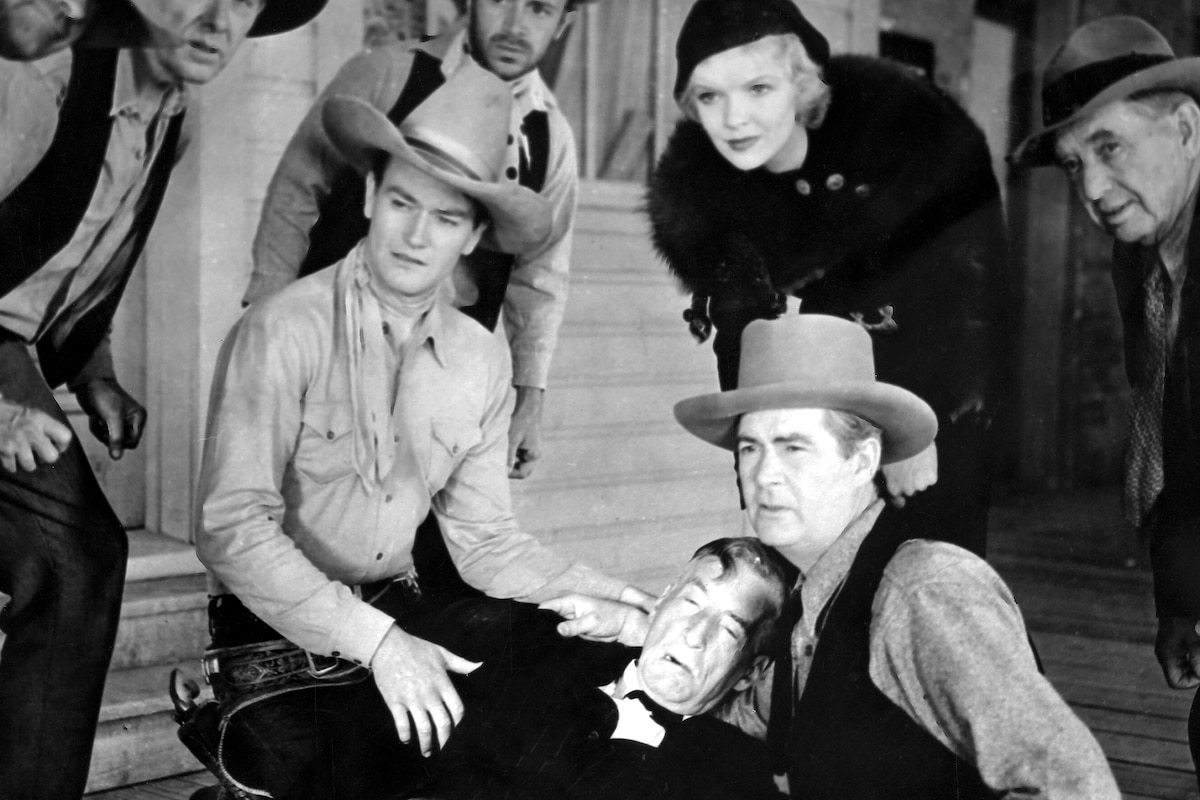
The Star Packer (1934) is one of the many rungs on the ladder John Wayne climbed on his way to becoming John Wayne. It is not a high rung. One of a string of ramshackle Westerns John Wayne made for Republic, its troubles start with that obfuscating title. A bit of translation is in order. As there are hombres who pack firearms, so there are those who carry stars as well. In other words, sheriffs. So why not simply have called it The Sheriff,? If the title is mystifying, everything else about the film is glumly transparent. It's of interest to John Wayne fans charting his way toward his eventual persona, which emerged and developed five years later in his breakthrough film, Stagecoach. It also features two other Western legends to be: George "Gabby" Hayes, in his pre-unkempt-beard sidekick days, and Yakima Canutt, the king of stuntmen turned actor, with 245 stunt credits alone, including the tough stuff, like riding horses off cliffs.
Others did most of Wayne's stunts, but his horsemanship was real. He and his brother rode since childhood on a ranch their father owned. His voice hadn't yet deepened by 1934, and he hadn't yet slowed it down to his famous drawl. He moves with competence rather than the authority that soon was to come, although the beginnings of his careful, deliberate walk are there. Here, his hat is white and his horse is whiter. When the third sheriff of Red Gulch is shot dead by a minion of the gang boss, and the cattlemen despair of ever establishing law and order, Wayne allows as how he reckons he'll take the job. He's already proven himself, foiling a stagecoach robbery and rescuing spunky but otherwise standard-issue damsel in distress, blond Verna Hillie, a good deed he repeats in the climax.
The town is mystified by the identity of the elusive gang boss, although there's only one possible person he can be. His devices for concealing his identity are laughable. The film also has a scrambled timeline. There's a standard Main Street set, a hideout that looks assembled by do-it-yourselfers and a ranch house that pops up in several Republic Westerns. They say 19th Century, but the film, shot in and around Santa Clarita, California, doesn't bother concealing utility poles and utilizes telephones and a mounted machine gun. Perhaps these details wouldn't be so noticeable or so irritating if the film weren't so poky for an action film. As if realizing this, the filmmakers throw in a bullet-riddled finale, with good guys and bad guys - about 15 each - firing away on horseback.
There's even Wayne chasing the criminal mastermind trying to get away in a wagon with the kidnapped girl. Fat chance. By then the film has long since capsized, though. Throughout, Wayne is unruffled, and it's fun to see Hayes in an atypical role, that of the girl's uncle and co-inheritor of the ranch owned by her murdered father. He's the only one of the locals who has soothing words for her - and a warning to sell her half and go back East. Which, of course, only whets her appetite for the showdown. Santa Clarita is not Monument Valley. Wayne and the others are working on a much smaller canvas, with a script and direction that give them little aid or comfort. Not just physically, but creatively. Sometimes there are reasons for the neglect of neglected films. Sometimes they are negligible.
In later years, Wayne joked that while his cheapo Westerns weren't down alongside R- and X- rated pictures, it was overrating them to refer to them as B movies. The biggest cast member with reason for complaint was the durable Canutt, who lived to 90 despite his hazard-filled livelihood. His character, Yak, is a compendium of every offensive way of portraying Native Americans, not just adding the suffix "um" to every other word. As if afraid to show an armed Native American, the film makes sure he's weaponless. Not even a bow and arrow. His duties are limited to watching back doors and acting as an extra pair of eyes for Wayne. The ending is cringe-worthy. A few years after Wayne and his Eastern blond have married, and are relaxing on their front porch, Canutt is dancing around, teaching their baby boy a war dance. Horrors! None of that, she declares, shutting down Yak, her infant son and the dance. Thus does civilization come to Red Gulch. True, the film was made in 1934. But still! Compared to him, Tonto looks like George Sanders.
By Jay Carr
The Star Packer
by Jay Carr | February 14, 2014
SIGN UP FOR OUR NEWSLETTERS

CONNECT WITH TCM