Between The Big Trail (1930), an early widescreen effort that gave John Wayne his first big role, and Stagecoach (1939), Wayne cut his teeth in Hollywood by starring in more horse operas, as the low-budget western quickies were called, than most people have probably ever seen. Born in 1907 as Marion Morrison, in Winterset, Iowa, he quickly eschewed his Christian name in favor of "Duke," the name given the family dog, beating out Indiana Jones and the Last Crusade's revelation of the same for its hero by some seven-plus decades. Calling himself Duke Morrison, he even managed to get a credit under that name at least once, in 1929's Words and Music. When Raoul Walsh and Fox Studios boss Winfield Sheehan hashed out a new name for Morrison, finally deciding on the name now synonymous with the American western hero, Wayne couldn't have been more thrilled. He'd never have to worry about being called "Marion" again.
The reason Walsh and Sheehan were keen on giving him a new name was because Walsh wanted him to star in the aforementioned The Big Trail and "Marion Morrison" seemed dull and not very star-like. Unfortunately for all concerned, The Big Trail bombed. Fortunately for Wayne, everyone liked him and he began to get part after part, from small ones in bigger pictures to lead roles in those horse operas he spent the decade doing. One of those was Somewhere in Sonora (1930) and, though it took place in the present day of 1933, had all the earmarks of an exciting western.
The movie takes place out west, way out west, in California. A couple of ladies, Mary (Shirley Palmer) and Patsy (Ann Fay), are headed out to a ranch to trade in their car for a horse. Why? Well, let's just say that horse operas didn't spend a lot of time explaining things and Somewhere in Sonora is no exception. They're on their way to get that horse when Patsy sees a sign for a rodeo and proceeds to pronounce it ROE-dee-oh, just as most people were already pronouncing it by the thirties. Either the screenwriter or director had it in their mind that this was the movie that was going to remind everyone that the proper way to pronounce it was roe-DAY-oh because Mary quickly gives Patsy an abject lesson in proper pronunciation. From that point on, everyone, including old grizzled farmhands, says roe-DAY-oh, which, to modern ears and eyes, sounds and looks a little peculiar.
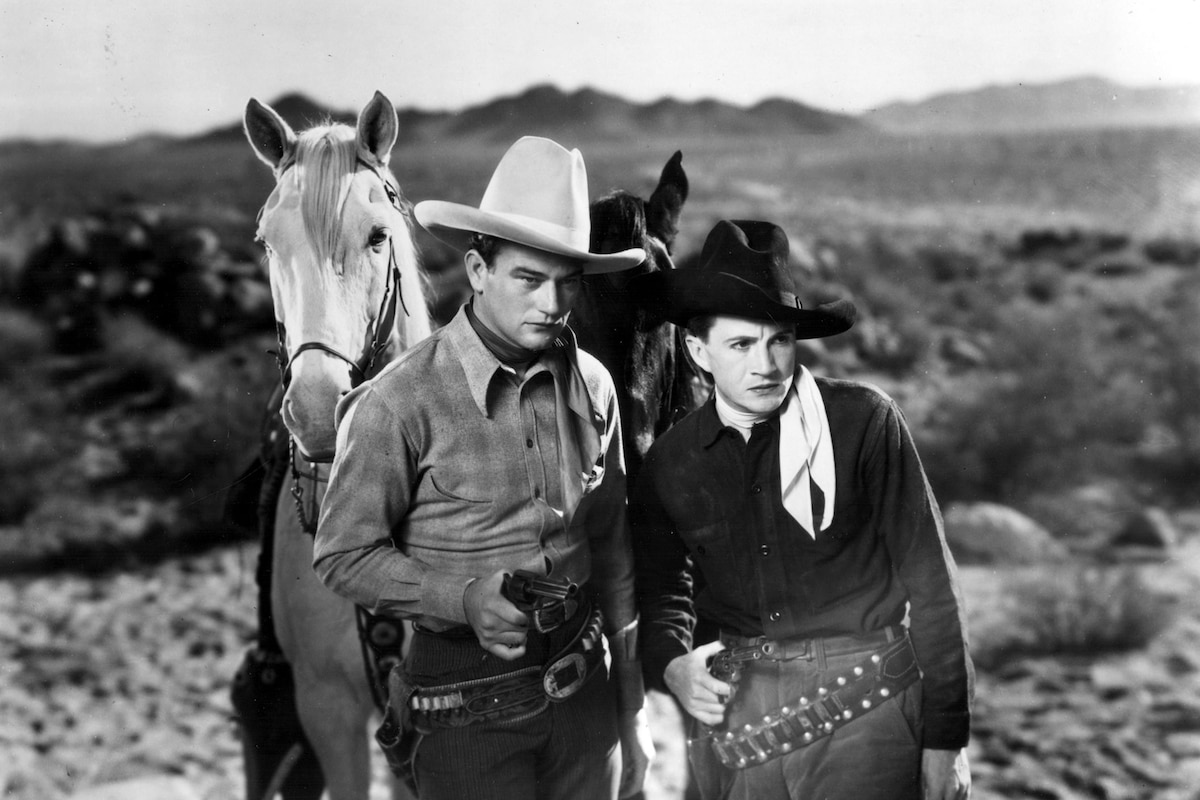
When Mary and Patsy arrive they're quickly greeted by Mr. Leadly (Henry B. Walthall) who introduces them to his star ranch hand, John Bishop (John Wayne), who's busy doing lasso tricks next to his horse, Duke (yes, the horse's name is "Duke" and he's billed on the opening title screen with Wayne). John introduces himself and Mary already seems a little taken. When prodded to stay on for the rodeo, she and Patsy quickly agree. John will be doing a stagecoach race and before the race starts, someone removes a bolt from his opponent's wheel, which eventually leads to the wheel falling off and the stagecoach crashing. At this point, in keeping with the horse opera tradition of "keep things moving and explain nothing," the sheriff arrests John Bishop because, well, why not? After all, he was in the race with him, right? And he wanted to win, right? So why wouldn't he sabotage his opponent's stagecoach? And what's the law against sabotaging a stagecoach to win a race? Well, the movie's not really sure either so when John gets arrested, the sheriff is asked this very question and answers, "We'll draw up charges later."
This leads to Leadly wanting to break Bishop out with the help of his inept ranch hands Riley and Shorty, played by old hand comedic sidekicks Frank Rice and Billy Franey, respectively. And all of this happens very early in the story because when a movie runs less than sixty minutes, as many of Wayne's early movies did, it's important to get things such as exposition and character development settled and out of the way as early as possible. The benefit of this, and having plot lines that make little to no sense, is that entertainment is at a high premium and the pacing is ferocious.
Low budget quickies like this don't have the reputation they deserve. They were often a lot more entertaining and adventurous than the big studio offerings of the day. Things that signify realism today, like filming on location instead of a studio set, happened routinely and just watching Mary and Patsy drive in a real car on a real road instead of in front of a rear-projection screen, gives the movie a more modern-day feel. The short running time also enables a movie that operates almost exclusively on action instead of backstory. These movies were meant to entertain the masses and entertain they did.
More importantly, they were filled with talent. John Wayne, of course, became a huge star, one of the biggest in history, and here, in his early career, the charisma that would serve him well for decades is already apparent. Other actors, like Henry Walthall, were old pros, making hundreds of movies in their careers. Walthall became most famous, early in his acting career, as Ben Cameron in D.W. Griffith's The Birth of a Nation (1915).
Somewhere in Sonora isn't the kind of movie that's meant to move or enlighten the viewer. Its existence isn't hinged upon charming the critics or wooing the festival crowds (which didn't exist at that time anyway). No, Somewhere in Sonora is about action, adventure, and good old-fashioned horse opera entertainment. And giving horses second billing. And, of course, how to properly say "Rodeo."
Director: Mack V. Wright
Producer: Leon Schlesinger, Sid Rogell
Screenplay: Joseph Anthony Roach (based on a story by Will Levington Comfort)
Cinematography: Ted D. McCord
Music: Leo F. Forbstein
Film Editor: William Clemens
Stunts: Jack Hendricks
Cast: John Wayne (John Bishop), Duke (Duke - John's Horse), Henry B. Walthall (Bob Leadly), Shirley Palmer (Mary Burton), Ann Faye (Patsy Ellis), J.P. McGowan (Monte Black), Paul Fix (Bart Leadly), Ralph Lewis (Mr. Kelly Burton), Frank Rice (Riley), Billy Franey (Shorty)
By Greg Ferrara
SOURCES:
Wikipedia
IMDB
Somewhere In Sonora
by Greg Ferrara | February 14, 2014
SIGN UP FOR OUR NEWSLETTERS

CONNECT WITH TCM