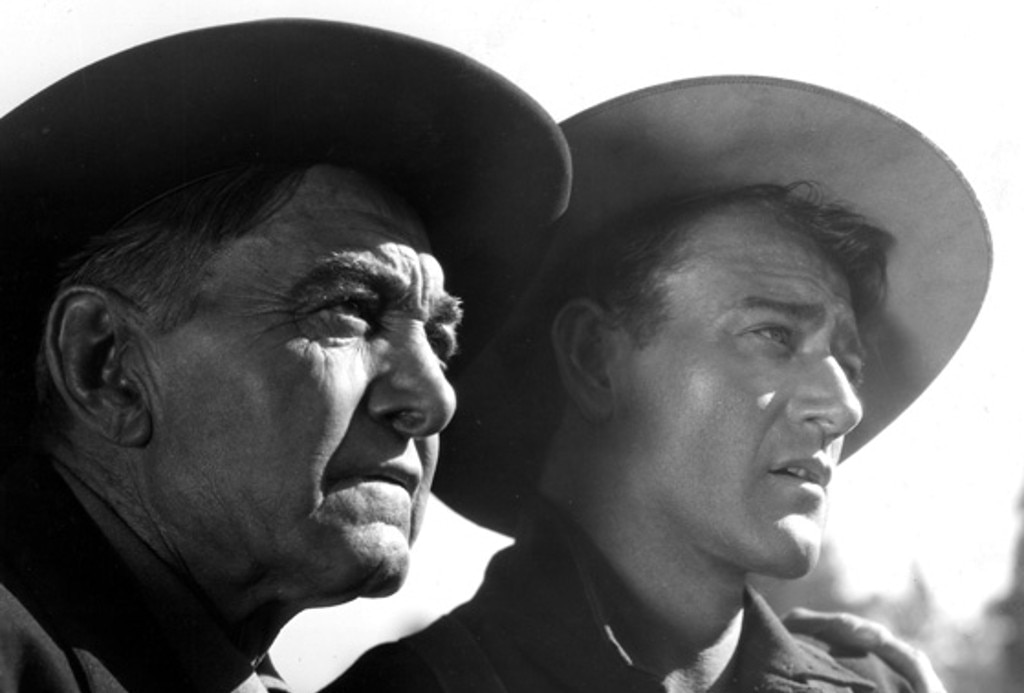
John Wayne already had some 90 pictures and 15 years in the business to his credit but was not quite yet the superstar he would become in the 1940s when he starred in this nostalgic tearjerker as an embittered young Ozark Mountains moonshiner obsessed with hatred for the father he believes deserted his mother. The young man's attitude contributes greatly to the atmosphere of animosity in the mountains until the gentle influence of a newly arrived stranger, the shepherd of the title, gradually changes the local people.
Venerable character actor Harry Carey plays Daniel Howitt, the title character, but Wayne gets top billing, thanks largely to his breakthrough in John Ford's Stagecoach (1939) and notable performances in Ford's adaptation of Eugene O'Neill's The Long Voyage Home (1940) and the Marlene Dietrich comedy-adventure Seven Sinners (1940). This was Wayne's first film in Technicolor. His co-star here is Betty Field, and the cast is rounded out with some of the most popular character players of the period: Beulah Bondi, Marjorie Main, and two regulars who would become staples of the John Ford stock company and appear in many films with Wayne, Ward Bond and John Qualen.
The film is based on a 1907 novel by Harold Bell Wright that was a mixture of real-life characters and fictional mountain folklore. The book was well received and translated over time into seven languages and popular enough to occasion three other big screen versions in 1919, 1928, and 1964, as well as a 30-minute television adaptation in 1960. None of them strayed as far from the original novel as this one. Two of the biggest changes were transposing the abandoned wife from a nurturing, kindly woman into a shrill, nasty moonshiner and making the shepherd not a cultured visitor from Chicago but an aging gunfighter with a guarded past. Other characters also varied greatly, and the film adds a shoot-out, making it more like the western movies audiences already closely identified with John Wayne.
The story takes place in the Ozarks section of Missouri around what is now a major entertainment capital, the city of Branson. Wright's original novel was adapted into in a popular outdoor play performed there weekly from May to October, from 1960 until its final performance October 19, 2013. The outdoor play featured more than 80 actors, 40 horses, and an actual nightly burning of the cabin.
This was the first time Wayne worked with director Henry Hathaway, but it wouldn't be the last. They made six more films together, including True Grit (1969) for which Wayne finally won an Academy Award. In his 44-year career, Hathaway was known for action pictures (The Lives of a Bengal Lancer, 1935, his only Oscar nomination; Raid on Rommel, 1971) and some memorable noir thrillers of the 1940s (The Dark Corner, 1946; Kiss of Death, 1947). Perhaps the least characteristic movie of his career was the dreamy fantasy romance Peter Ibbetson (1935), starring Gary Cooper.
According to stories in the Hollywood Reporter, Tyrone Power, John Garfield, Lynne Overman, Robert Preston, and Burgess Meredith were considered for lead roles in this film.
Much of the picture was shot in the San Bernardino National Forest, including a forest fire scene shot at Moon Ridge under the supervision of forest rangers and members of the Civilian Conservation Corps.
According to information in the film's press book, Paramount music director Troy Sanders coached Harry Carey on playing the spinet for his role.
By Rob Nixon
Director: Henry Hathaway
Producer: Jack Moss
Screenplay: Grover Jones, Stuart Anthony
Based on the novel by Harold Bell Wright
Cinematography: W. Howard Greene, Charles Lang
Editing: Ellsworth Hoagland
Art Direction: Roland Anderson, Hans Dreier
Original Music: Gerard Carbonara
Cast: John Wayne (Young Matt), Betty Field (Sammy Lane), Harry Carey (Daniel Howitt), Beulah Bondi (Aunt Mollie), James Barton (Old Matt), Marjorie Main (Granny Becky)
The Shepherd of the Hills
by Rob Nixon | February 14, 2014
SIGN UP FOR OUR NEWSLETTERS

CONNECT WITH TCM