Aki Kaurismaki, who has been making films for more than 30 years, has been called Finland's greatest director. But his style takes some getting used to. The Match Factory Girl (1990) is perhaps the quintessential Kaurismaki film: spare (just 69 minutes), nearly silent (the first dialogue comes 14 minutes into the film, and that's just the title character ordering a beer in a cafe), bleak yet droll, Kaurismaki's deadpan films are an acquired, but sneakily addictive taste.
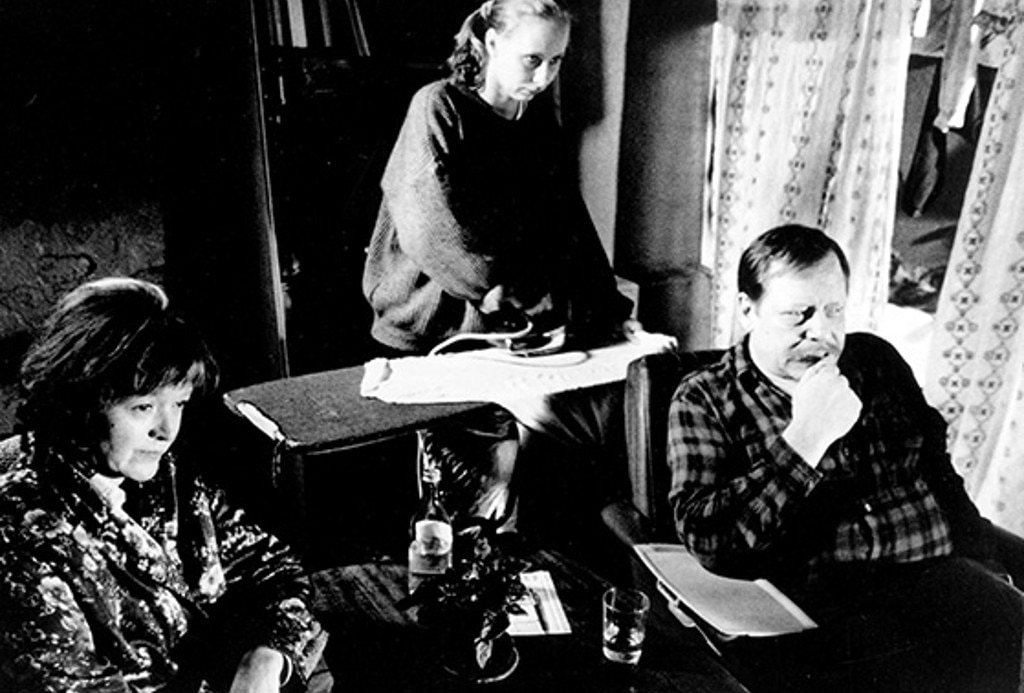
The third film in Kaurismaki's so-called "Proletariat Trilogy," after Shadows in Paradise (1986) , about a garbageman, and Ariel (1988), about an unemployed miner, The Match Factory Girl is another unblinking look at a dreary, dead-end life. Iris works on a factory assembly line and lives with her unloving mother and stepfather in a tiny apartment where she has a roof over her head, but little more. She comes home from work, turns over her wages, cooks dinner, cleans, and sleeps on the sofa. Looking for affection, she frequents a dance hall, where she meets and spends the night with an apparently successful middle-class man. But the hook-up means little to the man, and has disastrous consequences. Rejected and dejected, her life in disarray, Iris sets out to get revenge on those who have hurt her. It should be depressing, but somehow, Kaurismaki's meticulously detailed heaping of misery upon misery becomes darkly comic, and the audience roots for Iris to get her revenge.
Kati Outinen, who has appeared in many of Kaurismaki's films, is an ideal muse for the director, with an impassive face that can appear both plain and beautiful. She received the best actress award at Cannes for her work in Kaurismaki's The Man Without a Past in 2002. Asked in an interview to explain what she likes about working with him, she said "He trusts actors. On one of our films together I asked him about how my character would react in a certain scene, he said to me, 'You're the actress, you should know.'"
Kaurismaki not only refuses to explain the characters to his actors, he doesn't make it easy for critics and audiences either. Yet somehow, he seduces them without them quite knowing how he does it. Reviews of The Match Factory Girl are happily befuddled. Hal Hinson wrote in the Washington Post, "Once you get him, though, you get him, and suddenly all this nothingness becomes (and don't ask me how) hilarious. Hilarious and tragic and, in its purity and simplicity, sometimes almost holy." Caryn James of the New York Times found Kaurismaki's work deceptively simple: "The director's style is ruthlessly pared down, every scene edited to its core, every detail perfected, every lingering shot of an empty room used to good effect. Yet Mr. Kaurismaki's buoyant energy fends off any hint of a mannered or minimalist approach, and he keeps viewers trailing after him by unsettling every expectation." Roger Ebert of the Chicago Sun Times explained the key to audiences' affection for his downbeat characters: "I never get the idea he hates them; in fact, I think he loves them, and feels they deserve to be seen in his movies, because they are invisible to other directors. In making them, he seems to be consciously resisting all the patterns and expectations we have learned from other movies. He makes no conventional attempt to 'entertain.' That's why he's so entertaining."
As for Kaurismaki himself, asked at a screening of The Match Factory Girl if Finland is really as grim as it appears in the film, he replied in a laconic monotone, "It's a wonderland."
Director: Aki Kaurismaki
Producer: Aki Kaurismaki, Klas Olofsson, Katinka Farago
Screenplay: Aki Kaurismaki
Cinematography: Timo Salminen
Editor: Aki Kaurismaki
Principal Cast: Kati Outinen (Iris), Elina Salo (Mother), Esko Nikkari (Stepfather), Vesa Vierikko (Man), Reijo Taipale (Singer), Silu Seppala (Brother)
69 minutes
by Margarita Landazuri
The Match Factory Girl
by Margarita Landazuri | February 14, 2014
SIGN UP FOR OUR NEWSLETTERS

CONNECT WITH TCM