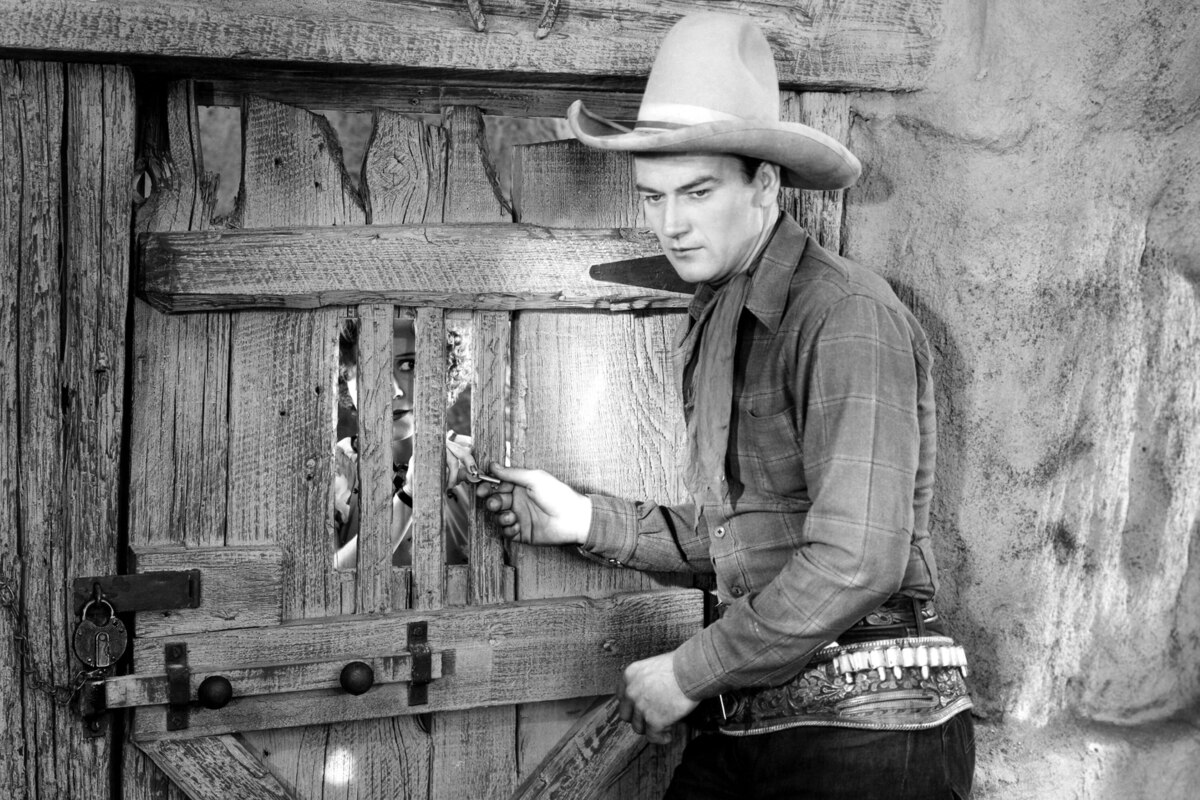
Randy Rides Alone (1934) was the seventh of sixteen B westerns starring John Wayne to be produced by Paul Malvern's Lone Star Productions, and released by Monogram Pictures, from 1933-1935. After the sixteenth, Paradise Canyon (1935), Monogram and five other poverty row studios merged to form Republic Pictures. (In 1937, Monogram was revived as a stand-alone studio.) For Republic, and later for Universal, Malvern continued to produce these quick little westerns (and films in other genres) starring Wayne, often with the additional involvement of character actor George "Gabby" Hayes and veteran stuntman Yakima Canutt.
By the time of Randy Rides Alone, released on June 15, 1934, Wayne had established himself as an indisputable star of the B movie world, though real, A-level stardom would not come until 1939's Stagecoach. Shot in less than a week on an $11,000 budget, Randy Rides Alone has a running time of under an hour and a plot that is structured as a variation of many of the other westerns in the series. The Motion Picture Herald, in its positive review, described it this way: "All the anticipated action is there, as Wayne, under suspicion as a bandit and a bad man, makes effective use of an assisted escape from prison to track down the gang which is guilty of the crime for which he was held."
Canutt later said that the plots for these little westerns tended to come straight from producer Paul Malvern, whom he described as "a really nice guy. [Malvern] said he'd been reading dime novels since he was a kid, and a lot of the plots for those films came from the novels he read. He reckoned he had about a hundred of these stories in his head."
In most of the Lone Star westerns, Wayne played good-guy gunmen, but he was consciously interested in adding something new to the type. He later told author Michael Munn, "All the screen cowboys behaved like real gentlemen. They didn't drink, they didn't smoke. When they knocked the bad guy down, they always stood with their fists up, waiting for the heavy to get back on his feet. I decided I was going to drag the bad guy to his feet and keep hitting him. I learned that as a kid from watching the westerns Harry Carey made with John Ford. He had realism, he was a real man, and I decided that's what my screen cowboy would be like."
This meant that much stunt work was required, and for that Wayne worked with legendary stuntman Yakima Canutt, a former rodeo cowboy who would eventually become the top stunt choreographer in the industry. One of his biggest claims to fame would be staging and actually directing the chariot race in Ben-Hur (1959). But for now, Canutt was honing smaller stunt techniques, doubling Wayne and other stars, and often appearing as an actor as well. Sometimes, when he doubled Wayne in a film in which he also played a separate character, he was literally chasing himself!
Working with Wayne, Canutt refined fist-fighting techniques for the screen: "You look at other films of the period or earlier," Canutt said, "and you see these guys bashing away at each other's shoulder, and it never looked real. What Wayne and I did was develop a way of standing at a certain angle to the camera and throwing punches to the face, just missing but looking to the camera like the fist had made contact. In fact, I would say that no one has ever been able to make a screen fistfight look as good as Wayne, even when he was older."
Co-starring in Randy Rides Alone is Alberta Vaughn, who had acted in numerous Mack Sennett and Buster Keaton comedies of the 1920s. Within months of making this film, she married a businessman and left the industry.
By Jeremy Arnold
SOURCES:
Yakima Canutt, Stunt Man
William K. Everson, The Hollywood Western
Fred Landesman, The John Wayne Filmography
Michael Munn, John Wayne: The Man Behind the Myth
Randy Rides Alone
by Jeremy Arnold | February 14, 2014
SIGN UP FOR OUR NEWSLETTERS

CONNECT WITH TCM