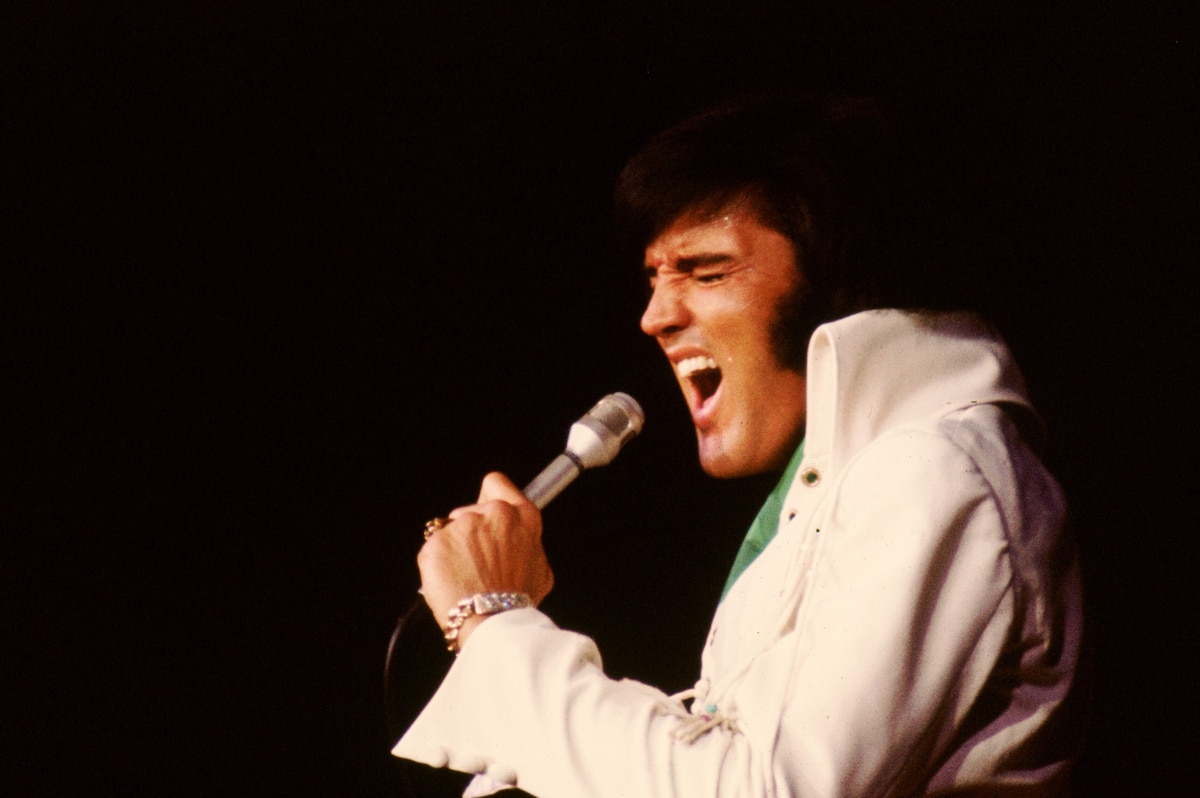
The documentary Elvis: That's the Way It Is chronicles Presley's 1970 summer appearance at the International Hotel in Las Vegas. The film begins with the rehearsals, which took place in July at MGM studios in Hollywood, then picks up a month later, on August 10, when Elvis opened at the ultra-modern International (later the Hilton). The cameras recorded the opening night as well as several performances throughout the engagement. In the original film, the concert footage created the illusion that it is one show, building to an exciting climax of Elvis performing his best material. Dressed in a simple, white jumpsuit, accented with fringe instead of the rhinestones and gems associated with the Vegas era, Elvis was clearly at the top of his game.
In retrospect, the film was more than just the kind of concert documentary in vogue at the time (Monterey Pop [1968]; Woodstock [1970]; Gimme Shelter [1970]). The footage also captured Elvis at a key juncture in his music and his career. In 1969, Elvis had experienced a seminal year in the same ways that 1956 and 1960 had been golden opportunities for him. Events in those years had determined a career course and constructed a specific image for him: In 1956, Elvis became a national sensation by singing a style of music that jolted the musical establishment and by performing with an intensity that shocked mainstream audiences outside his native South. After his discharge from the army in 1960, Presley eschewed his rebel image to embrace a new persona as a movie star in a spate of musical comedies. He abandoned his recording and touring career to become a mature leading man, who no longer shook his hips or rebelled against the mainstream. In December 1968, after he grew disillusioned with his film career, he agreed to star in Singer Presents Elvis (aka The '68 Comeback Special), a groundbreaking television special that reminded audiences he was more than a movie star. In May 1969, he released his first critically acclaimed album in decades, From Elvis in Memphis, which introduced new material that was not part of a movie soundtrack. In the summer, he opened at the new International Hotel in Las Vegas to record-breaking crowds. The high-profile Vegas engagements, combined with touring, completely changed Elvis's image by 1970. He stepped into his own as a musical superstar, whose larger-than-life legend was telegraphed by the jewel-studded jumpsuits and the standing-room-only crowds.
For his return to concert performing, Elvis wisely chose not to re-create his past by singing his old songs in his 1950s rockabilly style. He opted for a large-scale sound that included the contributions of a rock band, an orchestra, a gospel quartet, a soprano, and a trio of female soul singers. Though he did sing a few of his hits from the past, they were updated with different arrangements. Categorizing Elvis's music from this phase of his career is not easy. It was a combination of influences, like his original music from the 1950s, but it was also much fuller and richer. His new music seemed to integrate Southern-based sounds that the singer had always been drawn to, but his expressive vocals, large-scale sound, and sheer drama expanded those influences into something that became simply "Elvis's music."
The original Elvis: That's the Way It Is was directed by Denis Sanders, who had won an Academy Award for Best Documentary for his film Czechoslovakia 1968. Respected cinematographer Lucien Ballard caught the excitement of Elvis's performance on stage by using eight Panavision cameras. Ballard's reputation was made in part by his work on The Wild Bunch (1969), directed by Sam Peckinpah. The Wild Bunch became justifiably famous for its montage-style editing during the climactic action scene. A barrage of brief shots was used to make the gunfight more exciting and stimulating. Ballard and director Sanders employed a similar technique in Elvis: That's the Way It Is to capture the excitement surrounding the singer in concert. After Elvis's manager, Colonel Tom Parker, saw the film during a rough cut, he expressed his dislike for the editing style, but when Elvis saw the final version of the film, he was reportedly pleased.
Shots of the massive promotional buildup in Las Vegas were intercut with the rehearsal footage. A film crew was sent to Luxembourg to record an Elvis Presley convention to illustrate the excitement of fans, though some of the fans' comments and actions did not paint the fans in a positive light.
In 2001, Turner Entertainment Co. hired Rick Schmidlin to restore and rearrange footage for Elvis: That's the Way It Is, Special Edition. With a bit of detective work, Schmidlin discovered unmarked cans of original footage in MGM's storage facilities in an old salt mine in Kansas along with the original 16-track recordings. The tracks were digitally remixed, and footage of Elvis in rehearsal and on stage replaced the scenes of the promotional buildup and the interviews with fans. Some of the songs in the original were replaced with new numbers.
The additional rehearsal footage shows Elvis's unique way of working in the studio with his band members, revealing that he was indeed in control of his music. It also shows his unusual approach to rehearsal. Every time he sang a song, he actually performed it. Most singers hold back during rehearsal, and even recording, to focus on the technical details of the music, but Elvis always sang in rehearsal with the same enthusiasm as when he performed before the public. By far, the best element of the Special Edition is the elimination of the talking-head interviews with the oddball fans. The interviews were definitely not a true reflection of Elvis's loyal but mostly down-to-earth fans.
However, that doesn't mean the Special Edition is without flaws. By including additional footage in which Elvis appears in different costumes, the illusion of seeing one continuous concert is destroyed, dissipating the build-up of excitement. And, the editing lacks the immediacy and spontaneity of some of the sequences in the original. Most disappointing was that two beautifully performed songs in Elvis's repertoire from this period, "Bridge Over Troubled Water" and "I Just Can't Help Believin'," were eliminated from the concert section. Both are key examples of the diversity of his style during this period. Also, too many examples of Elvis joking around with songs were included, playing into accusations from his detractors that he became a parody during this period.
Still, the greater focus on Elvis makes the Special Edition a solid chronicle of the last phase of his career, which was later erroneously painted as an era of excess and decline that led to his death. In truth, the music represented a quintessential American sound while the concert performances are a piece of Las Vegas history.
By Susan Doll
Producers of Elvis That's the Way It Is, Special Edition: Rick Schmidlin, with Brad Arensman, George Feltenstein, and Roger Mayer
Editor, Special Edition: Michael Salomon
Supervising Sound Editor, Special Edition: Gregory Hedgepath
Producer, Original: Dale Hutchinson and Herbert F. Solow
Director, Original: Denis Sanders
Cinematographer, Original: Lucien Ballard
Editor, Original: Henry Berman
Special Edition: 2001 Color 96 mins. Original: 1970 Color 108 mins.
Elvis: That's the Way It Is
by Susan Doll | February 14, 2014
SIGN UP FOR OUR NEWSLETTERS

CONNECT WITH TCM