"I'm not a good actor, a good rider or a particularly good singer, but they seem to like what I do, so I'll keep on doing it as long as they want." So told a modest Gene Autry (1907-1998) to director Frank McDonald between takes of Rancho Grande (1940). Indeed this screen legend's fans never tired of his heroic Western deeds - and it was age and the security of diverse multimillion dollar investments (encompassing everything from real estate to the California Angels baseball team) that finally made the venerable three decade cinema veteran retire to enjoy the fruits of his innumerable labors.
Autry's entrance into show biz sounds like a fictitious bio manufactured by a press agent. Upgraded from day laborer to telegrapher for the Oklahoma branch of the St. Louis and San Francisco Railroad, the Texas-born performer was "reportedly" discovered by Will Rogers, who heard the recent high school graduate warbling during work hours at his office job. "You got something, go to Hollywood!," offered the humorist. Eventually taking Rogers' advice, Autry re-located to California. Billing himself as the Singing Cowboy, Gene almost immediately snagged the part of "square dance caller" in In Old Santa Fe (1934). Soon he had his own radio show, Melody Ranch and was cast in The Phantom Empire (1935), a bizarre science fiction/musical/Western which became a great success. By the end of the year, Autry had secured a contract with the newly-formed Republic Studios where he pioneered the Singing Cowboy Movie formula; it proved to be a hit with the public. Paving the way for his Republic successor Roy Rogers, as well as Tex Ritter, Eddie Dean and countless others, Autry helped bring country music to a highbrow East Coast audience, making it both respectable and profitable. Within a year after his meteoric ascension to movie star, Autry's popularity was aped by no less than Bing Crosby, who started recording Western songs - even starring in Rhythm on the Range (1936) - essentially a big budget Paramount version of the type of pictures Gene was regularly churning out at his Republic alma mater. Later, after a stint in World War II, Autry moved to Columbia, where he forged a more lucrative deal, producing his own pictures.
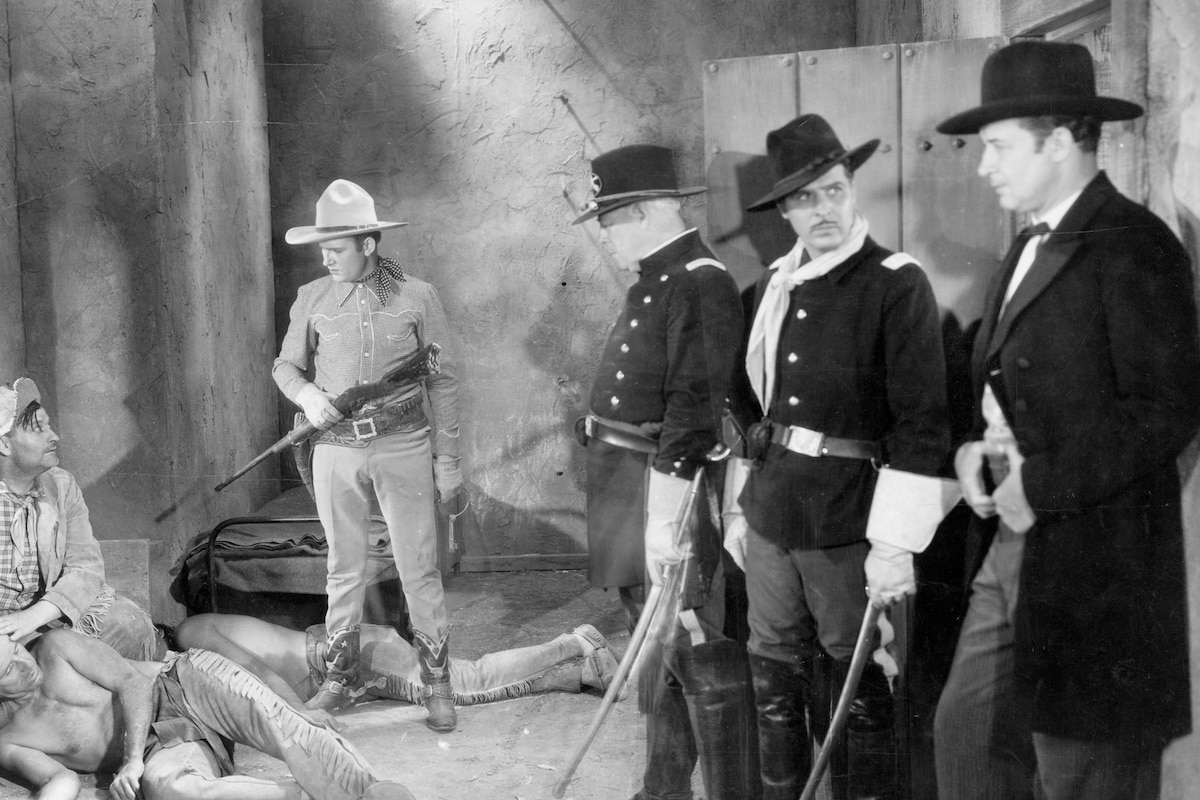
Ride, Ranger, Ride (1936) represents Autry at his peak. This enjoyable sagebrush romp doesn't scrimp on either songs or action as it tells the oft-recounted tale of a cowboy trio wrongly accused of foul play, eventually triumphing in the final reel. The cowboy trio was another Republic innovation and in Ride, Ranger, Ride, Autry was teamed with his former radio sidekick Max Terhune (a country western ventriloquist!) and hillbilly comedian Smiley Burnette (with whom he would maintain a long on-screen partnership and off-screen friendship). The trio's exploits would be copied by a plethora of B-movie studios who would triad indiscriminate western stars in literally hundreds of oaters produced during the 1930s and 1940s (some featuring a pre-Stagecoach John Wayne); the official series would cleverly be billed as "The 3 Mesquiteers."
It was a different teaming that made Ride, Ranger, Ride stand out from the rest - Autry and leading lady Kay Hughes. Usually, in B-western lore, the hero could serenade and romance the gal, but would ultimately ride off into the sunset with his buddies or solo with just his faithful horse as his companion. In Ride, Ranger, Ride a complete reversal of this scenario came into play: Autry splits from his cohorts and marries the girl! This did not sit well with contemporary audiences, who, while not daring to question their idol's virility, nevertheless felt betrayed. Years later, Autry, with tongue firmly in cheek, merrily explained his devotees' naive attitude due to the fact that "In my day, most people thought dance hall girls actually danced."
Producer: Nat Levine
Director: Joseph Kane
Screenplay: Dorrell McGowan, Stuart McGowan
Music: Arthur Kay, Hugo Riesenfeld, Sam H. Stept
Cast: Gene Autry (Himself), Smiley Burnette (Frog), Kay Hughes (Dixie Summerall), Monte Blue (Tavibo/Duval), George J. Lewis (Lt. Cameron), Chief Thundercloud (Little Wolf).
BW-56m.
By Mel Neuhaus
Ride, Ranger, Ride - Western Themes Singing Cowboys RIDE, RANGER, RIDE
by Mel Neuhaus | November 05, 2002
SIGN UP FOR OUR NEWSLETTERS

CONNECT WITH TCM