Men Of Action Blaze A Trail Of Love And Lead As Law And Order Comes To The
Old West!
Tag Line for Harlem Rides the Range
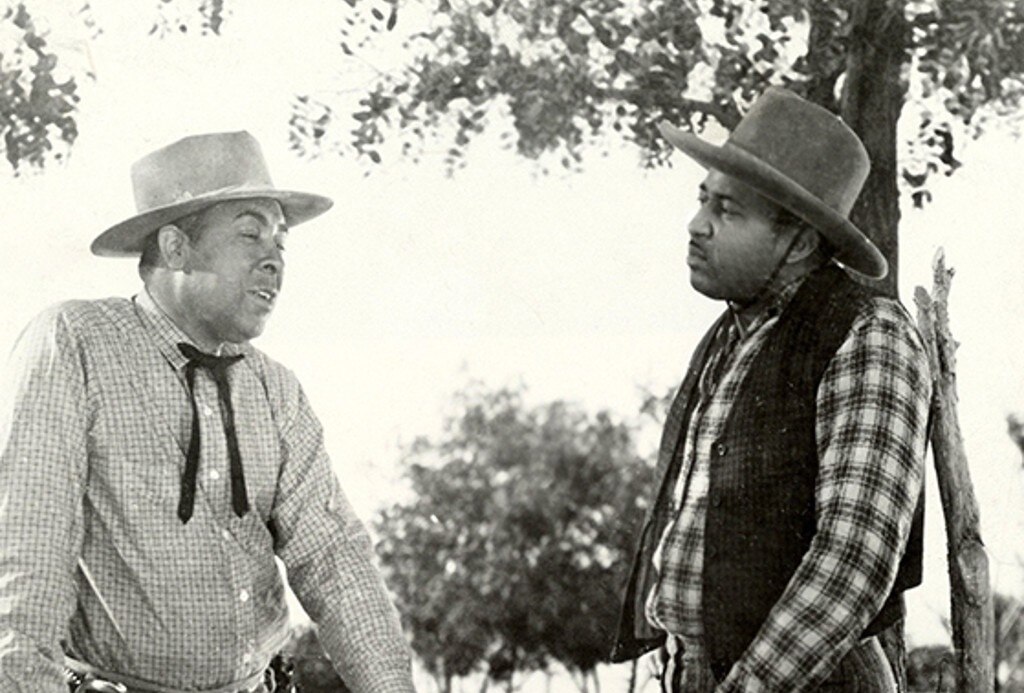
"Hi ho, Stardusk!" was the cry as Herbert Jeffries rode his trusty horse
for the fourth and last time in this rare all-black Western released in
1939. Despite the title, the only hint of Harlem in Harlem Rides the
Range was to be found in the low comedy provided by Jeffries'
sidekicks, Lucius Brooks and F.E. Miller, vaudeville veterans who first
made their name in all-black theatres. For the rest, the film was a clear
imitation of the low-budget westerns of the time, with an emphasis on talk,
music and one of the staples of the genre, the chase.
Harlem Rides the Range is a race film, a low-budget picture made
specifically for black audiences and shown primarily in segregated
theaters. The tradition had begun in the silent days when
African-Americans responded to the vicious racial stereotypes in D.W.
Griffith's The Birth of a Nation (1915) by producing movies of their
own with more positive images of black life. By the sound era, most of
them were produced by white men like Richard C. Kahn, the man behind
Harlem Rides the Range. Yet they still served an important purpose.
They gave black performers an alternative to the demeaning roles they had
to play in most Hollywood films while also giving black writers like
Spencer Williams and Francis Miller, who wrote and acted in Harlem Rides
the Range, a rare chance to work in the movies. Williams was one of
the few black filmmakers of the era who got to do more important work. In
1941 he moved into directing, creating The Blood of Jesus, a
powerful look at the role of religion in rural black life that has been added
to the National Film Registry. (Williams would achieve his greatest fame
with white audiences as Andy in the television version of Amos and
Andy, 1951.
Unlike The Blood of Jesus, however, Harlem Rides the Range was a more commercial venture. Jeffries was a cabaret singer who had first jumped into the saddle two years earlier for Harlem on the Prairie. A year later, Kahn cast him as Bob Blake
for the first time in Two Gun Man From Harlem, followed by The
Bronze Buckaroo. Each had a simple, formulaic plot, with the
light-skinned Jeffries saving the leading lady from darker-skinned villains
while also singing a few songs. Jeffries took his Western stardom
seriously. He even imitated Hollywood Western stars by outfitting his car
with bronze Western motifs for personal appearances. Unfortunately, his
films didn't catch on in northern theatres (they did better in the
South), and Harlem Rides the Range was the last of the Western race
films. Jeffries switched from white hat to black tie when he joined the
Duke Ellington Orchestra, then moved to France to run a night club. More
recently, he has appeared in documentaries about the history of black film
and, in 1996, released The Bronze Buckaroo Rides Again, a
country/western album.
Producer/Director: Richard C. Kahn
Screenplay: Spencer Williams, Jr. & Francis Miller
Cinematography: Roland Price & Clark Ramsey
Art Direction: Vin Taylor
Music: Lew Porter
Cast: Herbert Jeffries (Bob Blake), Lucius Brooks (Dusty), F.E.
(Francis) Miller (Slim Perkins the Cook), Artie Young (Miss Margaret
Dennison), Clarence Brooks (Bradley), Spencer Williams (Mr. Watson).
BW-57m.
By Frank Miller
Harlem Rides the Range
by Frank Miller | November 05, 2002
SIGN UP FOR OUR NEWSLETTERS

CONNECT WITH TCM