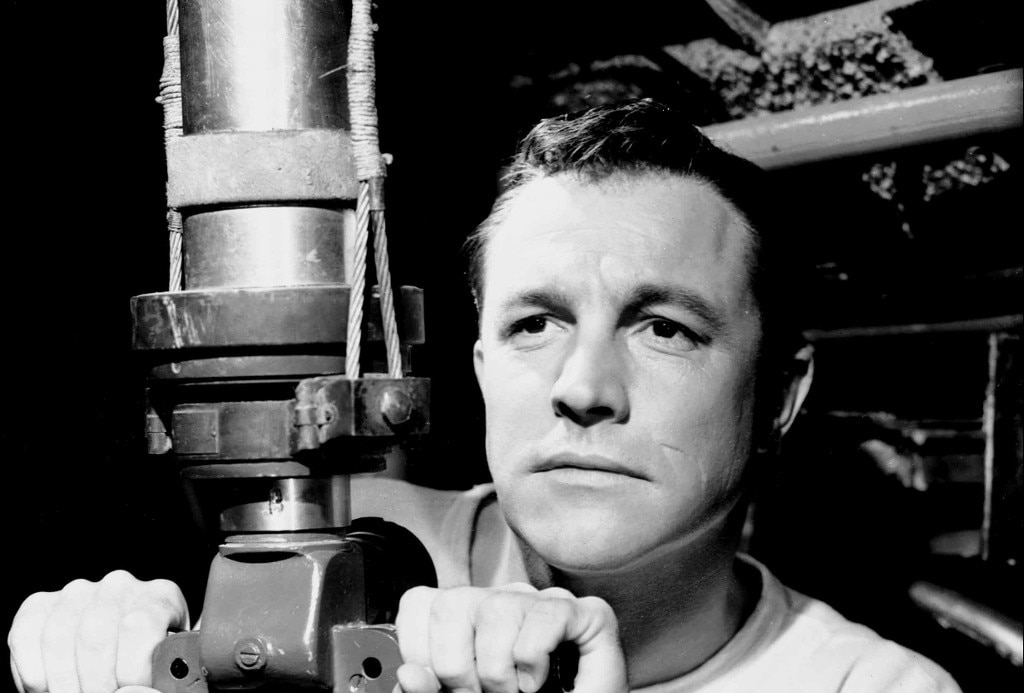
It's easy to forget how quickly movies used to get made, and how movie stars made, jumping from one to the other in a month's time, shooting three or five or more films in a year, only one of which would, a few decades hence, be remembered as A Major Work, while the others fall into obscurity. We recall Gene Kelly, for instance, by way of On the Town (1949), An American in Paris (1951), Singin' in the Rain (1952), Brigadoon (1954) and It's Always Fair Weather (1955), 100% athletic ballet, self-amused crooning, and broad comedy. But in that short peak span of six years Kelly also made seven other movies, some wildly uncharacteristic, including a full-on mobster noir (1950's Black Hand), a post-WWII spy melodrama (1952's The Devil Makes Three), and a classically subdued, techno-procedural British war film, Crest of the Wave (1954), courtesy of English-industry stalwarts Roy and John Boulting. What Kelly is doing in this curious piece of conflicted propaganda, titled Seagulls Over Sorrento in the UK, is actually less quixotic that you'd hope - MGM had funds frozen in European banks after the war, and to use them they had to spend it overseas, coproducing with British companies and sending their star, in this case, to Scotland.
Based on a forgotten play by Hugh Hastings (whose filmography is almost entirely, and bizarrely, taken up with the six versions of Seagulls Over Sorrento that were shot between 1954 and 1962 - including TV tapings in West Germany and Finland), the Boultings' movie is set entirely on a tiny Scottish island commandeered by the military during WWII. The outfit's only mission: to perfect a torpedo that can be loaded with a particularly volatile experimental explosive. When we open, one such test has already failed, leaving one soldier dying under gauze in the infirmary. As the stiff-upper-lipped brass wonder what to do next, it's easy to be overwhelmed with the particular character of mid-century British films - they are inordinately quiet experiences, due it seems both
to the English propensity to underplay and avoid histrionics of any kind, and to the singular way the British industry handled film sound, i.e., much of their film is post-dubbed, and as with Italian movies the process paid minimal lip service to ambient noise. What isn't post-dubbed is recorded simply, with a single mike.(When a character walks from across the room toward the camera, their voice becomes louder and clearer.) The result is an odd, serene placidity, augmented by the actors' unerring calm.
The small platoon of enlisted men is outlined for us, including a grouchy Cockney (Sidney James) and an anti-authoritarian Everyman (Bernard Lee) with a brewing hatred for the martinet officer above him (Patric Doonan), before the project's ostensible solution lands on the dock: a team of three explosive-expert Americans, comprised of Navy scientist Kelly and two sailor assistants (Fredd Wayne and Jeff Richards, who starred as one of the Pontipee brothers in Seven Brides for Seven Brothers that same year). Here, Hastings' play indulges in Brit-Yank culture clash, as both coteries of men mock each other's idioms and eventually discover that Richards' granite-chinned American swell was in fact the same Yank that unknowingly stole a cheap floozie girlfriend away from James' knobby-nosed schlub years before.
The contest of egos between the we-can-do-fine-ourselves Brits and the cut-the-nonsense Americans is explored, too, and Kelly's role is primarily the modest, unmilitary voice of reason amid the barely-raised arguments about glory-hounding and national pride. British films about the war tended for years to be scrupulously undramatic, kept to a low boil, and focused evenly on minutiae - as if the unconscious intention, so tellingly British, was to be calming instead of rousing. Here, of course all of the Allied toilers' differences are leveled out and their brotherhood is established once the next torpedo test ends with an unplanned explosion, killing one of the Brits. Facing failure in the mission, the operation is shut down from headquarters - but at the last second, one of the officers has an epiphany about a hardware glitch, and the day is saved.
As you can tell, the main story of Seagulls Over Sorrento is not quite white knuckle - making its momentary popularity all the more perplexing. Hastings' play, which had no American characters, ran on the London stage for four solid years - contractually postponing the release of the Boultings' film version by a year. Neither the play nor the film met much enthusiasm from American audiences, however - there might be something here that is quintessentially British. Perhaps it's that sense of thoughtful calm, but perhaps it's also the story's small, confining, somewhat idealized setting that makes it a beguiling experience. We watch movies sometimes to go where the movie is, to live there for awhile, especially if the location is secluded and mysterious, evoking childhood memories of exploring. Old mansions, ocean liners, forests, Old World ruins - part of the allure of any film that exploits such places is our nostalgia for being a youngster inhabiting and even ruling over, in our imaginations, tiny ersatz kingdoms. The rocky island of Crest of the Wave - wave-swept, cluttered with ancient fortress walls and recommissioned stone bunkers, small enough to run from one end to the
other in 20 minutes - is an ideal matinee getaway, a veritable tree fort. The Boultings don't waste screen time overemphasizing their location - they're nuts-&-bolts filmmakers. But the seduction of the place is ever-present, and you couldn't be blamed for looking at Kelly and the cast not as men at war but as boy-men playing war, on a sunlit atoll they have all to themselves.
By Michael Atkinson
Crest of the Wave
by Michael Atkinson | January 09, 2014
SIGN UP FOR OUR NEWSLETTERS

CONNECT WITH TCM