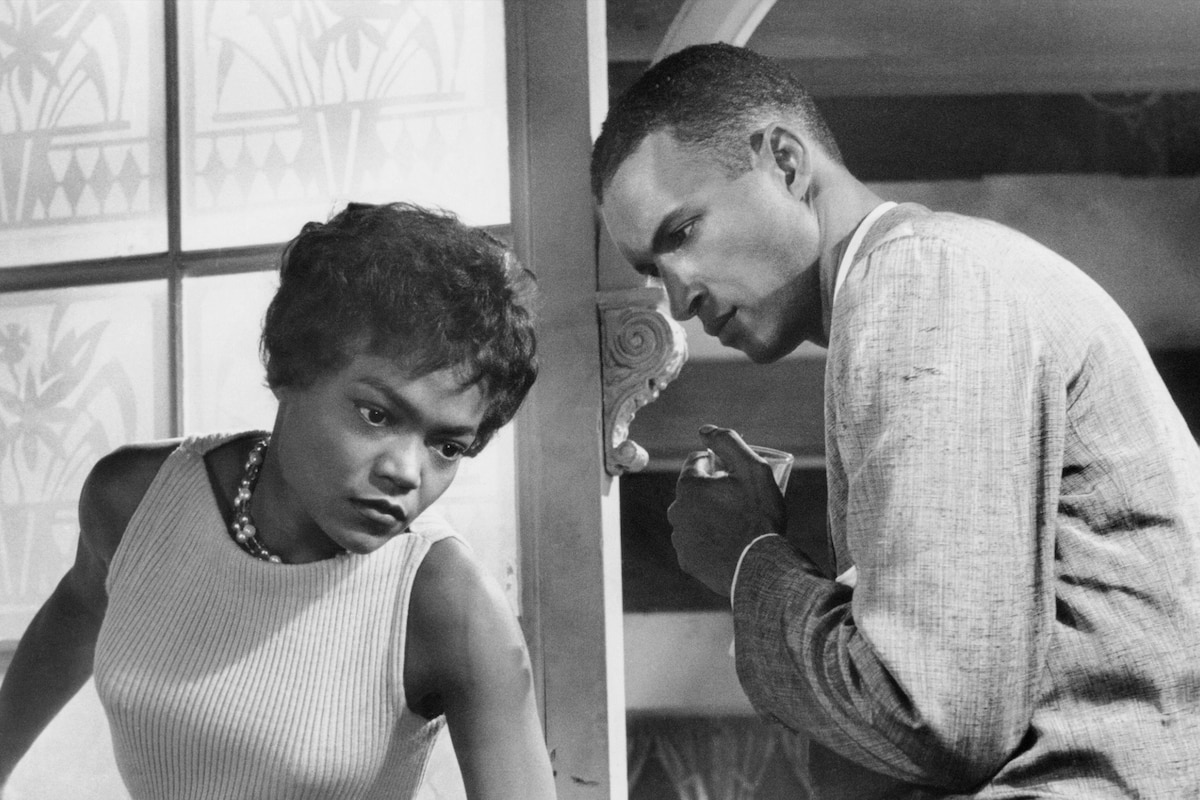
With screaming taglines like "It's That Red-Hot Picture About That Night-Time Girl!," "She's Every Inch The Shameless Sinner Who Blistered The Stages Of The World!," "THE MOST NOTORIOUS MEMBER OF A NOTORIOUS WALK OF LIFE!" and "Meet Anna - Whose Father Threw Her Out Because She Was A Tramp!," there could be little doubt what Anna Lucasta (1958) was all about.
The film was directed by Arnold Laven, with music by Elmer Bernstein and Sammy Cahn, and a screenplay by Philip Yordan. Yordan had originally written Anna Lucasta in 1936 as a stage play about Polish-Americans that was so controversial it had to wait until June 1944 to be produced. Even then, it was not shown on-stage, but performed by the American Negro Theater in the basement of the 135th St. Library in Harlem. Two months later, it opened on Broadway and ran for 959 performances. In 1949, Columbia paid six figures for the film rights and Paulette Goddard starred as Anna, but the film was not a success.
The Goddard film had been cut by the censor board, who objected to overtones of incest between Anna and her father, which was in the original play. When the remake's script was submitted for approval a decade later, the officials once again replied, "we think it would be wise were some additional motivation to be attributed to the father which would not place the emphasis so unequivocally on the suggestion of incestuous desire. We believe it would be quite easily possible to say that he was 'possessive' in nature, and for this reason would not want to see anyone else get Anna." The changes were made and the film proceeded. Rounding out the cast were Frederick O'Neal, John Proctor and Alvin Childress, who had been in the original 1944 production. Rex Ingram, Georgia Burke, Rosetta LeNoire, Isabel Cooley and Claire Leyba had all appeared in the Broadway production.
Anna Lucasta was produced by Longridge Enterprises, Inc., (the same company that had produced the 1949 film) and distributed by United Artists. It went into production at the Samuel Goldwyn Studio in Hollywood in early May and wrapped up a scant month later. Although he had appeared in films before, including musical shorts as a child, this was Sammy Davis, Jr.'s first dramatic role. In his autobiography, Davis wrote that financial problems, including overspending by his estranged wife, Loray, had forced him to appear in two shows nightly at the Sands in Las Vegas; a schedule he was obligated to keep during filming. Davis was already exhausted before production even began, having suffered a mild heart attack onstage. During production, Davis would fly to Las Vegas in the afternoon and then be driven home each night so that he could sleep. Adding to the stress was co-starring with former girlfriend Eartha Kitt, but Davis sent her flowers and took her to dinner, asking for her help since she was an experienced film actress. From all reports, the two were cordial during shooting but there was no renewal of their affections.
The more lurid poster lines had been rejected by the MPAA Advertising Code Administration because they felt they made it all too obvious that Anna was a prostitute and that the artwork emphasized "her posterior." The ad copy was revised and allowed to go out, although United Artists cleverly exploited the controversy by running their own campaign that asked, "Why won't they let us tell you what sort of woman 'Anna Lucasta' is?"
The film premiered in Chicago on November 26, 1958 and had the New York opening at the Victoria on January 14, 1959. The critics were certainly mixed. The New York Times veteran critic Bosley Crowther wrote that "If somebody dug down into the play-bin and brought up 'Bertha the Sewing-Machine Girl,' they could probably turn it into a better movie than has been made by Philip Yordan of Anna Lucasta." Crowther complained that Arnold Laven directed "as if he were looking out of the window most of the time, and it is played with surprising amateurishness by a big-name Negro cast." In an interview three months later, Sammy Davis, Jr. said, pointedly, "When the reviews appeared in the New York papers, six of the seven critics praised my acting. The other reviewer liked nobody." Davis would have been happier with The Deseret News, which wrote that "some wonderfully refreshing characterizations are presented by the featured players, including Frederick O'Neal," and The Washington Afro-American, which called it a "story of human frailty [that] shines forth in touching clarity."
By Lorraine LoBianco
SOURCES:
Crowther, Bosley "Anna Lucasta at the Victoria; Old Play is Revived with Eartha Kitt" The New York Times 15 Jan 59
Davis, Sammy, Boyar, Jane and Boyar, Burt. Sammy: An Autobiography: with Material Newly Revised from Yes I Can and Why Me?
"Sammy Davis, Eartha Kitt Co-Star in 'Anna Lucasta'" The Deseret News 26 Jan 59
Erickson, Hal The All-Movie Guide
Fishgall, Gary Gonna Do Great Things: The Life of Sammy Davis, Jr.
Gevinson, Alan Within Our Gates: Ethnicity in American Feature Films, 1911-1960
The Internet Movie Database
Kelly, Herb "'I'm Fall Guy' Says Sammy Davis to Wife, Sinatra and Eartha Kitt.'" The Miami News 6 Mar 59
"'Anna Lucasta' Film" The Washington Afro-American 27 Jan 59
Anna Lucasta
by Lorraine Lo | January 09, 2014
SIGN UP FOR OUR NEWSLETTERS

CONNECT WITH TCM