Joan Fontaine's recent death at the age of 96, on Dec. 15, 2013, has prompted renewed interest in her career, and by coincidence a great example of her work was recently issued for the first time on Blu-ray: Jane Eyre (1944). Fontaine made it hot on the heels of the three films for which she received Oscar nominations -- Rebecca (1940), Suspicion (1941, for which she won), and The Constant Nymph (1943) -- and her performance as Charlotte Bronte's famous heroine is certainly of a piece with what's considered to be her screen persona: shy, vulnerable, nervous, yet possessing surprising depths of passion and resolve.
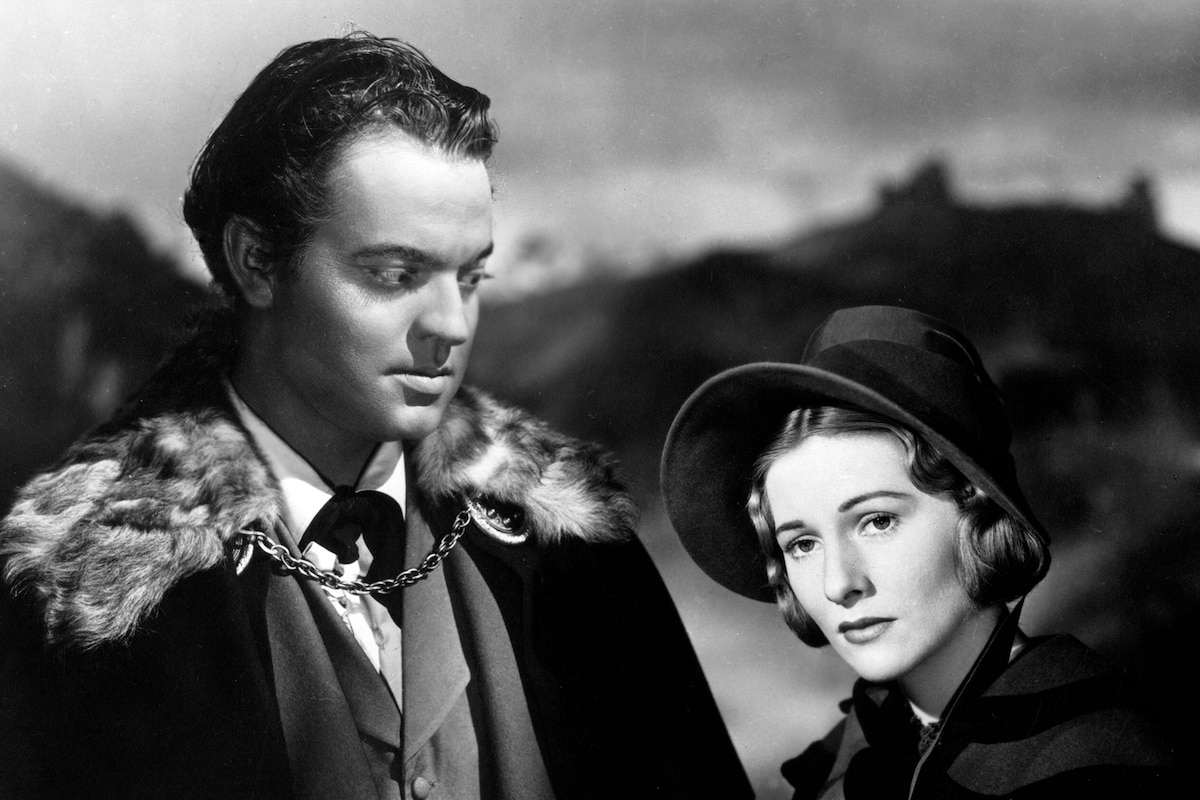
Jane Eyre has been the source of many film and TV adaptations over the years -- most recently, a 2011 version starring Mia Wasikowska -- but it's this 1944 edition that has best stood the test of time and is acknowledged as staying especially true to feel of Bronte's novel. (Note: Jane Eyre was released in England in late December 1943, but it was a 1944 U.S. release and bears a 1944 copyright in its on-screen credits, so it's officially considered a 1944 picture.) In the story, young Jane is raised in a foreboding school for impoverished girls after her parents die and her abusive aunt, Sarah Reed, kicks her out. After suffering for years at the hands of the malicious Mr. Brocklehurst, Jane finally departs the school a grown woman and takes a job at another sinister place: Thornfield Hall, where she works as governess to the young adopted daughter of Edward Rochester (Orson Welles), a mysterious, brooding, harsh and unpredictable figure who comes and goes erratically. Thornfield is a place of strange goings-on, with odd noises and an attic that is off limits and seems to be imprisoning someone. Jane and Rochester begin a relationship that moves into friendship and more, yet seems defined by undercurrents of repressed passions and deep secrets.
It's a real testament to the screenplay by Robert Stevenson, John Houseman and Aldous Huxley that their 96-minute film is able to fully keep the qualities that make Bronte's novel such a classic, even if the film does wrap things up a bit too quickly. Stevenson also directed the film, which has such a beautifully atmospheric look -- with deep-focus compositions, expressionistic black-and-white photography, and extravagantly gothic sets -- that it has often been attributed more to Orson Welles, who some assume exerted his own artistic influence onto a weak-willed Stevenson. But according to scholars who have actually studied the two men and this film, nothing could be further than the truth.
Several of the extra materials on this Blu-ray delve into this "controversy," including Julie Kirgo's superb liner notes, which inform viewers that the chain of influence among artists was much more complex than meets the eye. Welles had done his own radio adaptation of Jane Eyre in 1940, and several of his Mercury Theatre collaborators were involved in the 1944 film -- Agnes Moorhead, John Houseman and Bernard Herrmann among them -- but Stevenson and his cinematographer, the great George Barnes, were talented artists in their own right. Welles' cameraman on Citizen Kane (1941), Gregg Toland, had previously assisted Barnes and thought of him as a mentor. As Kirgo writes: "the question is begged: who was influencing whom? And does Eyre look Wellesian or, perhaps more accurately, does Kane look Barnesian?"
It's also said, understandably, that Jane Eyre is very reminiscent in look and narrative of the film Rebecca, which also starred Fontaine, but in fact, Rebecca author Daphne Du Maurier had been inspired in writing her 1938 novel by Bronte's Jane Eyre, published 91 years earlier. Nonetheless, producer David O. Selznick, who developed the Jane Eyre movie, sold it as a package -- talent included -- to Fox, because he ultimately decided it was too similar to Rebecca, which he had also produced.
Jane Eyre features a dazzling roster of supporting players, starting with a trifecta of remarkable child performances. Peggy Ann Garner is brilliant as a young Jane, in a performance that feels of a piece with Fontaine's turn as the grown Jane, and Margaret O'Brien and an uncredited Elizabeth Taylor are every bit Garner's equal. Taylor is all of 11 here, and already luminously beautiful in a touching performance. She would shoot to stardom one year later in National Velvet (1944), and O'Brien and Garner would be honored with special Academy Awards in 1944 and 1945, respectively. Also in the cast: Agnes Moorhead as Jane's cruel aunt Sarah Reed, Henry Daniell as the autocratic Mr. Brocklehurst, Sara Allgood as the loving maid Bessie, Hillary Brooke as the socialite and romantic rival Blanche, and John Sutton as the kindly Dr. Rivers.
The DVD and Blu-ray market for classic films has altered dramatically in recent years, with the major studios shifting more to made-on-demand DVD-Rs. The distributor Twilight Time, however, has developed a business model of releasing limited-edition Blu-rays of select Fox (and other) classic titles, and has become a gold standard for movie fans, up there with distributors like Criterion, Kino and Cohen. Twilight Time's Jane Eyre is a good case in point. The film was originally released onto standard DVD by Fox Home Entertainment in 2007, and Twilight Time has retained all the original, generous extras for this high-definition version, which looks and sounds excellent, and is limited to just 3000 copies.
Among the extras: an isolated score track so that one of Bernard Herrmann's finest scores can be appreciated in its glory; fine liner notes by Julie Kirgo; the original theatrical trailer; the 19-minute featurette "Locked in the Tower: The Men Behind Jane Eyre," about Stevenson's and Welles's involvement with the film; the 45-minute propaganda film Know Your Ally Britain (1944) which was also directed by Robert Stevenson and stands as a fascinating, very well executed documentary narrated by Walter Huston and produced by Frank Capra, designed to educate Americans about the history and culture of their wartime British ally; two insightful commentary tracks, one with film historian Joseph McBride and actress Margaret O'Brien, and the other with film historian Julie Kirgo, Herrmann biographer Steven C. Smith, and historian Nick Redman -- who, with Brian Jamieson, formed the Twilight Time distribution label.
By Jeremy Arnold
Jane Eyre on Blu-ray
by Jeremy Arnold | January 08, 2014
SIGN UP FOR OUR NEWSLETTERS

CONNECT WITH TCM