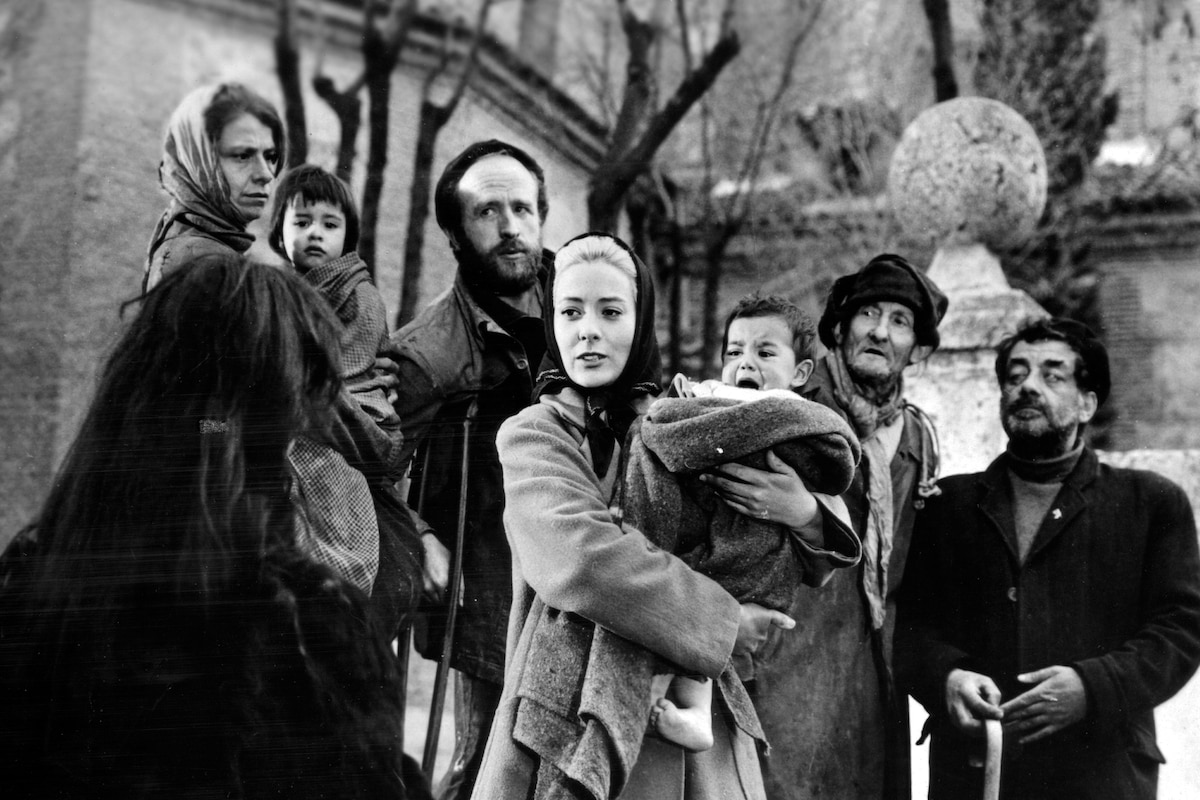
Deriving its title and main character's name from a minor Catholic saint (as well as the Latin term for "a green place"), Viridiana, Luis Bunuel's notorious 1961 critique of absolute religious charity, is the most blatant and outrageous of his Catholic studies including the earlier Nazarin (1959) and the later Simon of the Desert (1965). Here young novice Viridiana (Silvia Pinal) agrees to temporarily leave her convent and stay with her uncle, Don Jaime (Fernando Rey), a man whose debauched reputation is contradicted by his polite and formal treatment of her. However, he harbors secret desires to initiate Viridiana into womanhood due to her uncanny resemblance to his dead wife, whose wedding dress he coerces her into wearing during a sequence bordering on necrophilia. After an ironic twist of fate, Viridiana inherits his estate along with another relative, the jaded realist Jorge (Francisco Rabal), who barely tolerates her constant attempts to follow the teachings of the church by opening their home to vagrants on the condition that they work for their shelter.
After making films throughout Europe and in Mexico for twenty-five years, Bunuel was invited by Spain's dictatorial government under Francisco Franco to return home, a gesture to reclaim the country's most famous filmmaker. Though he was obliged to deliver a product acceptable to the country's censors, Bunuel instead created Viridiana, a deliberate affront to the country's political and religious standing which was first sent out to France to compete in the Cannes Film Festival. After winning the Palme d'Or, the film was banned outright in Spain and Italy by the incensed Franco regime and the Catholic Church ¿ primarily due to the infamous climactic sequence in which a group of beggars obscenely reenact Leonardo da Vinci's "The Last Supper." For a year the film was only screened at covert locations in France but, after being recognized as a Mexican production rather than Spanish (its Cannes triumph for that country notwithstanding), Viridiana opened to acclaim and outrage around the world.
The film also marked the first fully-fledged study of female objectification in the director's career, a pathology first hinted at with his masterpiece The Criminal Life of Archibaldo de la Cruz (1955) and subsequently revisited with overwhelming results in the even more fetishistic Belle de Jour (1967), Tristana (1970), and That Obscure Object of Desire (1977). As with many significant male directors, Bunuel was quite open about his own compulsions and, with Viridiana, managed to integrate a fantasy of his own ¿ namely, according to many interviews and even his own autobiography, a recurring erotic dream about making love to the drugged Queen of Spain.
Given its outrageous content, Viridiana's screenplay surprisingly managed to escape relatively unscathed through the censor board (who had no idea how the final banquet would actually play out on film); the only mandated change was to the original ending, which finds the virtuous heroine finally submitting and entering Jorge's bedroom, implying a sexual relationship. Though it now only seems to involve a simple game of cards, Bunuel's revised ending turns out to be even more perverse in its implications, a cheeky bit of innuendo almost as startling as the final shot in North by Northwest (1959). Somehow the near-rape of Viridiana managed to pass without comment, though the shooting of the sequence proved harrowing for the lead actress ¿ albeit not for the reasons one might expect. Most of the beggars were cast with professional theatrical actors, but according to the director in Objects of Desire, the role of the leper was played by a real beggar, Juan Garcia Tiendra, whose body odor greatly affected Pinal's performance. "The poor man had relieved himself in his pants," Bunuel recalls; Tiendra was taken to the hospital and prevented from drinking, finally to return for shooting and to go on to a short-lived career as a movie extra before his death.
Despite the film's controversy, all of the lead performers went on to illustrious careers in Spain and abroad. Along with numerous future appearances in Bunuel's films all the way to the director's final film, That Obscure Object of Desire, Fernando Rey became a familiar face in international cinema with appearances in projects as diverse as The French Connection (1971), The Hit (1984) and Moon over Parador (1988) before his death in 1994. Pinal continues to work steadily in Mexican cinema and television and has appeared in such films as Guns for San Sebastian (1968), Bunuel's The Exterminating Angel (1962), and Samuel Fuller's Shark! (1969), while Rabal remained in his home country of Spain and enjoyed a long career with such films as William Friedkin's Sorcerer (1977), Michelangelo Antonioni's L'eclisse (1962), and a number of cult horror films including The Tempter (1975), 1980's Nightmare City, and Stuart Gordon's Dagon (2001), before his death in 2001. Margarita Lozano, the virtually unknown Spanish actress who was cast as Jorge's mistress and companion Ramona, also remains active and later won a number of prominent roles in such prestigious projects as Jean de Florette (1986), Pier Paolo Pasolini's Porcile (1969), and Night of the Shooting Stars (1982).
As for Bunuel, his return to Spain and prompt expulsion from his homeland again had little effect on his career. The following year he released another masterpiece, The Exterminating Angel, and completed eight more well-received films before his death in 1983 ¿ each of them full of the vigor, insight, and irrepressible humor which have made him one of international cinema's most provocative film personalities.
Producer: Gustavo Alatriste, Ricardo Munoz Suay, Pere Portabella
Director: Luis Bunuel
Screenplay: Julio Alejandro, Luis Bunuel, Benito Perez Galdos (novel)
Cinematography: Jose F. Aguayo
Film Editing: Pedro del Rey
Art Direction: Francisco Canet
Music: Gustavo Pittaluga
Cast: Silvia Pinal (Viridiana), Francisco Rabal (Jorge), Fernando Rey (Don Jamie), Jose Calvo (Beggar), Margarita Lozano (Ramona), Jose Manuel Martin (Beggar).
BW-90m.
by Nathaniel Thompson
Viridiana
by Nathaniel Thompson | April 20, 2005
SIGN UP FOR OUR NEWSLETTERS

CONNECT WITH TCM