Synopsis: In 1860s Macao, Mr. Clay, an aging, wealthy merchant,
inhabits a villa previously owned by a business partner and rival whom he bankrupted
and drove to suicide. Unable to sleep, he asks his clerk Elishama Levinsky, a Polish
Jew who fled the pogroms as a child, to read to him at night. Elishama reads from
the prophecies of Isaiah but Mr. Clay objects, saying that he wants to hear stories
that actually happened to people. Mr. Clay himself relates the story of a sailor
who was paid five guineas by a wealthy man to sleep with his wife. When Elishama
says that the story is in fact a commonplace legend, Mr. Clay arbitrarily resolves
to make the story come true whatever the cost and asks Elishama to hire a sailor
and a prostitute to act out the roles.
The Immortal Story, Orson Welles' second-to-last completed feature,
is an adaptation of the story of the same name from the revered Danish author Isak
Dinesen's 1958 collection Anecdotes of Destiny. Welles' screenplay
is largely faithful to Dinesen's story, though the location has been changed from
Canton to Macao. Originally, the film was to have been just one episode in an anthology
of Dinesen stories filmed on location in Budapest; however, the initial financial
backing fell through--the sort of thing that plagued Welles throughout his post-Citizen
Kane (1941) career--and Welles was forced to flee Budapest without even money
to cover his hotel tab. The French television company ORTF later agreed to produce
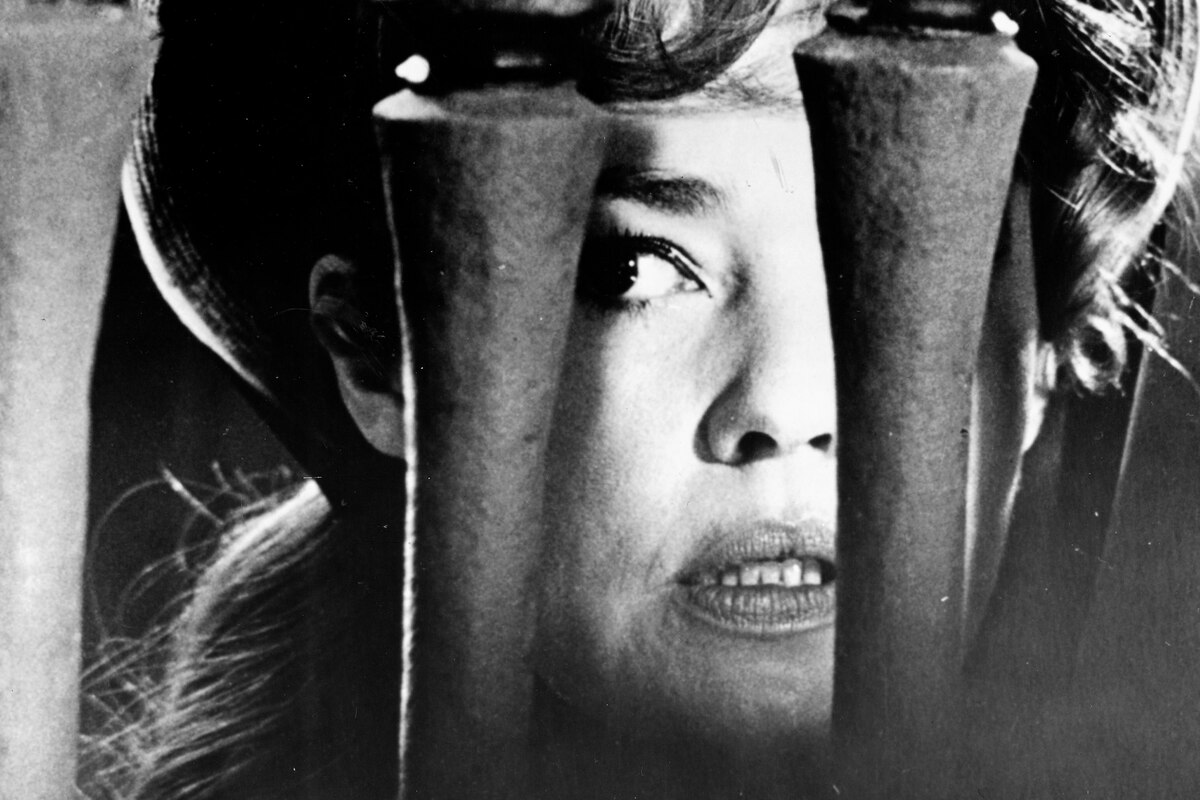
the hour-long film for French TV since Jeanne Moreau played the role of Virginie,
in what is easily the standout performance in the film. Welles' film was then released
theatrically in other countries after its initial French broadcast.
Isak Dinesen is the pseudonym of Karen Blixen (1885-1962). In 1914, Dinesen married
her cousin, Baron Bror Frederik von Blixen-Finecke; the two moved to Kenya and ran a coffee plantation.
Although the couple divorced in 1921, Dinesen stayed on at the plantation for another
ten years before returning to Denmark. She later wrote about her experiences in
the 1937 book Out of Africa, an enduring classic in the memoir
genre. Dinesen typically wrote parallel English and Danish versions of her work,
and thus should be considered as belonging to both English-language and Danish literatures.
Welles' film was the first feature-length adaptation of Dinesen's work; subsequent
adaptations include the little-known 1982 Italian adaptation of Ehrengard,
the phenomenally popular, Academy Award winning Out of Africa
(1985), and the well-regarded Danish/French co-production Babette's Feast
(1987); the latter is based on another story from the collection Anecdotes
of Destiny.
Although filmed in color, the visual style of The Immortal Story,
with its deep-focus cinematography and striking play between foreground and background,
is recognizably Wellesian. Some critics have also seen a deliberate commentary on
Welles the director in the figure of Mr. Clay; however, in the book-length collection
of interviews conducted by Peter Bogdanovich, Welles flatly denied any such allegorical
subtext, protesting that his aim was simply to adapt Dinesen's story.
The cinematographer Willy Kurant first worked with Jean-Luc Godard on Masculin,
Feminin (1966) and has since alternated between projects for French directors,
among them Agnes Varda, Alain Robbe-Grillet and Maurice Pialat, and miscellaneous
American TV movies and independent films. His most recent credit is the blaxploitation
spoof Pootie Tang (2001). The scriptwriter, Louise de Vilmorin,
is best known for writing the novel on which Max Ophuls' masterpiece Madame
de... (1953) is based; she also wrote the screenplay for Louis Malle's
controversial The Lovers (1958). The soundtrack for The
Immortal Story employs the delicately textured, pensive solo piano music
of Erik Satie.
The Immortal Story was released in the US in 1969 as part of
a double-bill with another medium-length work, Bunuel's Simon of the Desert
(1965). Like so many of Welles' later films, it polarized the critics. Penelope
Gilliatt of The New Yorker praised the film for capturing the
flavor of Dinesen's prose, adding that "[t]he film is composed with the formal
poignancy that Welles commands as no one else in the world can." Raymond A.
Sokolov of Newsweek called the film "a virtuoso exploration
of what can be done--and so seldom is--with color in the movies." Stanley Kauffmann
of The New Republic characterized it as "another step in
the descent of Orson Welles," arguing that its direction "shows the marks
of TV drama of the fifties." He also complained that Welles wore "his
phoniest makeup since Mr. Arkadin [1955]" Renata Adler of The
New York Times called the film "surprisingly ineffective in a feeble
way," criticizing the acting in particular, though she did single out Jeanne
Moreau's performance for praise. On the whole, Welles scholars have since tended
to regard the film sympathetically. Joseph McBride compares its spare textures and
"clear-eyed simplicity" to the late works of John Ford, Howard Hawks and
Carl Dreyer. Recognizing its technical limitations, James Naremore nonetheless considers
it a work of "modest but real virtue" as a television film. Welles biographer
David Thomson calls it a "small, great picture."
Producer: Micheline Rozan
Director: Orson Welles
Screenplay: Orson Welles and Louise de Vilmorin
Photography: Willy Kurant
Art Direction: Andre Piltant
Editing: Yolande Maurette, Marcelle Pluet, Francoise Garnault and Claude Farny
Costumes: Pierre Cardin
Cast: Orson Welles (Mr. Clay), Jeanne Moreau (Virginie Ducrot), Roger Coggio (Elishama
Levinsky), Norman Eshley (Paul), Fernando Rey (Merchant).
C-58m.
by James Steffen
The Immortal Story
by James Steffen | April 19, 2005
SIGN UP FOR OUR NEWSLETTERS

CONNECT WITH TCM