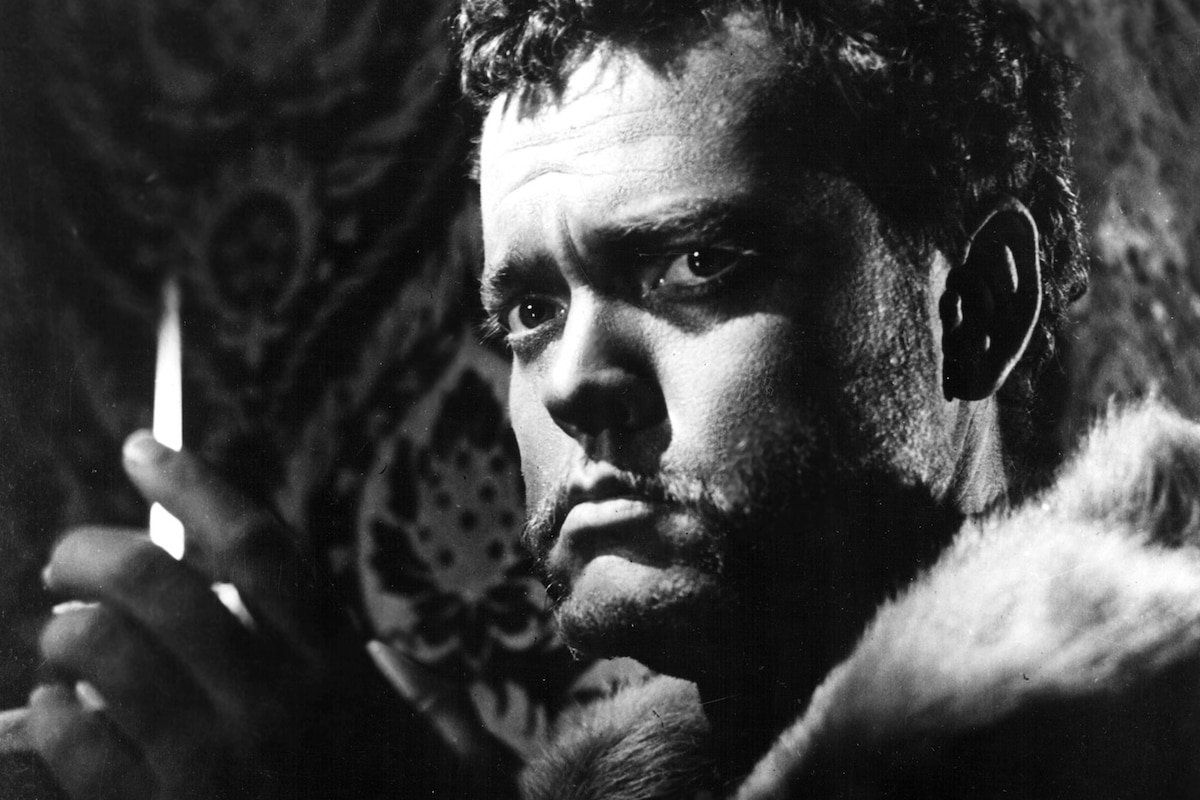
Almost four years passed between the premiere of Orson Welles' first adaptation of Shakespeare for the screen, Macbeth (1948) and the premiere of his second, Othello (1952). It was originally intended for release a year after Macbeth but the delay the film suffered made for one of the strangest stories in the history of moviemaking.
Before he was even finished editing Macbeth, Welles had left America for Europe, having received a job offer to direct a movie of Cyrano de Bergerac for producer Alexander Korda. When that project collapsed, Welles became a roving actor on the many productions that sprang up on the Continent in the years after World War II. His appearance in The Third Man (1949) would be his most famous, but the one that got Othello started was when he played the hypnotist Cagliostro in Black Magic (1949). The movie was shot in Rome at Scalera Film Studios and, with his usual charm, Welles managed to talk the studio's owner, Mr. Scalera, into backing a quicky production of Othello to be shot in Morocco.
With Black Magic finished, Welles gathered a cast, crew and a detailed screenplay and brought them all to the town of Mogador on the coast of Morocco. And there they waited for the costumes to arrive. As Welles later recounted, "..we got a telegram saying the costumes wouldn't come because they hadn't been completed. A day later, a telegram came saying they hadn't been started. And then a telegram came saying that Scalera had gone bankrupt. So I had a company of fifty people in North Africa and no money."
Usually everyone would have just gone home. Instead Welles emptied out his own bank account and started rolling, improvising costumes and sets. When he finally ran out of funds, he dismissed the cast and crew and took roles in other movies to raise money, then reunited the cast and crew to shoot more footage until the money ran out again. "Three different times I had to close it and go away and earn money and come back, which meant you'd see me looking off-camera left, and when you'd cut over my shoulder, it would be another continent - a year later."
This process went on until the summer of 1951, three years after he'd begun filming. But the trouble was not over yet. The soundtrack was in rough shape and the lack of money for post-production led to a pieced-together soundtrack that was often indistinct. The movie shared the grand prize at the 1952 Cannes Film Festival, but in the United States the movie received mixed reviews, with many critics pointing out the poor audio quality.
Four years after Welles' death in 1985, his daughter Beatrice instigated a restoration project for her father's movie, a project made much easier when the negative and sound elements were discovered in a New Jersey warehouse. Once again four years were spent on Othello, this time just for the restoration. Computers were used to remove film blotches, dialogue was meticulously re-synced to the actors' lips and the musical score was re-recorded with modern sound equipment. The result was released in 1992 to great acclaim, hailed as one of the best adaptations of Shakespeare for the screen. It took forty-four years to do it, but Welles' movie that couldn't be made was finally complete with the power and beauty he had always intended.
Director: Orson Welles
Writers: William Shakespeare adapted by Orson Welles, Jean Sacha
Producer: Orson Welles
Cinematographers: Anchise Brizzi, G. R. Aldo, George Fanto, O. Troiani, R. Fusi
Editors: John Shepridge, Jean Sacha, Renzo Lucidi, William Morton
Music: Angelo Francesco Lavagnino, Alberto Barberis
Cast: Orson Welles (Othello), Michael MacLiammoir (Iago), Suzanne Cloutier (Desdemona), Robert Coote (Roderigo), Michael Laurence (Cassio), Fay Compton (Emilia).
BW-93m.
by Brian Cady
Othello (1952)
by Brian Cady | April 19, 2005
SIGN UP FOR OUR NEWSLETTERS

CONNECT WITH TCM