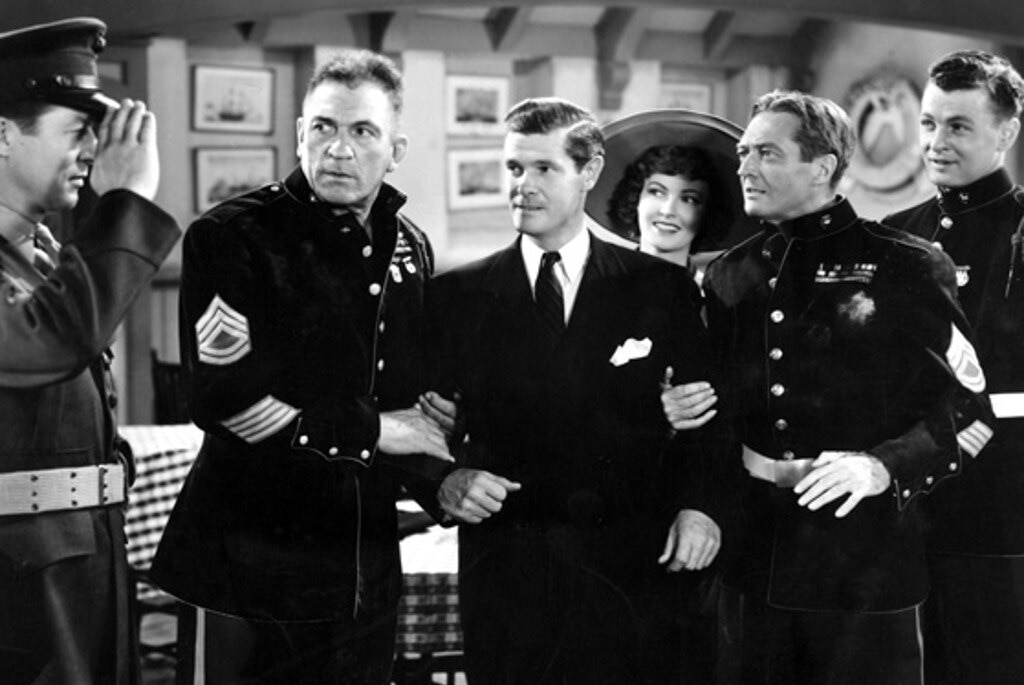
Although they'd never be confused with James Cagney and Pat O'Brien who made nine films together, Victor McLaglen and Edmund Lowe were, for a time, a popular screen team. They made a big hit in their first film together, Raoul Walsh's What Price Glory (1926), playing a couple of rough-and-tumble romantic rivals named Flagg and Quirt, who find themselves embroiled in World War I while competing for the charms of a lovely French girl (Dolores del Rio). The two appeared as those characters in three more movies, and as close versions of the same, albeit with different names, in half a dozen others through 1935. At the outbreak of World War II, producer Howard Benedict must have thought it would be a good idea to reteam the boys, so here they are again, this time under the names McGinnis and Curtis in Call Out the Marines (1942).
Despite the title and its wartime setting, Call Out the Marines is actually an espionage comedy with songs and less of a war movie; it features two Marine sergeants who become involved with a dockside Mata Hari. She's played by British actress Binnie Barnes, who made her first big mark on screen as Katherine Howard, the fifth wife of Charles Laughton's Henry the Eighth and the second to lose her head, in The Private Life of Henry VIII (1933). She was brought to Hollywood the following year, where for the next decade she made a career out of playing major supporting roles, among them was her role as real-life turn-of-the-century icon Lillian Russell to Edward Arnold's Jim Brady in Diamond Jim (1935). Barnes, who two years before this picture married football star and later producer Mike Frankovich, had no grand illusions about her screen career and once said, "I'm no Sarah Bernhardt. One picture is just like another to me as long as I don't have to be a sweet woman."
Call Out the Marines is further enlivened by the inclusion of several songs by Mort Greene and Harry Revel, who this same year composed the Oscar®-nominated song "There's a Breeze on Lake Louise" from the movie The Mayor of 44th Street (1942). There are no such accolades for the songs here, and titles like "Zana Zaranda" and "Hands Across the Border"
have hardly passed into the classic repertoire. But Greene, at least, achieved a certain level of immortality with his composition of the theme song for the TV series Leave It to Beaver.
Call Out the Marines was enough of a hit to lead the producing studio, RKO, to consider starting a new series with the two male leads, but it never happened. However, 14 years later Lowe and Oscar®-winner McLaglen (The Informer, 1935) renewed their act for a bit in the international hit Around the World in 80 Days (1956).
Director: Frank Ryan
Producer: Howard Benedict
Screenplay: William Hamilton, Frank Ryan
Cinematography: J. Roy Hunt, Nicholas Musuraca
Editing: Theron Warth
Art Direction: Carroll Clark, Albert S. D'Agostino
Original Music: Mort Greene, Harry Revel
Cast: Victor McLaglen (Jimmy McGinnis), Edmund Lowe (Harry Curtis), Binnie Barnes (Violet Hall), Paul Kelly (Jim Blake), Franklin Pangborn (Wilbur).
BW-68m.
by Rob Nixon
Call Out the Marines
by Rob Nixon | April 19, 2005
SIGN UP FOR OUR NEWSLETTERS

CONNECT WITH TCM