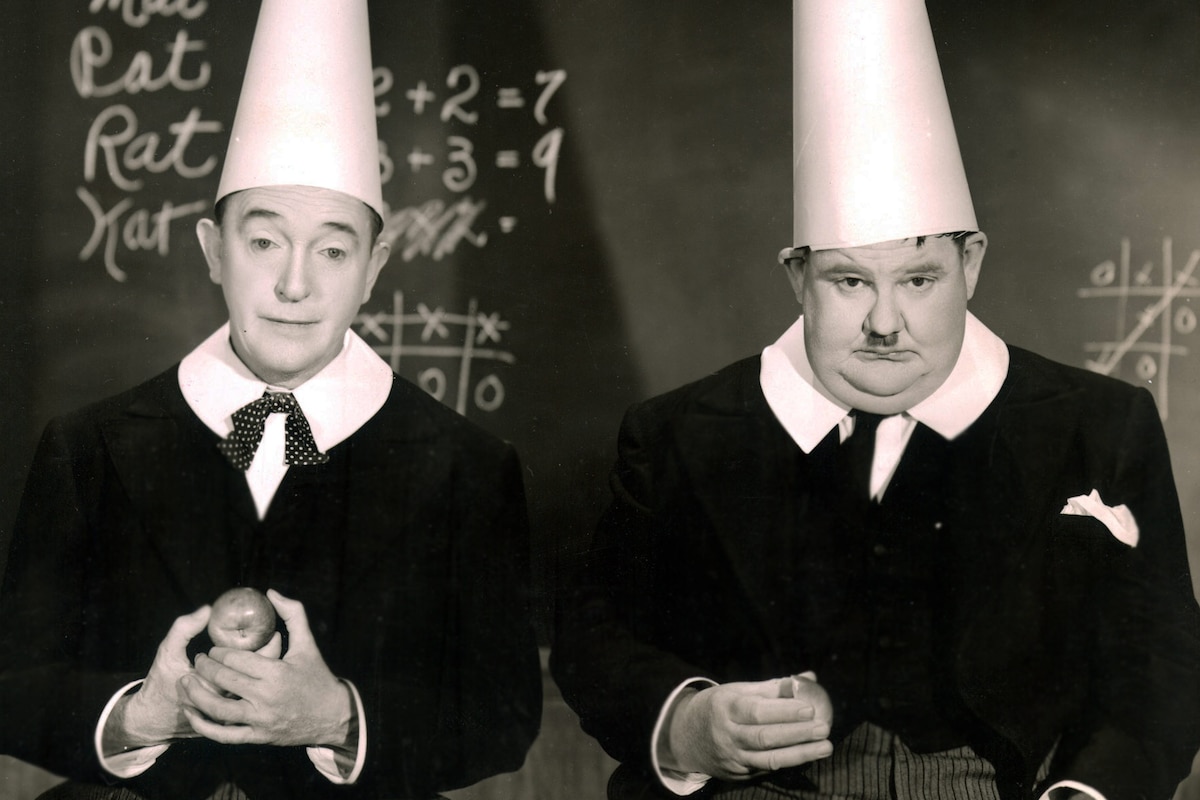
In 1940, the comedy team of Stan Laurel and Oliver Hardy went to school. Not because they needed an education, but because the ivory towers of higher learning were still virgin territory for the boys. Their contemporaries had already poked fun at academia years before they did. Buster Keaton did it in College (1927) and Harold Lloyd lettered as The Freshman in 1925. The Marx Brothers created chaos on campus in Horse Feathers (1932). But Stan and Ollie finally made it to college in A Chump at Oxford (1940). The title, by the way, is a playful take on a Robert Taylor vehicle, A Yank at Oxford (1938), which was released just two years prior to A Chump at Oxford.
The crack writing trio of Charles Rogers, Felix Adler and Harry Langdon (a former silent comedian himself) wrote the screenplay. They also penned Block-Heads (1938) and Saps at Sea (1940) for the boys. This story finds Stan and Ollie being sent to college, all expenses paid, by a grateful bank president whose bank would have been robbed if it hadn't been for the duo's fortuitous bumbling. So off they go to England's Oxford University. Arriving dressed in their Eton togs, the boys are hazed mercilessly by a group of students, among them a very young Peter Cushing. Although the film rehashes some of Stan and Ollie's older routines, it also adds a new twist: the Dean of the College insists that Stan is actually Lord Paddington, a student who years ago lost his memory and wandered off. "The greatest athlete and greatest scholar this university ever boasted of...what a brilliant mind!" Ollie is amused and incredulous, obviously. "I've known him for years and he's the dumbest guy I've ever known, aren't you?" "I certainly am," Stan dutifully replies. But later, when Stan leans out a window - the same one that Lord Paddington hit his noggin on - the window slams down on Stan's head and he suddenly becomes the brilliant former student.
In the role of his alter ego Lord Paddington, Stan demonstrates what an accomplished actor he really was. With his natural British accent and a solid contemptuous air, Stan runs roughshod over all the students (including the ones that were bullying him earlier) and most interestingly, Ollie himself. Once Lord Paddington takes over, the dynamic between Laurel & Hardy changes drastically. No more is Stan the docile, dumb one, and no longer is Ollie the one who claims intellectual superiority. It is now Ollie who is subjected to verbal abuse as he assumes the role of Stan's valet. He tells the Dean, "Pardon my valet being so horribly stupid." "Why do you tolerate him?" "Oh, he's got a jolly old face, you know - breaks the monotony - and besides, he helps to fill up the room." Off screen Stan Laurel was actually closer to Lord Paddington than he was to the sweet simpletons he played. And he was the true brains behind "Laurel & Hardy," working on their productions at every stage while Ollie mainly acted. Of course, Stan wasn't contemptuous of his co-star as Lord Paddington was of Ollie. The long-time partners got along famously for the 30 or more years they were together.
A Chump at Oxford was supposed to be only four reels long (approximately 40 minutes), but when the film wowed preview audiences, Hal Roach added an extra two-reel segment to the beginning to stretch it into a 63-minute full-length feature. This was the penultimate film Laurel & Hardy made with Roach, the man responsible for bringing the two comedians together and creating a household name. After completing Saps at Sea, Stan and Ollie left Roach in the name of artistic freedom, a decision that didn't go quite as well as planned for the independent duo. Their success without Roach was mixed at best.
Producer: Hal Roach
Director: Alfred Goulding
Screenplay: Charley Rogers, Felix Adler, Harry Langdon
Cinematography: Art Lloyd
Film Editing: Bert Jordan
Art Direction: Charles D. Hall
Music: Marvin Hatley
Cast: Stan Laurel (Stan/Lord Paddington), Oliver (Ollie), Wilfred Lucas (Dean Williams), Forbes Murray (Banker), Frank Baker (Dean's servant), Eddie Borden (Student ghost).
BW-63m.
by Scott McGee
A Chump at Oxford
by Scott McGee | March 24, 2005
SIGN UP FOR OUR NEWSLETTERS

CONNECT WITH TCM