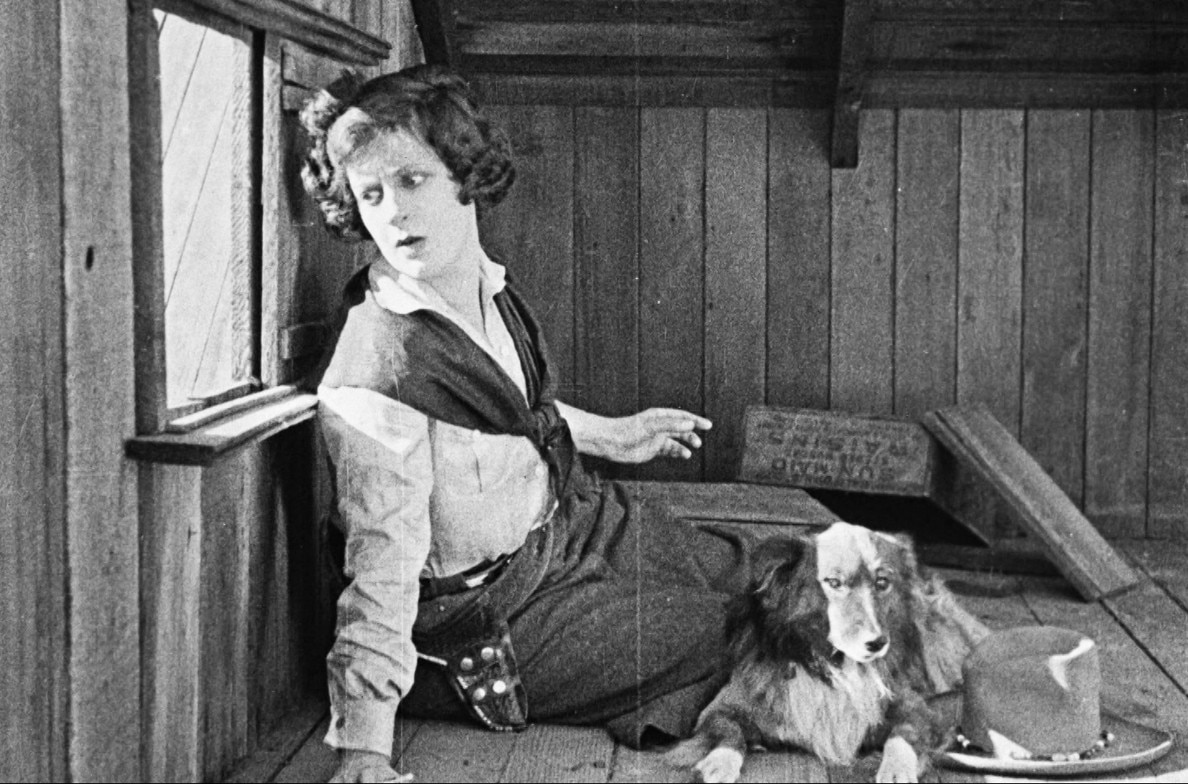
In case you thought product placement in movies began only recently, Something New (1920) should change your mind. This feature film touting the abilities of Maxwell Motors' new passenger car and its uncanny abilities to cover rough terrain was made by a young woman filmmaker as a way of starting and paying for her own studio. Her story is another in the nearly lost story of women moviemakers at the beginning of the twentieth century.
Nell Shipman, born Helen Barham in 1892, was raised on the west coast of Canada in Victoria, British Columbia. Something about middle-class life there didn't appeal to her and so, despite the fears of her parents, Nell ran off to join a vaudeville troupe at the age of fourteen. Four years later she went to work for the George Baker stock company where she met her first husband Ernest Shipman, the company's thirty-nine year old manager. They married the next year and had a son the year after that.
Nell's pregnancy and the raising of her young son kept her off the stage, putting the family, recently moved to Southern California, in need of money. Ernest borrowed money from a friend and made a movie based on a script by his wife. Writing appealed to the young mother and soon she was peddling scripts around Hollywood. Success led to a deal with Universal for the 22-year old to write, direct and star in three-reelers. There she found a niche, the wilderness movie, where the plucky Canadian would be trapped in a remote location by some crude, threatening character, only to be rescued by a hero and make a harrowing escape. God's Country and the Woman (1916) was her first big hit topped spectacularly by Back to God's Country (1919) that featured not only unspoiled vistas and wild animals (tamed and kept in a menagerie by Nell) but a nude bathing scene. The combination of bare skin and danger made the movie a hit and gave Nell the financial clout she needed to continue making her own films.
In 1920 Nell declared her independence in more ways than one, setting up her own production company and divorcing her husband. Something New was her first production combining all the elements of her previous successful films (minus the nudity) - Nell placed in jeopardy, scenes shot in the Mojave Desert, a hero riding to the rescue (her co-writer/director Bert Van Tuyle) and a trained dog to raise the alarm. What harm would a little cross-plug for the Maxwell auto do? Unfortunately, reviewers of the time took offense at what they perceived to be an hour-long commercial.
Shipman's studio was closed down in the mid 1920's. Ultimately she was too independent for the times. The studios wanted more of their productions made in Los Angeles, not out in remote locations where studio heads could not keep an eye on budgets. Shipman continued writing for the studios into the 1930's, then retired to a ranch to care for the wild animals she had tamed for her films. She died in 1970 leaving behind an autobiography that, along with a growing interest in early women filmmakers, led to revivals of her surviving films. Something New, then just considered another western action movie, now stands as a testament to a woman who, like the Maxwell car in the film, climbed over every obstacle in her way.
Writers/Directors: Nell Shipman, Bert Van Tuyle
Producer: Nell Shipman
Cinematographer: Joseph Walker
Cast: Nell Shipman (a writer), Bert Van Tuyle (Bill Baxter), L.M. Wells (Sid Bickley), Merrill McCormick (The Bandit)
BW-58.
by Brian Cady
Something New
by Brian Cady | March 25, 2005
SIGN UP FOR OUR NEWSLETTERS

CONNECT WITH TCM