A kind of proto-pre-feminist morality play bubbling out of the MGM factory on the eve of WWII, Four Girls in White (1939) is a classic example of a very particular sociocultural micro-genre from the 1930s: the nurse melodrama. That early in the century, the vocation still had a pious glamour to it, having only been first codified by the Nightingale schools in the 1870s, and institutionalized as a cultural icon during WWI. A decade or more later, alongside the advent of talkies, professional, extensively trained nurse-staff was becoming infrastructurally de rigueur in the U.S., and seen in Hollywood as a heroic, self-sacrificial role that required an almost devout calling (the intercourse nursing still had with nunneries, from its articles of devotion to its headgear, remained prevalent), and which played an indispensable role in the security and health of society. It was a perfect fit for "women's film," which for the Industry in the '30s meant just movies that catered to half of the moviegoing population - a supply-demand dynamic that has inexplicably all but vanished in the last 40 years. (If the advent of television has been the culprit, why have women stayed home and not men?) Nursing in real life was exploding, too, providing a newly-educated female population with a fulfilling and necessary professional alternative to school marm and housewife.
This gives nursing dramas, running from perhaps Night Nurse (1931) to Vigil in the Night (1940), an anthropological weight, as "topical" movie trends tend to accrue years after their ripped-from-daily-life salience has dissipated. If this wasn't exactly "how it was," then it was certainly how Americans conceived and daydreamed about it, in its most basic essentials. With Four Girls in White, the practical and procedural aspects of the nurse's life are front and center: the modern nursing college we land in, alongside newbies Norma (Florence Rice), Gertie (Una Merkel), Patricia (Ann Rutherford) and Mary (Mary Howard), is strictly sleepaway - young mothers must leave their babies behind for months at a stretch - and run like a boot camp, where the sassy maidens are tirelessly trained in technique and relentlessly schooled in decorum and manner, less one of them ever besmirch their trade with an unprofessional demeanor or a mistake or a moment of unsureness.
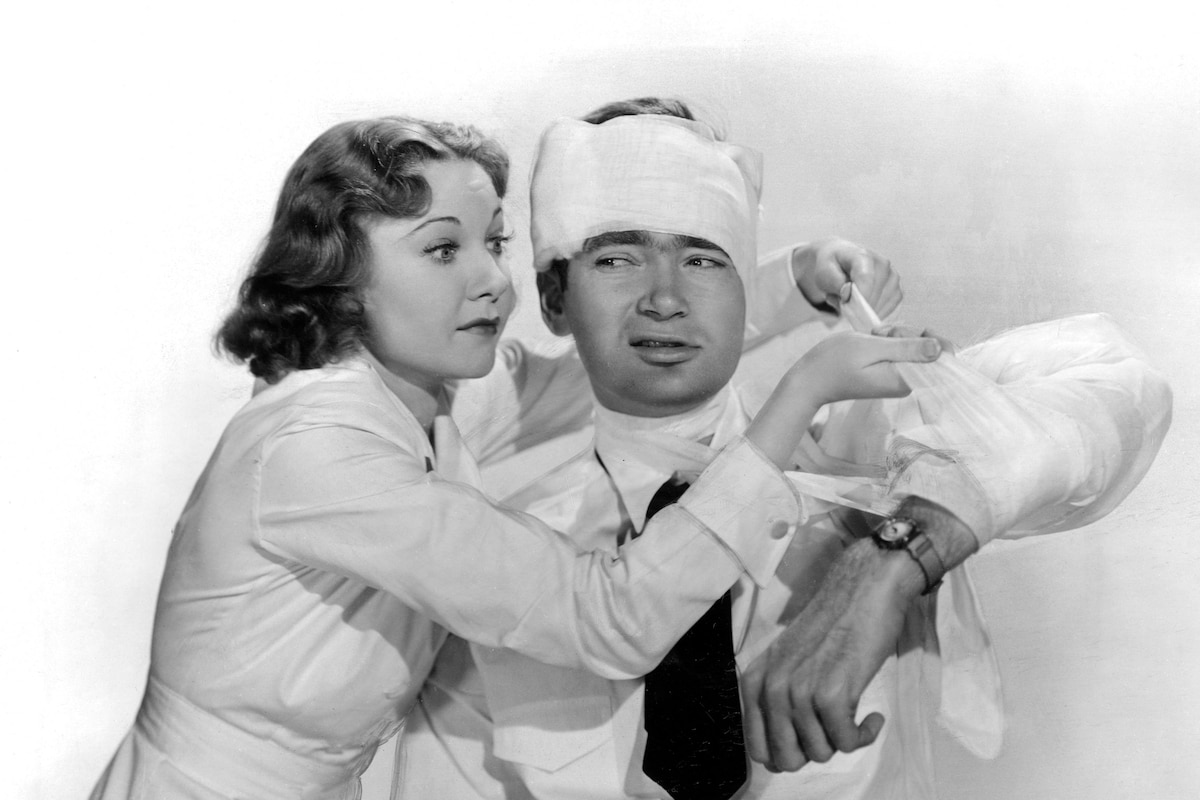
In fact, director S. Sylvan Simon's film seems to be 50% comprised of montages, collages of activity from perfecting hospital corners to assisting surgery, as if the movie itself was a kind of training film. It's certainly something of a medical-flag-waver, however much it eventually gets subsumed in melodramatic intrigue: Norma, we learn early, has come to nursing school only in order to meet and marry a doctor, and her machinations in this regard not only lead to her own disillusionment with dedicated doc Alan Marshal, but eventually a career disaster for Mary (who reluctantly tried to help Norma shirk her duties one night) and thereafter her suicide. Along the way Norma has to balance responsibilities for her little sister Patricia, and the fact that both at various points are in the tractor beam of a hypochondriac millionaire looking for a trophy wife. As comic-relief Gertie gets wooed by Buddy Ebsen's buffoonish male orderly, Rice's Norma eventually pays her penance, and becomes a genuine heroine in a rather alarming and elaborate trainwreck scenario.
The main subgenre motifs are all there, chief among them the conflicts that arise within the nursing sphere between pure-hearted career motivations and the intimacy with male patients and doctors - why work so hard when you can marry off? Nurses have been routinely portrayed as either sex toys or gold diggers, but in Four Girls the women's point of view is held fast, and the men are simply reactive to the protagonist's desires and learning curves. It's a woman's world, even as it boils along underneath the dominant sphere of patriarchy.
Rice herself, who retired just four years later, is a rather colorless heroine - rather Ann Harding-ish, as well as a touch Ellen DeGeneres-y but with no humor - and Four Girls otherwise suffers from a lack of serious star power. Merkel and crotchety head nurse Jessie Ralph try their best, but the small army of bland non-star actresses and look-alike male leads all meld together in the memory. The milieu's ideological force and structure is the main character here; the white-on-white teaching hospital seems to revolve much more around the staff than around the patients, who are rarely glimpsed, and the characters' moral crises, churning and doubling back all within 73 minutes, are manifestly paradigmatic, not specific. The nurses here are Everynurse, and their choices and problems were every woman's during the Depression.
The big difference, and the film's ethnographic raison d'etre, resides in the bumps and shoals of nursing itself, which was still an almost exotic professional lifestyle that tantalizingly for many American women held real life-and-death power in its hands and yet stood outside the mainstream of domestic life, where a woman's daily agenda revolved around her husband. Co-written by RKO genre scripter Dorothy Yost, veteran of no less than five Fred Astaire-Ginger Rogers musicals, Four Girls in White is a B movie in a subgenre that no longer exists, exploring a topic that has long since become passé, and made for a powerful female audience that has long ago ceased to participate meaningfully in the movie marketplace. You could think of it as an orphan to history, a piece of Americana without which any vestige of its cultural moment would vanish forever.
By Michael Atkinson
Four Girls in White
by Michael Atkinson | November 15, 2013
SIGN UP FOR OUR NEWSLETTERS

CONNECT WITH TCM