The late 1950s were a fascinating time for combat movies. The genre was by now firmly established, with its conventions of hero/group/objective and iconography of land, sea, and air situations, but the genre was also firmly evolving. Propaganda films were long gone, mere depictions of typical grunt life were not enough anymore, and all-star epic re-creations of famous battles were still several years away. It was a time that allowed major Hollywood filmmakers to create intimate, psychologically intense, deglamorized and subversive combat films. Robert Aldrich, for instance, made Attack! (1956), Anthony Mann made Men in War (1957), Don Siegel made Hell is For Heroes (1962), and Nicholas Ray made Bitter Victory (1957), which is now out on DVD courtesy of Sony Pictures Home Entertainment.
These films and others each take the genre's established conventions and in some way turn them upside down to make new points about the nature of military combat and the ways soldiers are affected by it. They are also each stamped with their director's strong style and personality. Bitter Victory is remarkably similar to Nicholas Ray's other great movies, such as In A Lonely Place (1950), On Dangerous Ground (1951), Johnny Guitar (1954) and Rebel Without a Cause (1955), even though those movies are film noir (the first two titles), western, and teen movie, respectively. What unites them are not plots or genres but psychological issues of vulnerability, confusion and paranoia, issues to which Ray was drawn. Of course, different genres made him find different ways of expressing those issues visually, which he excelled at doing.
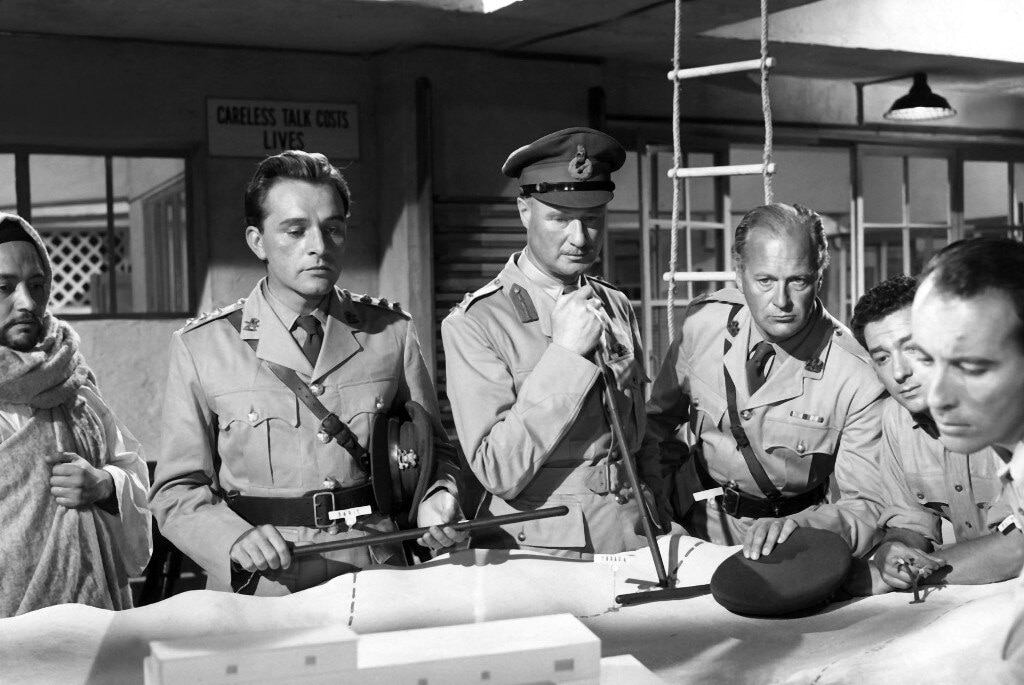
And so, Bitter Victory does have a hero (Richard Burton as Capt. Leith), a group (British commandos), and a military mission with an objective (to steal vital documents from behind Nazi lines in North Africa), but the movie's real concern is with the prickly relationship between Capt. Leith and Maj. Brand (Curt Jurgens). Brand is jealous of Leith's past relationship with Brand's wife Jane (Ruth Roman) and can plainly see before the mission starts that they still love each other. Brand's assignment as commander of the mission - and of Leith - thus creates strong tension, which is heightened by the fact that Leith is clearly the stronger leader of the two and commands the respect of the men. Brand, on the other hand, has been sitting behind a desk for 13 years and is in over his head. The combat that ensues is as interior and psychological as it is exterior and military, and that is what makes Bitter Victory such an unusual, rewarding experience.
Ray reminds us throughout that this is a different kind of war movie with different kinds of concerns. A long sequence before the mission begins, for example, explores the romantic relationships among the three main characters. Editing is often abrupt and bizarre, and some shots are held for strangely long lengths of time. Much less time is spent on showing the mechanics of the military mission than on probing the emotional conflict between Brand and Leith, and yet the elements of combat and warfare are constantly there in the frame, surrounding them. It all creates an unsettled, surreal quality which casts a strange spell indeed. Using a beautiful black-and-white CinemaScope frame, Ray's treatment of war is biting and cynical, never more so than in the final image of the picture. His visualizations overcome some shaky dialogue that occasionally hits the audience over the head with explanations that are already obvious from the images or situations.
Burton and Jurgens are superbly cast, with Burton perhaps never better than in this picture. A French-American co-production, Bitter Victory was hailed in France and named by Jean-Luc Godard as the best film of 1957. In the United States, it was chopped to 82 minutes and ignored. Sony's DVD features a quite decent widescreen transfer of the original 102-minute movie. Considering the film's importance, it's surprising that no extra material on the film or even significant liner notes are to be found. All Sony provides are trailers for Castle Keep (1969), From Here to Eternity (1953), and The Fog of War (2003).
For more information about Bitter Victory, visit Sony Pictures. To order Bitter Victory, go to
TCM Shopping.
by Jeremy Arnold
Nicholas Ray's Bitter Victory on DVD
by Jeremy Arnold | March 07, 2005
SIGN UP FOR OUR NEWSLETTERS

CONNECT WITH TCM