Tragedy and scandal led director Roman Polanski to Tess (1979), the film version of Thomas Hardy's 1891 novel Tess of the D'Urbervilles. In 1969, Polanski's pregnant wife Sharon Tate had given her husband a copy of the Hardy novel just before she left London to return to their California home. She thought it might be a film they could do together. Less than a month later, Tate was murdered. It took ten years for Polanski to finally make the film that he and Tate had envisioned as a joint project. Tess was his first film after fleeing the U.S. to avoid prison for having sex with a 13-year old girl. The final opening credit on Tess reads "for Sharon."
Tess Durbeyfield is a peasant living in "Wessex," Hardy's name for Dorset, the southwestern region of England where most of his novels are set. After a local minister tells Tess's father that they are the descendants of the noble D'Urbervilles, her parents send her to seek employment with the present-day D'Urbervilles, wealthy commoners who have purchased the title. Tess catches the eye of the family's dissolute son, Alec, who seduces her. Pregnant, she returns to her family. After her child dies, she works at a dairy farm, where she meets Angel Clare, an idealistic son of a clergyman who is learning to be a farmer. The two fall in love and marry, but when Tess confesses her past, her tragic descent begins.
Polanski was a French citizen, so after leaving the U.S. in early 1978 he settled in Paris. His longtime friend, French producer Claude Berri, was enthusiastic about making a film version of Tess of the D'Urbervilles and secured financing for the film. Location shooting took place in France, in Normandy and Brittany, not only because much of the landscape was still rural and resembled 19th century Britain more than modern Dorset did, but also because Polanski was afraid to work in Britain, which had an extradition agreement with the United States, and France did not.
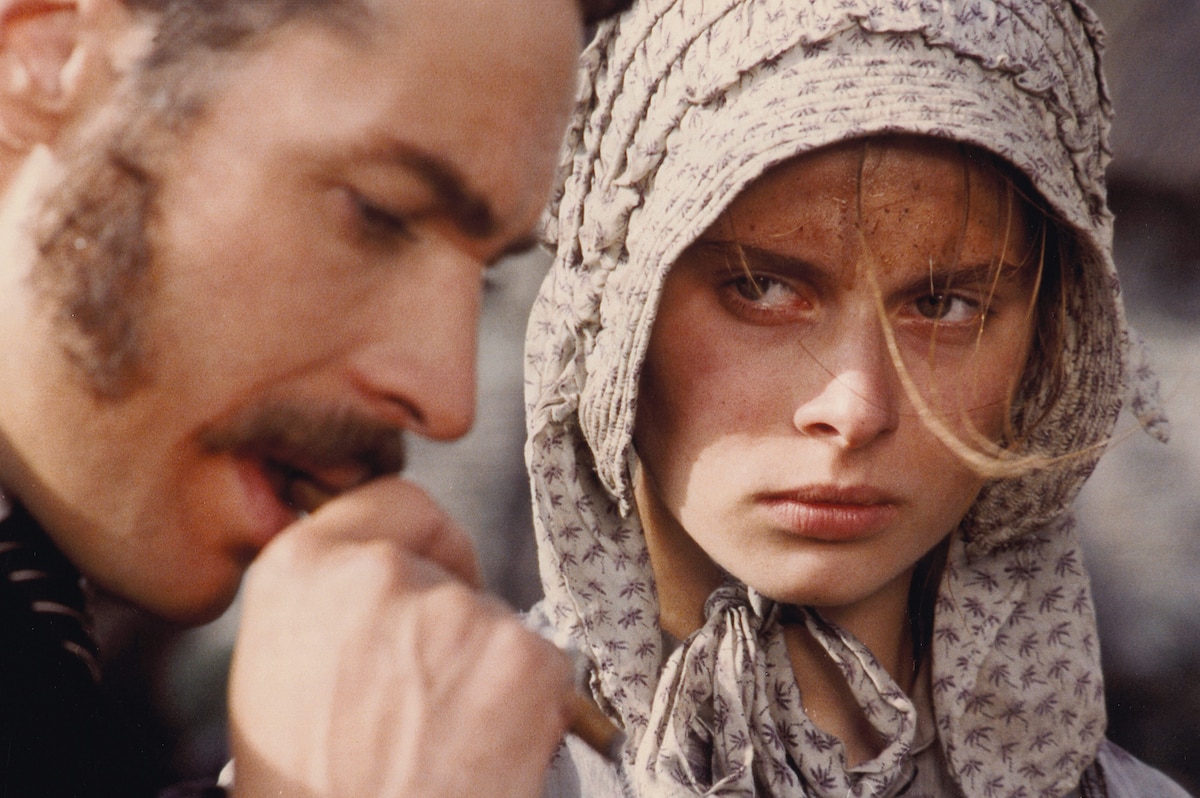
Polanski had met Nastassja Kinski, the daughter of German actor Klaus Kinski, two years earlier, when she was 15. He photographed her for French Vogue, and they had a brief affair. Berri agreed with Polanski that Kinski had the youthful beauty to play Tess (critics later commented on her startling resemblance to the young Ingrid Bergman), but both were concerned about her German accent. She worked with a dialogue coach for months, and while she never entirely got rid of the accent, the trace that remains adds to the sense of "otherness" about Tess.
Location shooting in the French countryside took nine months, covered all four seasons, and included building a replica of Stonehenge outside of Paris. While much of the landscape still looked as it had a century earlier, production crews repeatedly had to cover paved roads with dirt and gravel for the many shots of walking and riding over country lanes, and to find creative ways to avoid or conceal utility wires. Weather and labor strikes also caused delays.
Location shooting wasn't the only hardship the crew faced during the making of Tess. Cinematographer Geoffrey Unsworth died suddenly of a heart attack just a few weeks into production. Within days, Ghislain Cloquet -- who had worked with Robert Bresson, Jacques Demy, and Arthur Penn -- quickly stepped in and completed the film, after carefully studying the footage Unsworth had shot. His work was so seamless that both men won the Oscar® for cinematography.
Because Polanski had set out to film Hardy's entire novel, he made the decision early on that Tess would be as long as it needed to be. The version that opened in France in 1979 was three hours long, and was well-received there. Berri felt that it would be easier to find an American distributor if the film were shorter. Editor Sam O'Steen, who had worked with Polanski on Rosemary's Baby (1968) and Chinatown (1974), made additional cuts, but Polanski was not satisfied with that version. Director Francis Ford Coppola considered distributing it and flew to Paris to look at the film. Among his suggestions were beginning the film with turning pages of the book, and a voiceover narration, neither of which were acceptable to Polanski. Finally, Los Angeles Times critic Charles Champlin, who had seen Polanski's original cut of Tess at the 1979 Cannes Film Festival, gave it a glowing review in the paper, and Columbia agreed to distribute it at 172 minutes. It opened in the U.S. in December of 1980, more than a year after it had opened in Europe, just in time for Academy Awards® consideration.
Most American critics shared Champlin's enthusiasm. Roger Ebert of the Chicago Sun-Times called it "A beautifully visualized period piece....the kind of exploration of doomed young sexuality that...makes us agree that the lovers should never grow old." In the New York Times, Janet Maslin compared the film favorably to the work of David Lean, calling it "a lovely, lyrical, unexpectedly delicate movie." The New Yorker's Pauline Kael was one of the few dissenters, objecting to Tess's burnished beauty: "Hardy's account is raw and sexual; Polanski's movie is lush, ripe, settled....You can't help being upset by the novel; it's all morally open for you to puzzle over...But Polanski, who is such a wizard at perversity, and whose specialty was characters in a double bind, goes soft."
At Oscar® time, Tess earned six nominations and won three: for Unsworth's and Cloquet's cinematography; Pierre Guffroy's and Jack Stephens's art direction; and Anthony Powell's impeccable costume design, which included not only re-creations of period clothing, but actually some antique clothes from the era, among them a threadbare jacket worn by Peter Firth's Angel Clare. The film was also nominated for Best Picture, director, and Philippe Sarde's original music score. More than twenty years later, Polanski finally won a Best Director Oscar®, for 2002's The Pianist. Still a fugitive from American justice, Polanski did not attend the ceremonies to claim his award.
Director: Roman Polanski
Producer: Claude Berri
Screenplay: Roman Polanski, Gerard Brach, John Brownjohn, based on the novel Tess of the D'Urbervilles by Thomas Hardy
Cinematography: Geoffrey Unsworth, Ghislain Cloquet
Editor: Alastair McIntyre, Tom Priestley
Costume Design: Anthony Powell
Art Direction: Pierre Guffroy, Jack Stephens
Music: Philippe Sarde
Principal Cast: Nastassja [credited as "Nastassia"] Kinski (Tess Durbeyfield), Peter Firth (Angel Clare), Leigh Lawson (Alec Stokes-D'Urberville), John Collin (John Durbeyfield), Rosemary Martin (Mrs. Durbeyfield), Carolyn Pickles (Miriam), Richard Pearson (Vicar of Marlott), David Markham (Rev. Clare), Pascale de Boysson (Mrs. Clare), Suzanna Hamilton (Izz Huett)
172 minutes
by Margarita Landazuri
Tess
by Margarita Landazuri | November 08, 2013
SIGN UP FOR OUR NEWSLETTERS

CONNECT WITH TCM