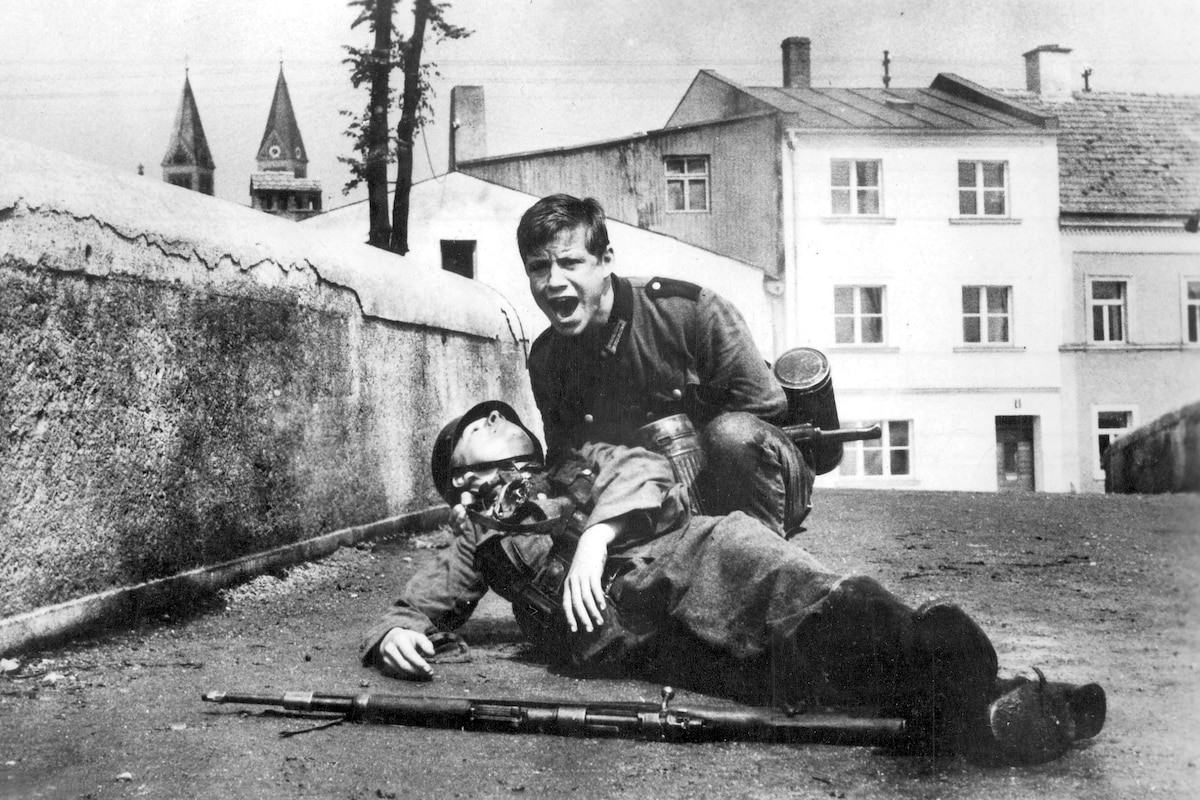
Imagine seven high school kids, aged 15 and 16, huddled together one cold night by a bridge. They have been given one simple instruction by their adult superiors: don't let any strangers pass. The people in charge know that the bridge is not important, and they have assigned this meaningless task to the kids as a distraction to keep them away from the adults as they engage in dangerous activity. As the skeleton of a plot, this is a premise that could go in any direction except for one thing; it's not a fanciful contrivance to launch a coming-of-age story or a nostalgic look back at the glory years of men in their youth. We know this long before the teenager's in question fire grenades from a bazooka and destroy an approaching American tank, killing the soldiers inside. We know this because this is a story that takes place during the end of World War II and because this is a story told by the same German teenager who saw an American G.I. ablaze and in agony as he tried to climb out of the tank only to die halfway off the turret. That kid's name was Gregor Dorfmeister. The day that he saw that man die was the day that Dorfmeister decided he was a pacifist. Years later at the age of 29, he wrote a book under the pseudonym of Manfred Gregor that was published in 1958 called Die Brücke (English: The Bridge).
A few years before Dorfmeister was traumatized by what he saw in the war, a young 18-year-old Austrian actor by the name of Bernhard Wicki was engaged with the drama school of the Staatliches Schauspielhaus in Berlin. He was imprisoned in 1939, a day or two before Kristallnacht, and then sent to the Sachsenhausen concentration camp where he experienced Nazi brutality for ten months. When he was released from the concentration camp, he moved to Vienna and then in 1944 to Switzerland. He would go on to become an actor in many films, an accomplished photographer and would direct his first film in 1958, a documentary called Warum sind sie gen uns? It was with his second directorial outing, released the next year in 1959 and based on Dorfmeister's book, Die Brücke, (aka: The Bridge) that Wicki was launched onto the international stage. Despite initial skepticism from the film industry that The Bridge would be a financial disaster, instead, it won several international prizes and was nominated for an Academy Award for Best Foreign Language Film. The film would go on to redefine the anti-war movie and influence members of the New German Cinema, including Volker Schlöndorff who has referred to Wicki as "a spiritual godfather" to their movement.
The success of The Bridge would end up being a bit of a curse for Wicki because everyone expected him to continue hitting home runs, but nothing that followed ever quite won over the critics or audiences as with The Bridge. Still, that did not stop Wicki from directing what was widely regarded as the best segment in The Longest Day (1962) and later working with Marlon Brando and Yul Brynner in Morituri (1965).
Most of Wicki's career would be absorbed by acting. When he died on January 5, 2000, it was with a directorial run of 15 films. The last one, Spider's Web (1989), also a war drama, was set in the chaotic years after World War I and got good reviews in Germany and the few countries where it was released. Wicki would later admit that he felt it would have made better sense to have begun his career with Spider's Web and then have it culminate with The Bridge, presumably for both chronological reasons as well as to see his directorial arc end on a high point.
What made The Bridge such a smashing success? Wicki, inspired by the Italian neorealism of directors like Visconti, would audition over 300 kids, none of whom had been trained as actors, to select the chosen seven. It helped that Wicki took Dorfmeister's original story and stripped it of flashbacks. This allowed the first half of the film to focus on the teenagers behaving like most kids behave, inside and outside the classroom. This allowed audience members to empathize with them as young kids rather than as Nazi soldiers. Without flashbacks all the action is in the present moment, which lends immediacy to the proceedings. That the film doesn't have a clear protagonist also sets it apart from its peers making each character equally important, and equally expendable. That the violence of war is not introduced until the second half adds to its impact.
In the 1950s, the German film industry released many war movies that tried to depict "good Germans" but The Bridge was the first film to depict a lost generation of grown-ups who failed their country and left hapless teenagers behind to save it. Wicki, working a scant 14 years after the events portrayed on film, was able to find locations and settings that recreated the actual war footage that many people of that time had seen; footage showing American soldiers marching through destroyed German towns after the fall of Nazi Germany. The Bridge, however, should not be pegged as distinct to WWII and Germany. The audience takeaway should not be bound to time and space. To use the words of Dorfmeister, "I hope that the book and the film can help many people to realize that there's no dumber way to handle conflict than by shooting and killing and taking each other's lives."
By Pablo Kjolseth
The Bridge
by Pablo Kjolseth | November 08, 2013
SIGN UP FOR OUR NEWSLETTERS

CONNECT WITH TCM