Better known for his German epics of the silent era (Metropolis [1927] and Die Nibelungen [1924]) or his American films noir (Scarlet Street [1945] and The Big Heat [1953]), Fritz Lang was actually quite a fan of the traditional western. In fact he spent vacations traveling throughout the West, shooting dozens of home movies recording the landscape and people of the Old West as it faded into history. "All my life I've loved the American West," he once said.
Lang's interest in cowboy culture was not strictly a hobby. He made several westerns while working in Hollywood, including the Technicolor epic Western Union (1941).
When Vance Shaw (Randolph Scott), a fugitive from justice, encounters a wounded man in the wilderness, he tends the man's wounds and helps him to a town where he can receive medical attention. The wounded man is Edward Creighton (Dean Jagger), an engineer in charge of running a telegraph wire from Omaha to Salt Lake City. While hiring men for the difficult crusade, Creighton overlooks Shaw's criminal background and offers him a job as a scout to repay the debt. Shaw quickly becomes interested in Creighton's sister Sue (Virginia Gilmore), as does the tenderfoot Richard Blake (Robert Young), who joins the mission from back east, sporting fringed, tailored western attire. Blake soon earns the respect of his peers as they travel into the wilderness. But friendships grow strained when the group's supply of cattle is stolen. Creighton suspects Shaw knows something of the crime, which he does. Shaw recognizes the work of his own brother Jack Slade (Barton MacLane), whose gang rustles cattle dressed up as Native American warriors. Unwilling to betray his brother, Shaw searches for a way to avenge the crimes without jeopardizing Western Union's westward campaign.
Western Union was the final novel by Western writer Zane Grey. The book was published three days prior to the author's death of a heart attack on October 23, 1939. Grey had discussed with actor Gary Cooper the idea of an independent production of Western Union (to be released by either United Artists or RKO), but it failed to materialize. At one point Paramount Pictures was also interested in purchasing screen rights, but Fox ultimately won the property with a $25,000 offer.
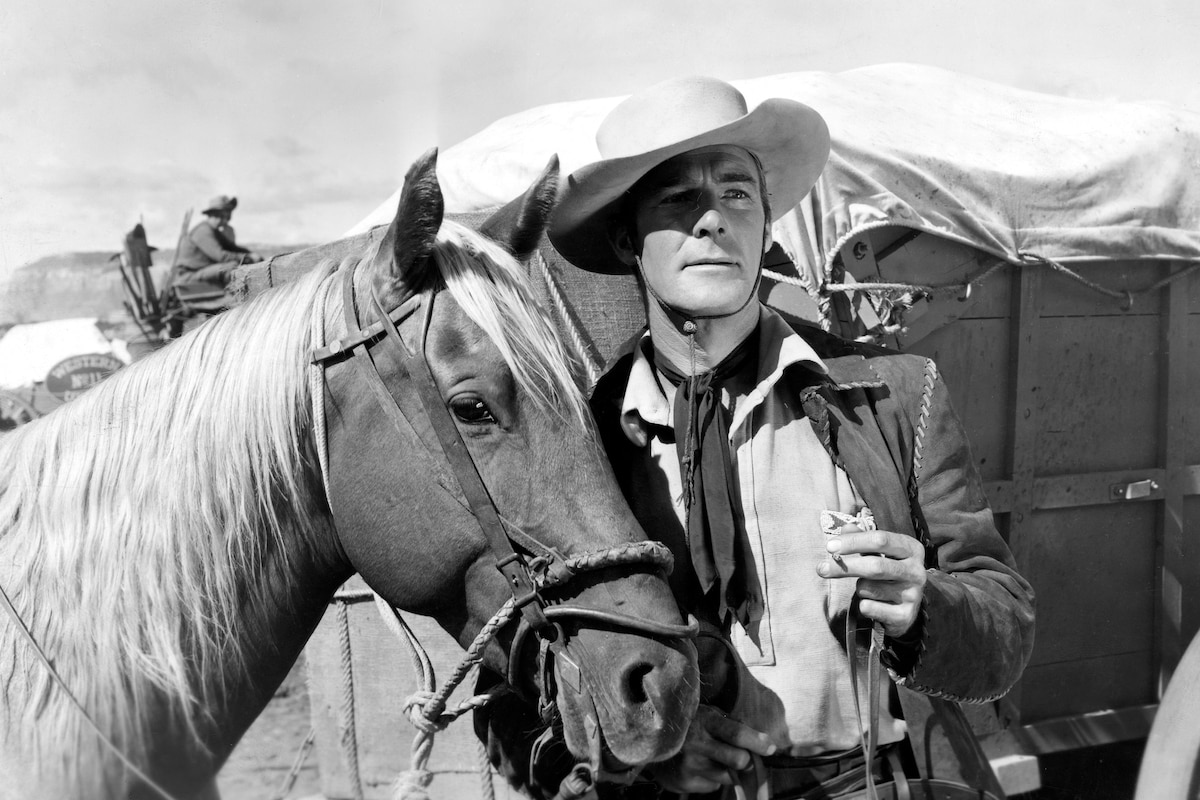
In many ways Western Union is a relatively authentic depiction of life and work in the Old West, largely due to location shooting near Kanab, Utah and at Arizona's House Rock Canyon. The outstanding Technicolor photography, by Edward Cronjager and Allen M. Davey, made the most of the exotic settings, favoring muted colors and dusky earthtones, occasionally offset by bursts of vivid color, such as the warpaint or ceremonial feathers of the Native American characters. American Cinematographer called it "one of the most spectacularly beautiful examples of color cinematography we've seen in many months."
Western Union tried to avoid the artifice of the stereotypical western, and the scene in which Blake arrives dressed more like a stage dandy than a horseman seems to be a jab at the colorful (but not very genuine) cowboys who populated matinee screens of the era.
Lang discussed the film's authenticity with Peter Bogdanovich in 1965. "I got a letter from a club of Old Timers in Flagstaff which said, 'Dear Mr. Lang, We have seen Western Union and this picture describes the West much better than the best pictures that have been made about the West...' For a European director to get such a thing from Old Timers who knew about the West -- I was, naturally, very flattered; but I suppose what these gentlemen wrote was not quite correct. Because I don't think the picture really depicted the West as it was; maybe it lived up to certain dreams, illusions -- what the Old Timers wanted to remember of the old West."
One of Lang's departures from reality was in the casting of the Native Americans. Because the local Paiute tribesmen didn't fit the stereotype of the chiseled desert warrior, Lang (according to The New York Times), "ordered a shipment of Hollywood Indians from Central Casting -- tall, high cheek-boned fellows who look like aborigines are supposed to look." This order was soon canceled, after Lang discussed the matter with John Collier, Commissioner of Indian Affairs. Collier allowed Lang to instead recruit 200 Navajos from a reservation, under the promise that they would be treated with dignity.
Lang was astute enough to realize that, no matter how well constructed and photographed, his West was just a higher grade of fantasy than the typical Hollywood oater. He had tried to inject some period detail into Western Union, but quickly encountered resistance at 20th Century-Fox. "I had found...that there were cowboys in those days who wore bowler hats. But this was already too much for the studio. Not that they didn't believe it, but they always preferred to give an audience the same old thing -- with some new trimming." When first offered the project, Lang thoroughly rewrote the script, presumably to give it more of a factual feel, but his draft was discarded by the studio. Still believing in the project, even if his ideas were largely ignored, he agreed to continue as planned and direct the film. Besides, maybe the true story of Western Union's westward expansion wouldn't have made such a great movie anyway.
"In reality, nothing happened during the entire building of the line except that they ran out of wood for the telegraph poles," Lang explained, "and the only other thing that disturbed the laying of the line was the ticks on the buffaloes; the buffaloes got itchy and rubbed themselves against the poles, and the poles tumbled. And that was all that happened."
Making a film about laying the telegraph line was apparently twice as complicated as the original task. A 1941 newspaper article reported that "In 1861 it cost $212,000 to extend the telegraph...and the crew took four months and eleven days, covering 1,100 miles. To reproduce their feat in 1940, a company of 300 traveled 2,000 miles in ten months, at a cost of more than $1,000,000."
Lang and company seem to have also doubled the amount of planning that went into the mission. Assistant editor Gene Fowler, Jr. recalled, "On Western Union I learned of the immense preparation that goes into a Lang picture...Models of sets were built and camera angles and focal lengths of lenses were selected. He believed that each shot must relate to the whole. The design of the shot (even the lighting) must relate to the dramatic concept. Details, no matter how good or how interesting, are only good if they fit into the overall pattern."
Director: Fritz Lang
Producer: Darryl F. Zanuck
Screenplay: Robert Carson, based on the novel by Zane Grey
Cinematography: Edward Cronjager and Allen M. Davey
Production Design: Richard Day and Albert Hogsett
Music: David Buttolph
Cast: Randolph Scott (Vance Shaw), Dean Jagger (Edward Creighton), Robert Young (Richard Blake), Virginia Gilmore (Sue Creighton), John Carradine (Doc Murdoch), Slim Summerville (Herman), Chill Wills (Homer Kettle), Barton MacLane (Jack Slade).
C-96m. Closed captioning.
by Bret Wood
Western Union
by Bret Wood | February 25, 2005
SIGN UP FOR OUR NEWSLETTERS

CONNECT WITH TCM