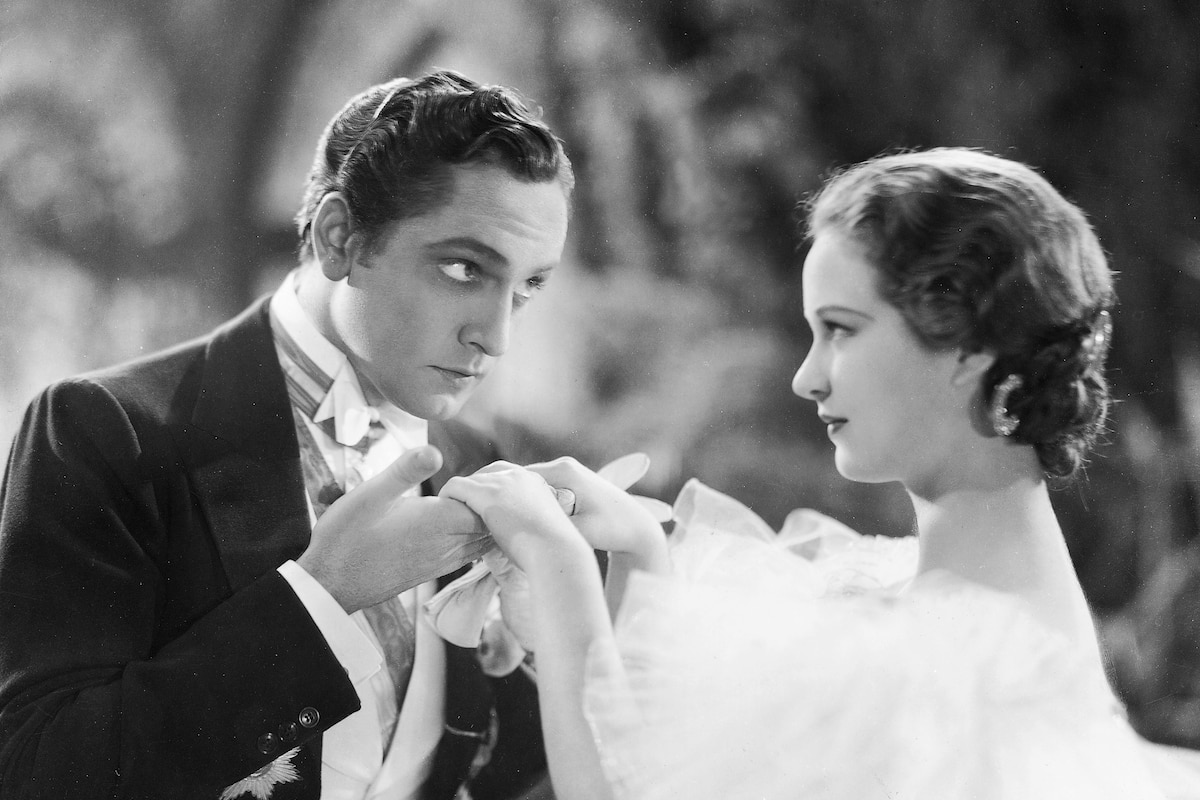
Synopsis: A group of Italian nobles are staying as guests at the villa of Duke Lambert. However, a pall is cast over the occasion when a strange shadow on the road causes a near-fatal auto accident. Grazia, the fiancee of Lambert's son, Corrado, is frightened by an intruder on the premises, but no one is able to find him. That night, when Lambert is alone Death appears and explains that he wants to take a three-day holiday in order to live as a mortal and learn why humans cherish life so highly. Assuming the form of Prince Sirki, an old friend of Duke Lambert, he lives among the guests; all death in the world temporarily ceases while he is on holiday. "Prince Sirki" and Grazia fall in love with each other, but the future of their romance is in doubt since Death has not yet revealed his true identity to her.
Death Takes a Holiday (1934) is based on a play by the Italian writer Alberto Casella; the English-language version, written by Walter Ferris, opened in New York in 1929. Although the play was a commercial success, Ferris subsequently found more of a steady career writing screenplays such as the Shirley Temple vehicles Heidi (1937) and The Little Princess (1939) and the adventure classic Swiss Family Robinson (1940). In the film adaptation by Gladys Lehman and the playwright Maxwell Anderson, the stylized flavor of the play's dialogue is retained, but the action is opened out and the dialogue flows more smoothly. Anderson, who had already established a nationwide reputation thanks to the anti-war play What Price Glory? and the verse drama Elizabeth the Queen, periodically wrote original scripts for Hollywood as well as adapted his own plays for the screen. During the same year, Maxwell Anderson also worked on We Live Again (1934), an adaptation of Tolstoy's Resurrection. Significant films based on Anderson's plays include: the 1926 and 1952 adaptations of What Price Glory? directed by Raoul Walsh and John Ford, respectively; Mary of Scotland (1936); Winterset (1936); The Private Lives of Elizabeth and Essex (1939); Key Largo (1948); Joan of Arc (1948); and The Bad Seed (1956).
One of the more interesting aspects of the film is its use of special effects, which were supervised by Gordon Jennings. Director Mitchell Leisen recalls: "The effect of Death being transparent was very difficult to do because we wanted to do it right in the camera instead of having the lab put it in, and we had to keep him within two or three feet of Sir Guy Standing, who had to remain solid. We duplicated certain pieces of the set in black velvet. Then we put a mirror in front of Freddy that was only 30% silvered so that you could shoot through it. In order to make him transparent, we simply lit up certain portions of the black set which reflected in the mirror superimposed over Freddy, giving the appearance that he was transparent."
The film became a great box-office success, one of Paramount's highest-grossing films that year. Leisen later recalled: "We had seven or eight thousand letters come in from people all over the country, saying they no longer feared death. It had been explained to them in such a way that they could understand the beauty of it." The play was also adapted as a 1971 television film starring Yvette Mimieux and Monte Markham (with Melvyn Douglas and Myrna Loy in supporting roles) and, most recently, the Martin Brest film Meet Joe Black (1998), an updated version set in New York, with Brad Pitt playing Death. However, the 1934 version remains the most affecting thanks to a strong central performance by Fredric March, gleaming set design by Hans Dreier, and elegant direction by Mitchell Leisen, who was given a special award at the 1934 Venice Film Festival for his work on this film. This was only Leisen's second feature as a director, the first being Cradle Song (1933). During the 1920s, Leisen had worked as a costume designer and art director with several Cecil B. DeMille films to his credit. Clearly, his experience working under the master of "production values" paid off.
Producer: E. Lloyd Sheldon
Director: Mitchell Leisen
Screenplay: Maxwell Anderson and Gladys Lehman, based on the play La Morte in vacanza by Alberto Casella, adapted for the English language by Walter Ferris
Photography: Charles Lang
Technical Effects: Gordon Jennings
Art Directors: Hans Dreier and Ernst Fegte
Music: Bernhard Kaun, John Leipold, Milan Roder
Cast: Fredric March (Prince Sirki/Death), Evelyn Venable (Grazia), Guy Standing (Duke Lambert), Katharine Alexander (Alda), Gail Patrick (Rhoda Fenton), Helen Westley (Stephanie), Kathleen Howard (Princess Maria), Kent Taylor (Corrado), Henry Travers (Baron Cesarea), G. P. Huntely, Jr. (Eric), Otto Hoffman (Fedele), Edward Van Sloan (Doctor Valle).
BW-78m.
by James Steffen
Death Takes A Holiday (1934) - Death Takes a Holiday (1934)
by James Steffen | February 25, 2005
SIGN UP FOR OUR NEWSLETTERS

CONNECT WITH TCM