The Big Idea Behind SOME
CAME RUNNING
James Jones' debut novel, From
Here to Eternity, proved to be a
critical success and a national
best-seller upon its publication in
1951. It also provided Frank Sinatra
with his famed "comeback" role as
Private Maggio when it was adapted
for the screen in 1953. Jones
subsequently set out to write a
worthy follow-up for his sophomore
effort. MGM bought the movie rights
to this next novel almost a year
before publication, paying $250,000
for it in January 1957. Some Came
Running, all 1,266 pages of it,
was finally released by Scribner's in
November, 1957 - more than six years
after the publication of Jones' first
novel. Literary critics were not
overly impressed with the book,
calling it rambling and
self-indulgent. MGM was undeterred,
however, and was determined to create
an effective melodrama out of the
Jones epic.
Sol C. Siegel had just taken over
from Dore Schary as MGM production
chief, and under his supervision a
screenwriting team was assigned to
condense Jones' book down to feature
film size. John Patrick and Arthur
Sheekman cut out many of the book's
secondary characters, eliminated
confusing flashbacks, and condensed
the timeline from three years to
several weeks. Siegel first gave
thought to casting bankable star
Glenn Ford in the lead, then hit upon
a bit of stunt casting - namely,
Frank Sinatra, who had been such a
smash in the film of Jones' first
novel. Sinatra's price had gone up
quite a bit since the dark days of
1953. His fee for Some Came
Running and two other Metro films
was a then-astounding $400,000
against ten-percent of the gross
profits.
Vincente Minnelli had just returned
from shooting The Reluctant
Debutante (1958) when MGM offered
him Some Came Running to
direct. For Minnelli, it was a
wonderful opportunity to explore
small-town life in America and a
welcome change of pace after months
of filming in Europe. Minnelli later
wrote in his autobiography, "The
James Jones novel was long and
rambling, heavily populated, but I
felt the main characters were
interesting and well thought out."
So he took on the rigorous schedule -
six months to turn a first-draft
script into a film in time for an
Oscar®-qualifying showing in Los
Angeles before the end of
1958.
Minnelli set about casting the rest
of the picture. Sinatra pal Dean
Martin was a natural as the hero's
gambling buddy Bama Dillert. For the
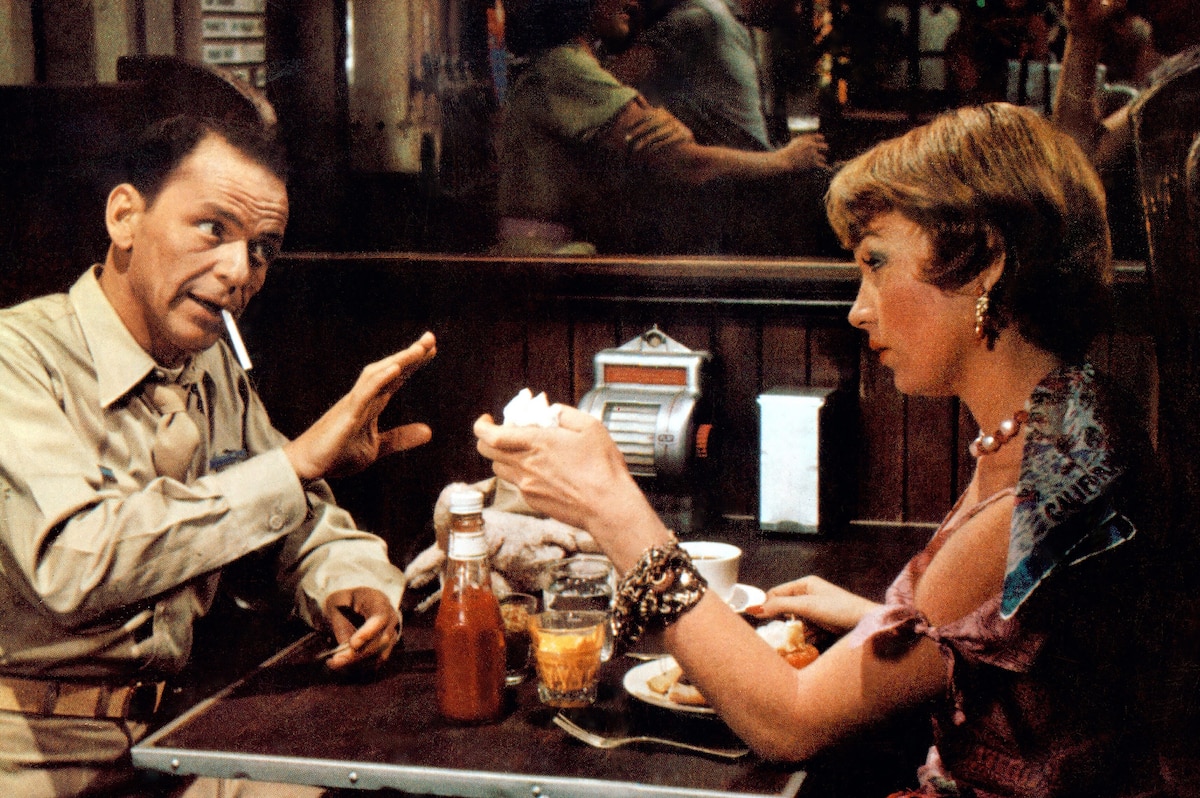
showy role of dimwitted Ginny
Moorhead, Sinatra suggested Shirley
MacLaine because he had seen her on a
Pat Boone TV special, and because (as
MacLaine was to write later), "they
couldn't get Shelley Winters."
MacLaine continued, "Upon learning
that I had landed the role of Ginny
Moorhead, I immediately went to a
specialty store and had a stuffed toy
dog made, which I would use as a prop
for the role. I boarded a bus for
Madison and arrived on location
completely in character. Frank saw
me get off the bus and just fell down
laughing, 'That's Ginny,' he
said."
With filming set to begin in early
August in Madison, Indiana, Sinatra
and Martin rented a house adjacent to
the hotel where the rest of the cast
and crew would be housed. In their
personal bungalow, Frank and Dean
could relax, drink, play cards and
play host to assorted colorful
out-of-town guests. Shirley MacLaine
later called these guests "The Boys
from Chicago" and said, "I didn't
know who they were. I only knew that
the nightlife of poker, jokes, pasta,
and booze went on until five a.m.
Our calls were at six a.m."
by John Miller
The Big Idea (1/14/2006) - SOME CAME RUNNING
by John Miller | February 23, 2005
SIGN UP FOR OUR NEWSLETTERS

CONNECT WITH TCM