SYNOPSIS
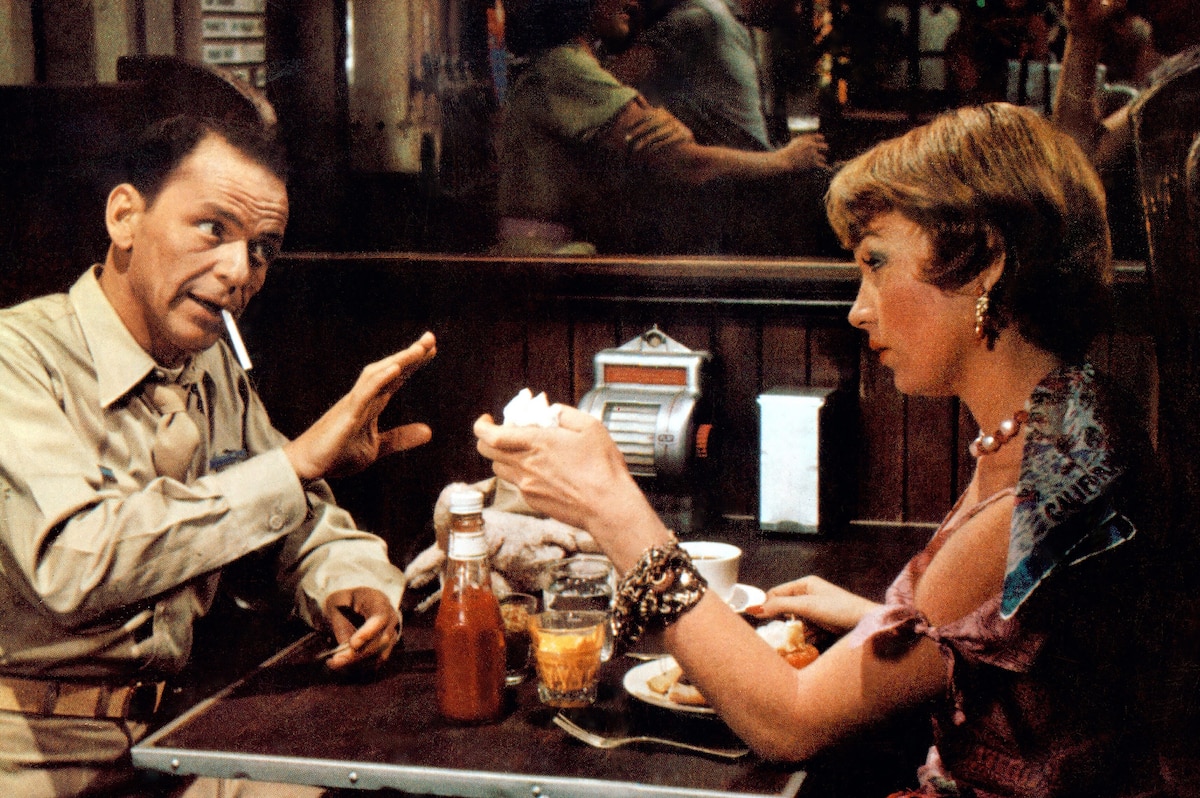
Dave Hirsh is a returning WWII
veteran whose career as a writer has
taken a nosedive. He arrives by bus
to his boyhood home of Parkham,
Illinois, carrying a new manuscript.
Shortly upon arrival he hooks up with
a good-hearted floozy named Ginny.
Dave proceeds to shake up the
complacency of the small town as he
reacquaints himself with his
estranged brother Frank and his
upper-crust family. Ginny attaches
herself to Dave and his other circle
of friends, which includes local
gambler Bama. Playing both sides of
the town's dividing line of
respectability, Dave also forms a
relationship with Gwen, a lonely
schoolteacher.
Director: Vincente Minnelli
Producer: Sol C. Siegel
Screenplay: John Patrick, Arthur
Sheekman, based on the novel by James
Jones
Cinematography: William H.
Daniels
Editor: Adrienne Fazan
Art Direction: William A. Horning,
Urie McCleary
Music: Elmer Bernstein
Song: Sammy Cahn, Jimmy Van
Heusen
Costume Design: Walter Plunkett
Makeup: William Tuttle
Cast: Frank Sinatra (Dave Hirsh),
Dean Martin (Bama Dillert), Shirley
MacLaine (Ginny Moorhead), Martha
Hyer (Gwen French), Arthur Kennedy
(Frank Hirsh).
C-137m. Letterboxed. Close
captioning.
Why SOME CAME RUNNING is Essential
Encouraged by the sales and the
critical acclaim of his book, From
Here to Eternity, James Jones set
down to write the great American
novel. The result was Some Came
Running, the story of a war
veteran with literary aspirations who
returns in 1948 to his hometown of
Parkham, Illinois, after a failed
writing career. While it wasn't the
masterpiece Jones hoped it would be,
Metro-Goldwyn-Mayer, hoping to
duplicate the success of From Here
to Eternity (1953), optioned the
book and cast Frank Sinatra as the
lead, Dave Hirsh. Sinatra, in turn,
approved Dean Martin for the role of
his gambling pal, Bama Dillert.
Martin had recently split from a
partnership with Jerry Lewis and was
just beginning to prove himself as an
actor.
Producer Sol Siegel brought Vincente
Minnelli on board as director.
Minnelli was no doubt attracted to
many of the story's major themes -
the tortured artist (a frequent
Minnelli protagonist), the conflict
of two brothers who are polar
opposites in temperament (reminiscent
of the brothers that had been seen in
Minnelli's Undercurrent (1946)
and would feature in his 1960
melodrama, Home from the
Hill), and small-town America -
here featuring complex layers of
hypocrisy and social strictures.
Minnelli later wrote that he drew
upon his own childhood memories for
many of the small-town
details.
The movie provided Shirley MacLaine
with her best role to date. In her
autobiography, Dance While You
Can, MacLaine gave much of the
credit for her success in the part to
Sinatra: "I always thought he was
responsible for my good performance
in Some Came Running. 'Let
the kid get killed,' he said to
Vincente Minnelli and to the head of
the studio. 'If she dies, she'll get
more sympathy. Then she'll get
nominated.' He was right."
Minnelli puts every part of the
CinemaScope widescreen to use in
Some Came Running - it is a
textbook example of using the format
in a non-epic film. Minnelli's
staging and composition within the
frame often provides as much
information about character
relationship as does the dialogue.
Using very few close-ups, Minnelli
stages long takes in medium shots
that are crammed with background
detail and bits of business that
reveal much about the town and the
characters' shifting social status
within it.
The film features careful color and
design choices throughout. Minnelli
saw Some Came Running as "a
story of small-town honky-tonks, of
cheap low lifes not without charm.
The audience had to be knocked out by
their vulgarity. I decided to use
the inside of a juke box as my
inspiration for the settings - garishly
lit in primary colors." While the
pyrotechnics of color are clearly
evident in the carnival setting of
the finale, the entire film is
enhanced by a subtle color
design.
Elmer Bernstein provides Some Came
Running with a varied and
underrated music score. It avoids
being overwrought in supporting the
quiet melodrama of the picture, but
is appropriately jazzy for the
violent outbursts. A flash of
intense red kicks off the carnival
finale, and Bernstein keeps up with
Minnelli's garish "juke box" visuals
shot for shot.
In addition to MacLaine's Oscar®
nomination for Best Actress in
Some Came Running, the film
was also in the running for Best
Supporting Actor (Arthur Kennedy),
Best Supporting Actress (Martha
Hyer), Best Song ("To Love and Be
Loved" by Sammy Cahn and Jimmy Van
Heusen), and Best Costume Design
(Walter Plunkett). Although Some
Came Running didn't win in any of
the categories, 1959 was a banner
year for Vincente Minnelli who won
the Best Director Oscar for
Gigi. He could be proud of
the fact that together his two films
racked up a total of fourteen Academy
Award nominations.
by John Miller & Jeff Stafford
The Essentials (1/14/2006) - SOME CAME RUNNING
by John Miller & Jeff Stafford | February 23, 2005
SIGN UP FOR OUR NEWSLETTERS

CONNECT WITH TCM