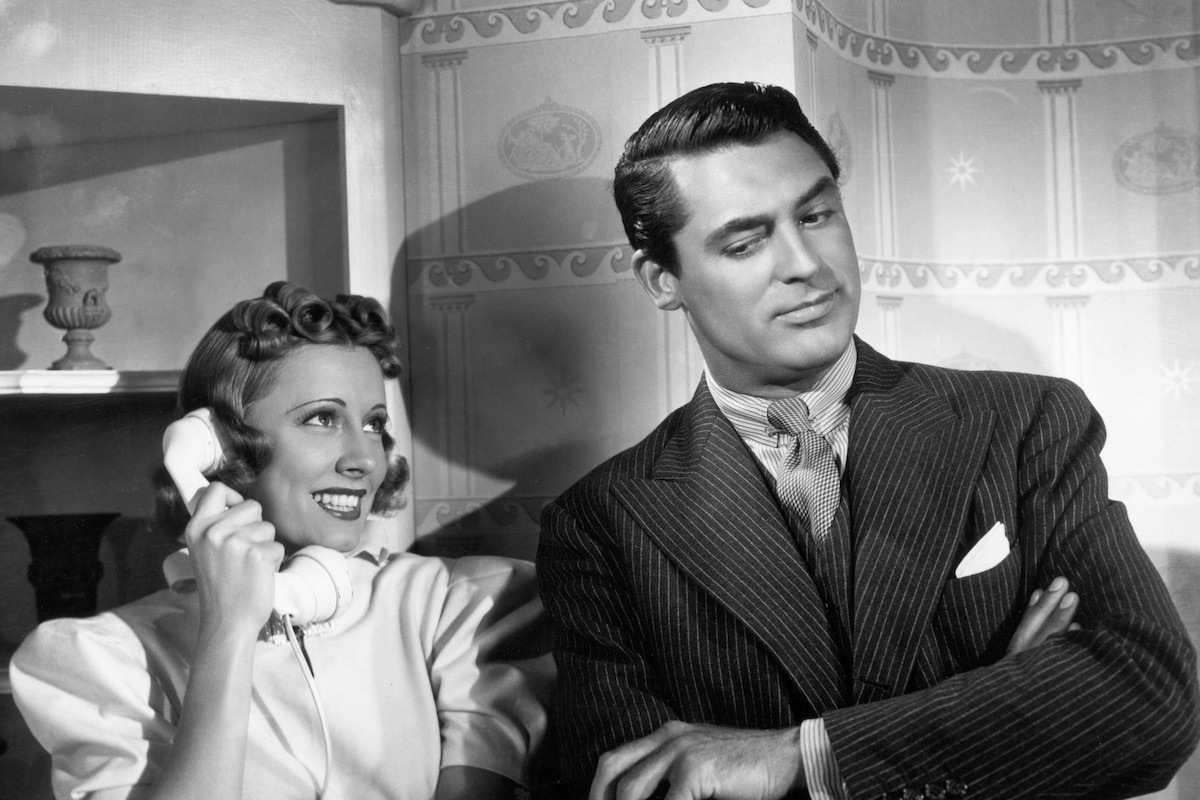
Cary Grant did not receive an Oscar nomination for his work (some say it was because he was already developing a notorious reputation for being a difficult and financially demanding actor), but the film gave a tremendous boost to his career. He quickly signed a contract with RKO to make three films over the following two years at an initial fee of $50,000 against a percentage of the profits of each picture.
Leo McCarey and Cary Grant made two more films together: Once Upon a Honeymoon (1942) and An Affair to Remember (1957), a remake of McCarey's classic romance Love Affair (1939), which starred Irene Dunne. McCarey also produced and wrote the story for the first Grant-Dunne re-teaming, My Favorite Wife (1940). He was set to direct it, too, but a bad auto accident put him out of commission and Garson Kanin stepped in. In spite of their frequent collaboration, McCarey maintained some bitterness all his life toward Grant. Some have said it was because Grant never acknowledged McCarey's influence on his career and on the creation of the "Cary Grant" image.
In addition to My Favorite Wife, Grant and Dunne appeared together in the sentimental drama Penny Serenade (1941).
The success of The Awful Truth proved to be a boon for Leo McCarey. From 1937 on, he was able to produce all but one of his own movies for the rest of his career.
The son of one of California's best-known boxing promoters, McCarey took a turn at law on his father's wishes but found himself most at home in motion pictures. He started out as third assistant director to Tod Browning, who later directed Dracula (1931), Freaks (1932), and a number of Lon Chaney pictures. McCarey then moved on to the Hal Roach studios. When sound came in, it was difficult for many silent directors to get work since producers often thought they were not capable of handling dialogue. But McCarey was given the chance to direct his first sound feature, The Sophomore (1929), by fellow Irish-Catholic Joseph Kennedy, father of the future president.
Ingrid Bergman, who worked with McCarey on The Bells of St. Mary's (1945), found him "a terribly funny man...the jokes that went on, the gaiety!...He was a very easy-going man."
McCarey won three more Oscars in 1945 for writing, producing, and directing the Best Picture of that year, Going My Way (1944).
Famous Quotes from THE AWFUL TRUTH
LUCY (Irene Dunne): You've come back and caught me in the truth, and there's nothing less logical than the truth.
JERRY (Cary Grant): You can't have a happy married life if you're always suspicious. There can't be any doubts in marriage...marriage is based on faith, and when you've lost that, you've lost everything.
LUCY: I've seen your picture in the paper and wondered what you looked like.
DAN (Ralph Bellamy): I'm in oil, you know.
PATSY (Cecil Cunningham): Marinated, so to speak.
PATSY: Look at that rain.
LUCY: Why, is it doing anything besides falling?
JERRY: And if you get bored in Oklahoma City, you can always go over to Tulsa for the weekend!
JERRY: In the spring, a young man's fancy lightly turns to what he's been thinking about all winter.
ARMAND (Alexander D'Arcy): I am a great teacher, not a great lover.
LUCY: That's right, Armand. No one could ever accuse you of being a great lover.
JERRY: What did you tell him?
LUCY: I told him the truth, and strangely enough, he believed me.
LUCY: You're all confused, aren't you?
JERRY: Aren't you?
LUCY: No.
JERRY: Well you should be, because you're wrong about things being different because they're not the same. Things are different except in a different way. You're still the same, only I've been a fool... but I'm not now.
LUCY: Oh.
JERRY: So long as I'm different, don't you think that... well maybe things could be the same again... only a little different, huh?
