Pop Culture 101 - THE THIRD MAN
Composer and Zither-master Anton
Karas had quite a career following
the release of The Third Man
(1949). His "3rd Man Theme" (as it
was more commonly written out) was a
worldwide hit. Consequently, the
tune was covered by many artists and
performers throughout the 1950s and
beyond. The tune was adapted to
almost every musical style and taste,
from Big Band, calypso, space-age,
cha-cha, Hawaiian, rock, and more.
For the Hi-Fi-listening public of the
day, the tune was performed by the
likes of Guy Lombardo, Esquivel, Ray
Coniff, Jackie Gleason, Herb Alpert,
Nelson Riddle, Ben Pollack, and many
more. In the Rock era, The Band and
The Shadows covered the tune, and
during the "Get Back" sessions in
1969, even the Beatles took a stab at
it. More recently, The Del Rubio
Triplets performed it on their 1991
album of cover songs, Whip It.
Sheet music sales for the song in the
50s were very brisk. There was also
a set of lyrics written for the tune,
by Walter Lord:
When a zither starts to
play
You'll remember yesterday
In its haunting strain,
Vienna lives again, free and bright
and gay.
In your mind a sudden
gleam
Of a half forgotten
dream,
Seems to glimmer when you
hear the third man theme
Once again there comes to
mind
Someone that you left
behind
Love that somehow didn't
last
In that happy city of the
past.
Does she still recall the
dream
That rapture so supreme
When she first heard the
haunting third man theme?
Incredibly, the popularity of the
music even spawned merchandise for
the film. The Harbert Company of New
York City, maker of toy musical
instruments, marketed a "3rd Man
Junior Zither" in 1950. It came with
sheets with the notes of the "3rd Man
Theme" and several other popular
songs printed out "in sensational
easy-to-play chart form." Laying the
sheet under the strings, a child or
amateur could pick out a tune with
the accompanying felt pick. The
zither, music sheets, and box all
featured the movie logo and artwork
of Harry Lime.
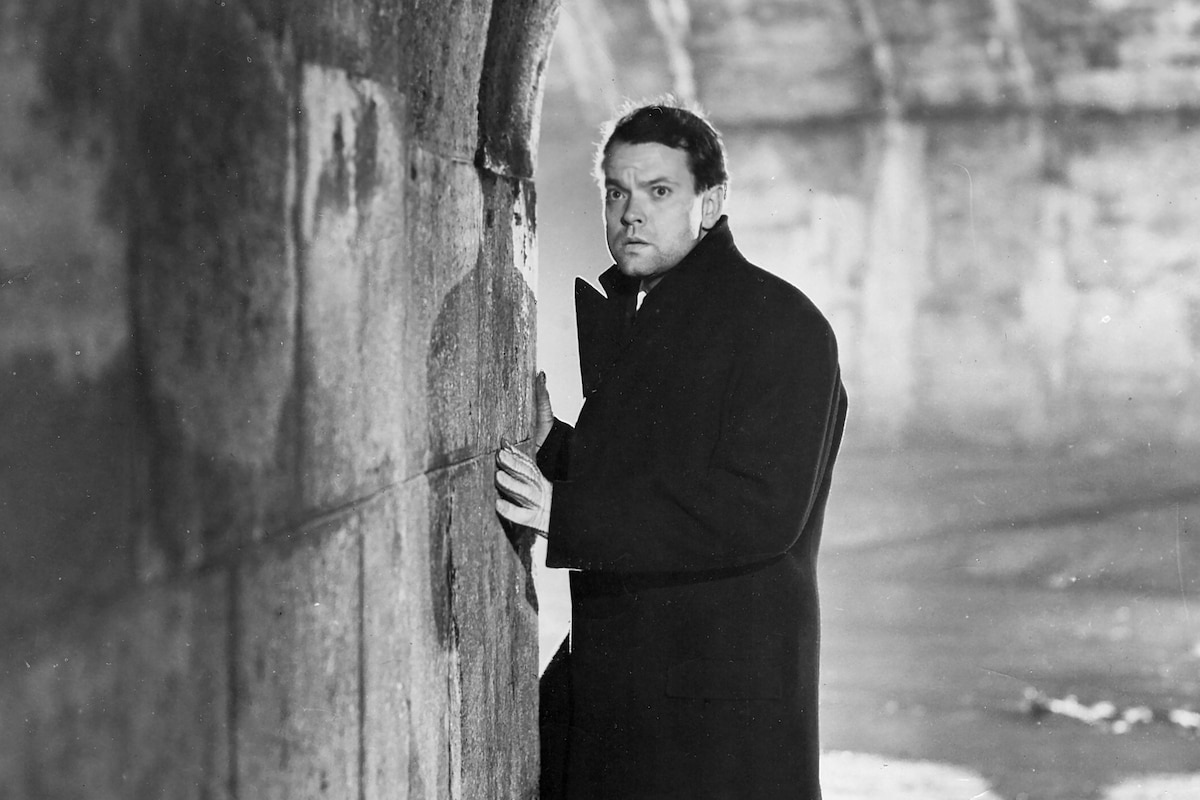
The popularity of The Third
Man, and especially the charm and
allure of Harry Lime as a character,
spawned spin-off series for both
radio and television. Orson Welles
had been a fixture on radio since the
late 1930s of course, through such
series as "Mercury Theatre on the
Air," "Campbell Playhouse," and
"Orson Welles Almanac." Beginning in
1951 he could be heard as the title
character in the British series "The
Adventures of Harry Lime." A total
of 52 half-hour episodes were
recorded, several of which were also
written by Welles. The premise was
set up every week: After the
audience hears Lime met his death in
the sewers of Vienna in the opening,
we hear Welles say, "Harry Lime had
many lives. And I can recount all of
them. How do I know? It's very
simple. Because my name is Harry
Lime." The stories are flashbacks,
then, of a less villainous but
nevertheless roguish adventurer and
opportunist hopping the globe in
search of romance and easy riches.
In one notable episode written by
Welles, "Man of Mystery," Lime meets
up with eccentric financer Gregory
Arkadin. In this show Welles was
developing ideas he would later
incorporate into his film Mr.
Arkadin, released in 1955.
In 1959, the BBC and
Twentieth-Century Fox co-produced a
syndicated TV series called The
Third Man, but it bore little
resemblance to the film. Michael
Rennie starred as a much more
respectable Harry Lime, now an art
dealer jet setting the world and
solving crimes with a sidekick played
by Jonathan Harris. Seventy-seven
half-hour episodes were produced.
Although this series did not follow
the lead of the film, it did set a
tone for subsequent TV jet-setters,
such as those in The Saint and
I Spy.
Since Graham Greene is so associated
with the Cold War Spy mythos, both in
fact and in his fiction, and since
the spy genre was to become so
important to the 1960s British film
industry, it should be no surprise
that there are connections between
The Third Man and the later
James Bond series of films. Reed's
assistant director, Guy Hamilton,
went on to a notable directing career
of his own, most conspicuously at the
helm of four James Bond films,
including Goldfinger(1964)
which many regard as the
quintessential Bond movie. The
others he directed were Diamonds
Are Forever (1971), Live and
Let Die (1973), and The Man
With the Golden Gun (1974).
Hamilton also directed the non-Bond
spy thriller Funeral in Berlin
(1966).
Bernard Lee (Sgt. Paine in the film)
made his career by playing a long
line of police detectives, military
men, inspectors, customs officers,
and spies. He is fondly remembered
today for his long-standing role as
M, James Bond's boss. He originated
the role in the first Bond film,
Dr. No (1962), and went on to
play the role in no less than eleven
of the films in the series. He also
played variations of the role in many
send-ups and parodies throughout the
60s and into the 70s. Orson Welles
himself played in the 1967 James Bond
spoof Casino Royale.
by John M. Miller
Pop Culture (12/10) - THE THIRD MAN
by John M. Miller | February 23, 2005
SIGN UP FOR OUR NEWSLETTERS

CONNECT WITH TCM