The Critics' Corner on THE THIRD
MAN
Time Magazine noted that the film had
already been hailed by critics in
Britain, and that U.S. moviegoers
were likely to find it one of the
best movies of 1950. They go on to
say that the film "adds an extra
depth of character insight and a new
texture of pictorial eloquence to the
kind of spellbinding thriller that
made Alfred Hitchcock famous." The
reviewer gives much credit to Reed,
saying that in his hands "a shot of
a body floating in the Danube tells a
story of its own, a shot of a cat
licking a man's shoe becomes a
chilling premonition of shock." Time
finds flaws in the film, but says
these are "largely the product of
its brilliance." In a clear
indication of the low esteem to which
Welles was held by the press at the
time, the review concludes by saying
"the ultimate proof of Reed's powers
as a director: he has managed to get
a temperate, first-rate performance
out of Orson Welles." - Time,
February 1950.
"The haunting music of a zither, the
ring of Vienna's cobbled streets, and
a ghostly Graham Greene story about a
manhunt in that seamy capitol flow
smoothly and beautifully together
into one piece of top screen artifice
in Carol Reed's The Third Man.
But we feel we are bound to inform
you that our key word is
'artifice.'...for the simple fact is
that The Third Man, for all
the awesome hoopla it has received,
is essentially a first-rate
contrivance in the way of melodrama -
and that's all. It isn't a
penetrating study of any European
problem of the day...It doesn't
present any 'message.' It hasn't a
point of view. It is just a bang-up
melodrama, designed to excite and
entertain." - Bosley Crowther, New
York Times, February 1950.
"A complete, striking demonstration
of the use of art for art's sake,
with cinema molds shattered
effortlessly. Carol Reed is a
picture Titan of genius." - New York
Daily Mirror, February 1950.
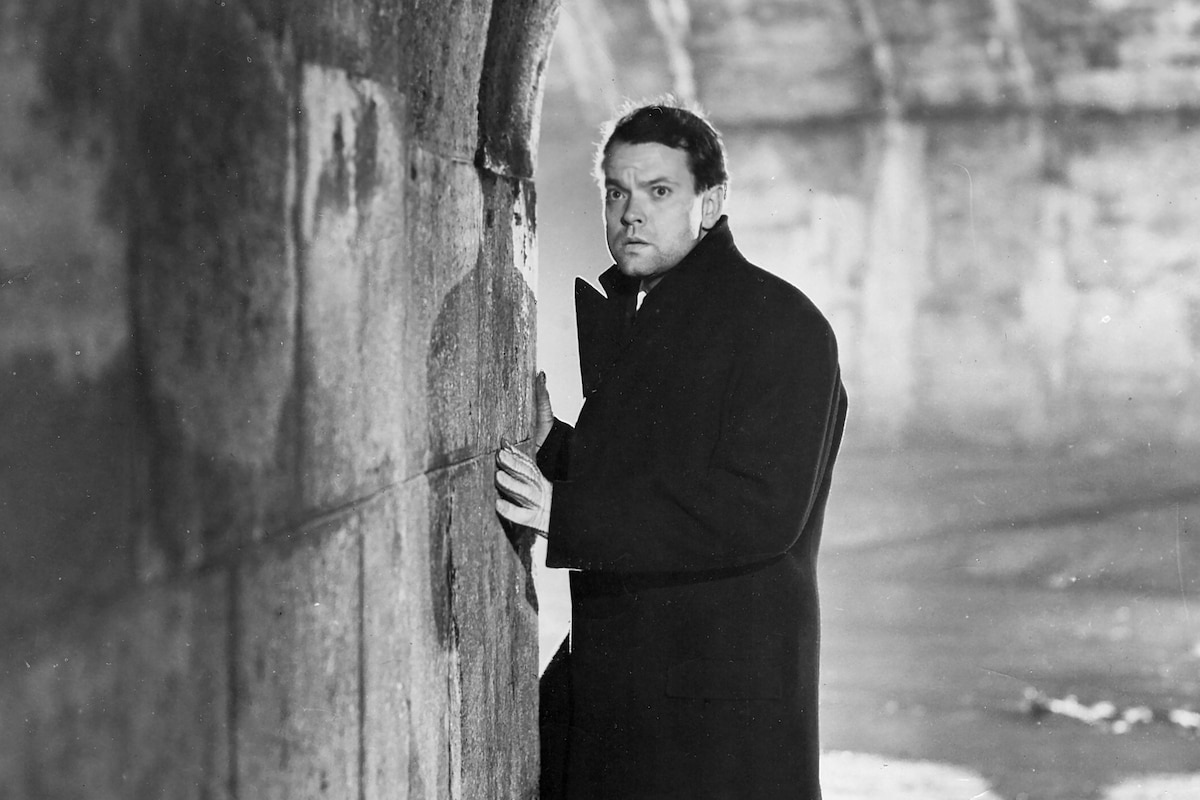
The Third Man is "the supreme
movie about the night-world, the
ultimate example of that
shining-streets-and-lurking-shadows
`realism' that was so popular in the
forties. But in addition to the
famous atmosphere - the knowing,
world-weary people; the magnificent
imperial ruins; the alternatingly
menacing and ingratiating zither
music - The Third Man sustains a
mood of pessimistic irony - which
seemed to reveal the nasty and
permanent truth about adult
experience, the truth that you could
not feel superior to as you got
older; life was not orderly and sane,
but chaotic, sordid and dangerous;
you didn't get what you wanted or
possibly deserved; moral virtue,
honesty and even courage might count
for very little, and these qualities,
as well as being useless, might make
you unappealing to women and a
general nuisance to everyone else.
With its extravagant, almost
voluptuous pessimism, The Third
Man provides a pleasurable
consolation in bad moments, a
reassurance that nothing was ever
meant to go right in the first place.
It's so enjoyable, in part, because
it gives the viewer the agreeable
sensation of having confronted the
worst." - David Denby, Favorite
Movies: Critic's Choice,
1973.
"...A tour de force on postwar
Vienna...for decades The Third
Man has worked as a mystery: you
can smell the sewers, the fear, and
the mistrust in Vienna. A time and a
place were captured; scenario and
locale were stirred, like cream going
into dark coffee. Joseph Cotten and
Holly Martins are from a writer's
forgotten drawer. But Trevor Howard,
Valli, and the wolfish Viennese faces
tell the truth. The Third Man
has one of the most intense
atmospheres the screen has ever
delivered." - David Thomson, The
New Biographical Dictionary of
Film.
"It is the highpoint of the British
entertainment film between 1946 and
1958...Not surprisingly, the moral
lessons of The Third Man tend
to be obscured by the accumulation of
incidents and sinister characters.
The clichés of melodrama abound, but
the total spell continues to
fascinate, a spell worked partly by
the crystalline photography of Robert
Krasker and the tantalizing,
regretful zither music of Anton
Karas." - Peter Cowie, Eighty
Years of Cinema.
"There is an ambiguity about our
relation to the Cotten character: he
is alone against the forces of the
city and, in a final devastating
stroke, he is even robbed of the
illusion that the girl (Alida Valli)
is interested in him, yet his
illusions are so commonplace that his
disillusion does not strike us
deeply. Greene has made him a
shallow, ineffectual, well-meaning
American." - Pauline Kael, 5001
Nights at the Movies.
"The film owes debts to the
Grierson/Rotha tradition of British
documentary film, as well as to the
post-war neorealism of Rossellini's
Roma Citta Aperta [1945] and
De Sica's Ladri de Biciclette
[1948]; like its Italian
predecessors, The Third Man
studies the effects of post-war
economic and social corruption within
the context of a once grand though
now rubble-strewn European
capital...But overshadowing all of
these influences is the presence of
Orson Welles in the role of Harry
Lime." - Leland Poague, The
International Dictionary of Films and
Filmmakers.
"This thriller is...in some ways a
portrait of the "cold war," then in
its early stages. Carol Reed's
perfectly controlled technique,
somewhat reminiscent of Lang and
Hitchcock, creates an overwhelming
melancholy atmosphere that is
heightened by the haunting,
relentless zither music and the
sharply drawn and well-acted
characters." - George Sadoul,
Dictionary of Films.
"Totally memorable and irresistible romantic thriller. Stylish from the first to last...Hitchcock with feeling, if you like." - Halliwell Film & Video Guide.
Awards and Honors:
The Third Man won the Grand
Prize at the Cannes Film Festival of
1949.
The Third Man received a
justly deserved Academy Award for
Best Black-and-White Cinematography,
which went to Robert Krasker. Also
nominated were Carol Reed for Best
Director and Oswald Hafenrichter for
Best Film Editing. Perhaps the film
would have done better had it been
released in the U.S. in 1949. Because
of the haggling over terms between
Korda and Selznick, the film did not
play in Los Angeles until early 1950,
causing it to be ineligible to
collect an Oscar® until
1951.
In 1950, The Third Man won for
Best British Film at the BAFTA
Awards.
The Third Man topped the "BFI
100," a list of a hundred of "the
best British films ever" compiled by
the British Film Institute in
1999/2000.
Compiled by John M. Miller
The Critics Corner (12/10) - THE THIRD MAN
February 23, 2005
SIGN UP FOR OUR NEWSLETTERS

CONNECT WITH TCM