Behind the Camera on THE THIRD MAN
By all accounts Carol Reed was a
relatively slow director, completing
only a few shots or set-ups per day.
Time was all-important during the
Vienna shooting of The Third
Man (1949), however, because the
location filming needed to be
completed before the late winter
snows set in. To accommodate this,
three shooting units were set up: a
day unit, a night unit, and a sewer
unit. Each had a separate director
of photography (Robert Krasker shot
the night footage), and Reed directed
all, aided by his assistant director
Guy Hamilton and (by some accounts)
Benzedrine.
Reed went to great lengths to capture
the atmosphere of the beleaguered
city on film, and he was helped along
by city officials and ordinary
inhabitants. On nights when rain was
unavailable to give the cobblestone
streets the appropriate glistening
sheen, for example, the city would
provide a fire brigade to wet things
down. Reed also incorporated many
local residents into the film as
extras such as the often glimpsed
balloon seller.
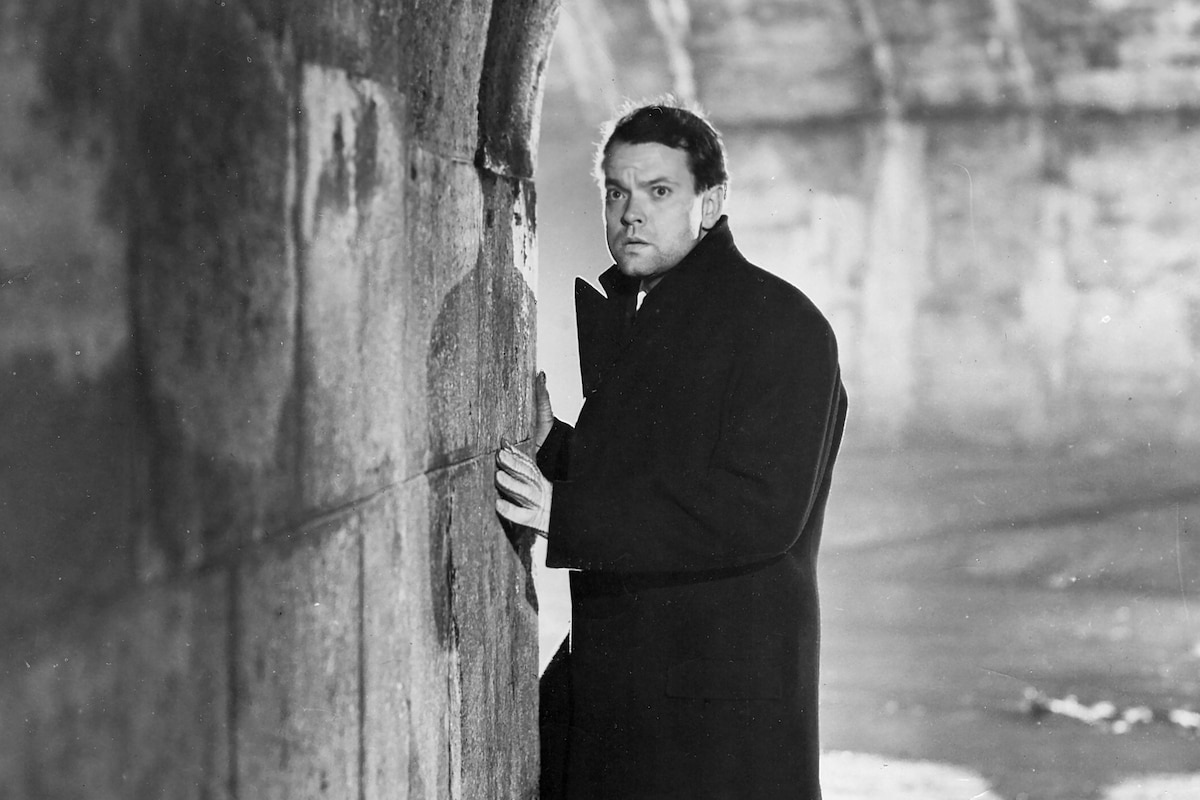
Orson Welles arrived in Vienna in
mid-November. Expecting to shoot
around him earlier in the filming,
Reed had already enlisted Guy
Hamilton to play Lime in shots
involving disembodied shadows caught
running on building sides. (In
another famous shot, Reed himself
stepped in for Welles - the fingers
seen reaching through the
street-level grate at the end of the
film are those of the director
himself). The first scenes to be
shot upon Welles' arrival were to
take place in the sewer. However, the
actor quickly fled the location as
soon as he saw (and smelled) the
sewer. In spite of the fact that the
crew and several actors had been
shooting down there for weeks, Welles
refused to participate. Most of his
scenes would be shot back in London
in a sewer set built at Shepperton
Studios. According to Reed's own
account of this (quoted in
Dictionary of Film): "Orson
suddenly turned up one morning, just
as we had set up our cameras in the
famous sewers. He told me that he
felt very ill, had just got over a
bout of influenza, and could not
possibly play the role...I entreated
him, in any case, just to stay and
play the scene we had prepared, where
he is chased along the
sewers...Reluctantly he agreed.
'Those sewers will give me
pneumonia!' he grumbled, as he
descended the iron steps. We shot the
scene again. Then Orson asked us to
shoot it again, although I was
satisfied with the first 'take.' He
talked with the cameraman, made some
suggestions, and did the chase again.
Then again. The upshot was that Orson
did that scene ten times, became
enthusiastic about the story - and
stayed in Vienna to finish the
picture."
Many accounts of Welles' tenure on
the film imply that he wrote all of
his own dialogue and/or took over
directing chores from Reed. In
truth, Welles added only the famous
"cuckoo clock" speech and a few odd
lines concerning indigestion
pills.
Wrapping the location shooting by the
end of 1948, the production shot for
three months at Shepperton Studios in
early 1949, only a week of which
involved Welles. It is a credit to
Reed and to art director Vincent
Korda that many viewers assume that
all of the shooting was done in
Vienna.
One of the key elements of the film's
unique flavor is the zither-only
score by Anton Karas. Reed heard the
zither player at a reception held
when the company arrived in Vienna.
On off days during location work,
Reed made demo recordings of Karas at
his hotel, later matching up the
demos to footage during rough
editing. He later brought Karas to
London for proper recording, still
intending to employ a mixture of
zither and conventional orchestral
scoring. As Reed combined the zither
playing to more of the final edited
shots, he realized they were a
perfect match and used the solo
instrument exclusively. When the
film opened to sensational notices,
almost every review singled out the
score for special praise.
by John M. Miller
Behind the Camera (12/10) - THE THIRD MAN
by John M. Miller | February 23, 2005
SIGN UP FOR OUR NEWSLETTERS

CONNECT WITH TCM