THE BIG IDEA - The Origins of THE
THIRD MAN (1949)
It may be a cliche to say that film
is a collaborative art, but in the
case of The Third Man (1949),
the term is particularly apt. The
movie was launched by not one, but
two, strong-willed moguls; it was
written by a celebrated
novelist/screenwriter/raconteur; its
director was riding a streak of
successes; and the actor playing the
title role was a notorious
multi-hyphenate in his own right.
The egos involved were massive, in
other words, and there was no doubt a
bit of luck involved in the fact that
the resulting movie not only thrived
on this energy - it became something
much greater than any one of the
major players involved imagined.
Sir Alexander Korda presided over his
London Films Productions and was
known as the leading film producer in
Europe. As such, he had offices both
in England and in various countries
around the Continent. World War II
had brought distribution to a halt
throughout most of Korda's European
territories, so after the war he took
stock of the situation. Due to
post-war currency controls, he found
that he had to keep some profits from
foreign distribution from leaving
those countries. To solve this
problem, he began to shift some of
his production into these countries
as well. On a visit to Vienna,
Austria he observed the unique
five-part Allied occupation of the
city and determined that the setting
would be ideal for a picture,
preferably a thriller.
Meanwhile, British director Carol
Reed was on a roll. In 1947 his
crime thriller Odd Man Out had
garnered him worldwide attention, and
he was presently finishing the film
The Fallen Idol (1948) for
Korda's London Films. This movie was
based on the story "The Lost
Illusion" by the celebrated British
author Graham Greene, who had also
written the screenplay. Upon its
release, this film would also reap
worldwide praise. Korda had an
agreement for American distribution
with mega-mogul David O. Selznick and
his Selznick Releasing Organization.
The Fallen Idol also did very
well at the U.S. box office. Reed
and Greene were ready to collaborate
again, and were anxious to lighten
the mood with a comedy-thriller.
Greene would later say that Korda
made the request that Greene devise a
story to take place in post-war
Vienna, so Greene pulled out the
intriguing opening line of a story he
had filed away several years before:
"I had paid my last farewell to Harry
a week ago, when his coffin was
lowered into the frozen February
ground, so it was with incredulity
that I saw him pass by, without a
sign of recognition, among the host
of strangers in the Strand." Other
accounts indicate that Greene
actually had the story more or less
worked out, and that he and Reed
approached Korda, who then suggested
the Vienna setting. At any rate,
Greene checked into a hotel in Vienna
in February 1948 on Korda's tab and
spent two weeks there in writing and
research. Here he no doubt
discovered the intricacies of the
divided sectors of the city, the
black markets that flourished, the
ways in which the inhabitants
maneuvered through the bombed-out
rubble and bargained for goods and
services, and perhaps most famously,
the way the sewer system beneath the
city was patrolled by a special
police detail. Greene went on to
Italy and finished writing his
novella, The Third
Man.
Greene's novella was published in
1950, after the release of the film,
but it could more properly be called
a film treatment. Greene himself
admitted that the movie was superior,
writing in his introduction that the
novella "..was never intended to be
more than the raw material for a
picture. The film is - the finished
state of the story." The screenplay
was written in tighter collaboration
with director Reed.
Korda and Selznick entered into
further negotiations in May of 1948
to launch co-production deals to
circumvent the British governments'
Anglo-American Film Agreement, which
restricted the revenues which could
be converted from the box-office to
American film studios. Korda also
welcomed the chance to bring an
American flavor to his films to
increase their earning potential in
that country. The first film in this
agreement was to be The Third
Man, which now would also feature
a partial American cast. Along with
the deal, for better or worse, would
be the creative input of David O.
Selznick, who was notorious for being
a hands-on micromanager of projects.
The vast number of memos and
directions that sprang from his
dictation on productions such as
Gone with the Wind (1939),
Rebecca (1940),
Spellbound (1945), and Duel
in the Sun (1946) were already
well known and legendary in
movie-making circles. Selznick saw
the script and the criticisms and
suggestions began immediately.
Greene and Reed traveled to America
for conferences with Selznick for two
weeks in August 1948. It was
Selznick's idea to open the film with
a brief documentary treatment
explaining present-day Vienna. Reed
approved of this, but virtually every
other suggestion by Selznick was
ignored. Selznick was primarily
concerned about the depiction of the
two Americans, one evil, the other a
fool. At Selznick's urging, Reed did
bring in a writer, Jerome Chodorov,
to work uncredited to make the
Martins's dialogue more "American."
In typical fashion, Selznick went on
to obsess in memo form about costumes
(Valli's weren't glamorous enough),
the title (he preferred something
more prosaic like "A Night in Vienna"
or "The Claiming of the Body"), and
casting (he desperately wanted Noel
Coward for the role of Lime).
Selznick's most important
contribution was the loan of two of
his contract players, Joseph Cotten
and Alida Valli, for the leads.
Ironically, Reed himself would have
preferred James Stewart in the
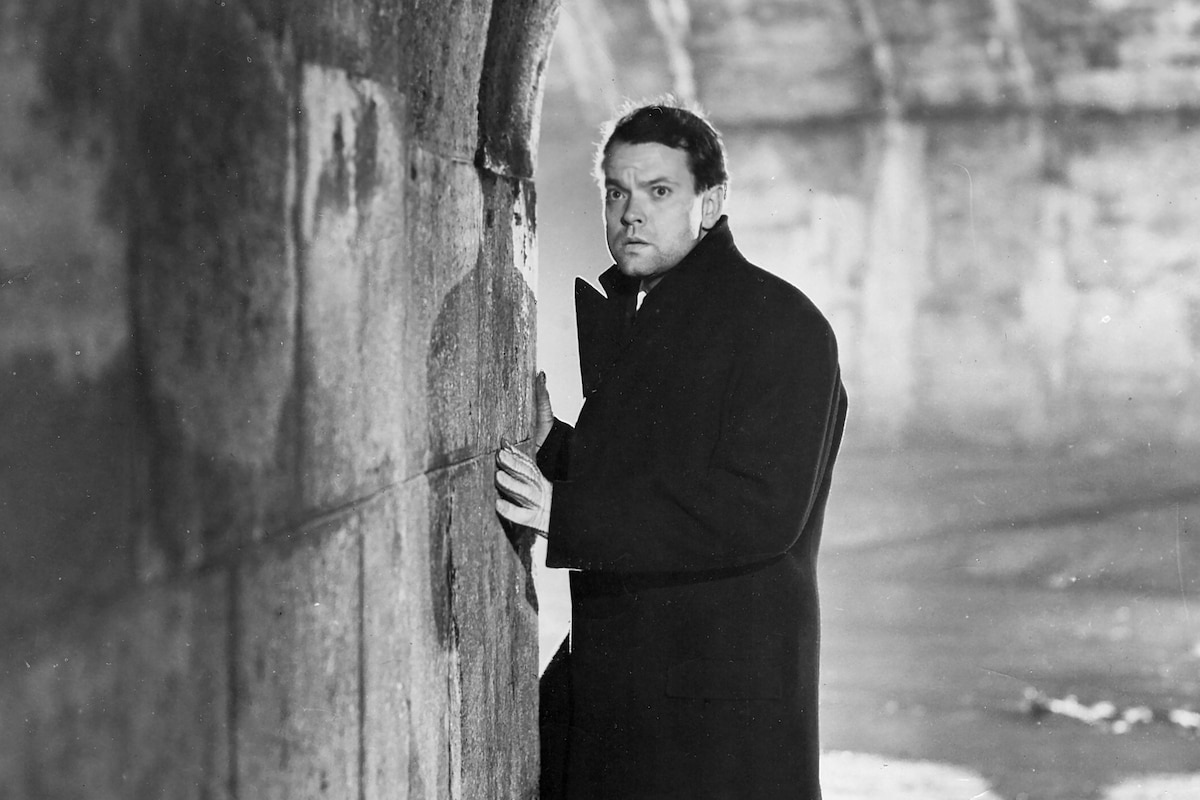
Martins role. With Welles and Cotten
now cast, however, it seemed
appropriate that the two old friends
Lime and Martins were to be played by
two actors who were old friends in
real life. Principal photography was
set to begin in Vienna in October
1948.
by John M. Miller
The Big Idea (12/10) - THE THIRD MAN
by John M. Miller | February 23, 2005
SIGN UP FOR OUR NEWSLETTERS

CONNECT WITH TCM