SYNOPSIS
An American writer of pulp westerns,
Holly Martins, arrives by train in
the war-torn, divided city of Vienna.
He has been promised a job there by
his boyhood friend, Harry Lime.
Martins arrives just in time to
attend his friend's funeral; he is
informed that Lime has just been
killed in a traffic accident.
Martins seems determined to
investigate Lime's death, in spite of
being told repeatedly that he should
leave the country and go home - both
by Major Calloway, the British
officer who was pursuing Lime for
black marketeering, and by Lime's
former lover Anna, with whom Martins
is falling in love. Eventually,
Martins learns much more about Lime
than he ever wanted to know while
grappling with questions of morality
far more complex than those
introduced in his western novels.
Producer/Director: Carol Reed
Executive Producers: Alexander
Korda, David O. Selznick
Associate Producer: Hugh Perceval
Screenplay: Graham Greene
Cinematography: Robert Krasker
Film Editor: Oswald Hafenrichter
Assistant Director: Guy Hamilton
Music: Anton Karas
Makeup: George Frost
Sound Editor: Jack Drake
Set Designers: Joseph Bato, John
Hawkesworth, Vincent Korda
Principal Cast: Joseph Cotten (Holly
Martins), Alida Valli (Anna Schmidt),
Orson Welles (Harry Lime), Trevor
Howard (Major Calloway), Bernard Lee
(Sgt. Paine), Paul Hoerbiger
(Porter), Ernst Deutsch (`Baron'
Kurtz), Siegfried Breuer (Popescu),
Erich Ponto (Dr. Winkel), Wilfrid
Hyde-White (Crabbin), Hedwig
Bleibtreu (landlady)
B&W-104m.
Why THE THIRD MAN is
Essential
Film Noir is typically thought of as
a purely American style or genre, but
in 1949 two Englishmen - novelist
Graham Greene and director Carol Reed
¿ collaborated to flesh out an idea
by producer Alexander Korda for a
film set in the divided war-torn city
of Vienna. The resulting movie,
The Third Man, was an
overnight worldwide hit and is often
listed as the greatest British film
of all time. An American influence
came from producer David O. Selznick
and the stars Joseph Cotten and Orson
Welles, but there is no mistaking the
European flavor of the movie. Shot
largely on location, it captures the
darkness and decay of the formerly
grand city that is now littered with
rubble, just as it captures the
corruption and decadence in the soul
of people warped by World
War.
The Third Man works on many
more levels than merely the
"entertainment" that Greene termed it
to be. It wonderfully captures a
time and a place unique in history;
it is an early example of a cold-war
intrigue that, while not depicting a
single spy, can be seen as a
prototype for spy thrillers to come.
It also works as a study of post-WWII
morality with Harry Lime viewing his
victims not as human but as
far-removed dots that stop moving.
It is also a character study
featuring a hopeless love triangle.
The Third Man won an
Oscar® for cinematography at the
1951 Academy Awards (it also received
nominations for directing and
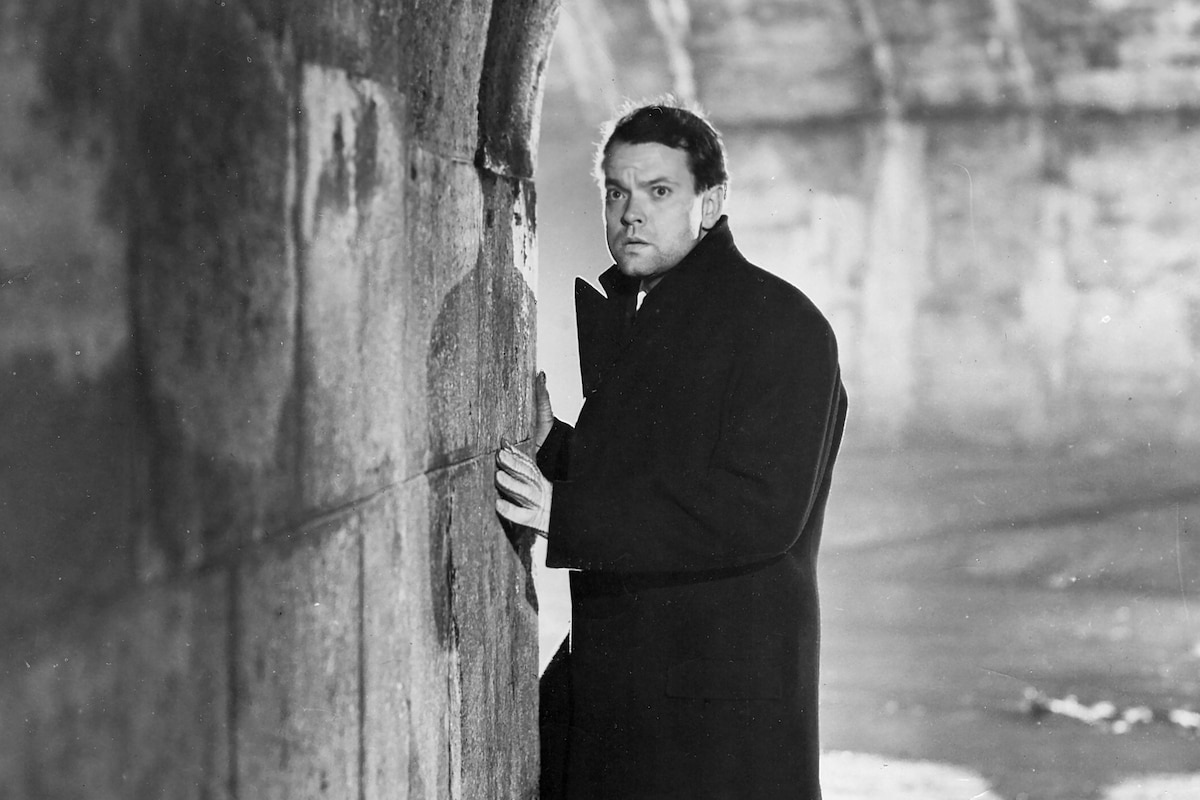
editing). Robert Krasker shot the
night scenes of the film, which
present a brilliantly stylized world
filled with wet streets, shining
cobblestones, shafts of brilliant
light illuminating running shadows -
angled shots with stark contrasts and
deep-focus baroque detail. The
flashy photography was not merely for
show. It truly reflected the mindset
of a city divided. The story, too,
is served by the theatrics, and the
corruption and decay of the city is
also reflective of the corrupted
morals to be found within. In a
movie filled with wonderful
performances, Orson Welles is truly
unforgettable as Harry Lime. One of
the great, complex villains of the
cinema, Lime sets himself up in the
Russian sector after being "killed"
in an accident, and maneuvers about
the city using the underground sewer
system.
Aside from the intrigue that occurs
in the city on this horizontal plane,
it is interesting to note the
parallel that the moral ambiguities
of the movie have to the vertical
plane, i.e., it is atop one of the
highest points in the city that Lime
rationalizes his crimes, while it is
in the underground sewers that he
conducts most of his business and is
finally served justice.
Graham Greene and Carol Reed also
present a fascinating character study
and a most unorthodox love triangle.
Our nominal hero is ineffectual and
naïve. He arrives in Vienna as a
know-nothing but never seems to learn
his lesson. He falls in love with a
woman that he hasn't got a chance
with, because she loves a dead
man.
Carol Reed directs with assurance in
this, his greatest film. There were
ups and downs in his career (he
finally won an Oscar® in 1968 for
his energetic but uncharacteristic
work on the musical Oliver!),
but he brought together every
disparate element with aplomb in
The Third Man. He had a sense
of what would work in the film, even
when at first it appeared to be a
square peg in a round hole. The most
rewarding example of this is the
music score. Reed avoided using the
expected Viennese waltzes, and
instead scored the film entirely with
the plinking jangle of zither music.
At the time, it was considered an odd
choice, but the result is quite
unique and now it seems just
right.
The Third Man rewards repeated
viewings because it goes far beyond
being a witty and exciting
mystery-thriller. It flips all
expectations on their heads by
featuring an attractive embodiment of
villainy and ineffective heroism; an
enjoyable sense of cynicism and a
bleak view of romance; a calming
sense of chaos and a nostalgic vision
of decadence. And when you meet
Harry Lime, prepare yourself for a
smiling justification for everyday
corporate evil in the post-war modern
world.
by John M. Miller
The Essentials (12/10) - THE THIRD MAN
by John M. Miller | February 23, 2005
SIGN UP FOR OUR NEWSLETTERS

CONNECT WITH TCM