Behind the Camera on MOGAMBO
Director John Ford and producer Sam Zimbalist arrived in Africa two months before principal photography began to prepare for the shoot. They also dispatched a second unit crew to French Equatorial Africa to shoot footage of wild gorillas to be cut into scenes with the stars. This seamless editing trick was never announced to the press, for fear it would undermine the authenticity of the production. The second unit crew was led by famed stuntman Yakima Canutt, who had stood in for Clark Gable on Gone with the Wind (1939).
To get to the film's African locations, Gable was forced to fly for the first time since the death of his wife Carole Lombard in a plane crash. The flight hit a storm with rock-sized hailstones and had to make a forced landing in the jungle. That near-disaster actually reawakened his interest in flying.
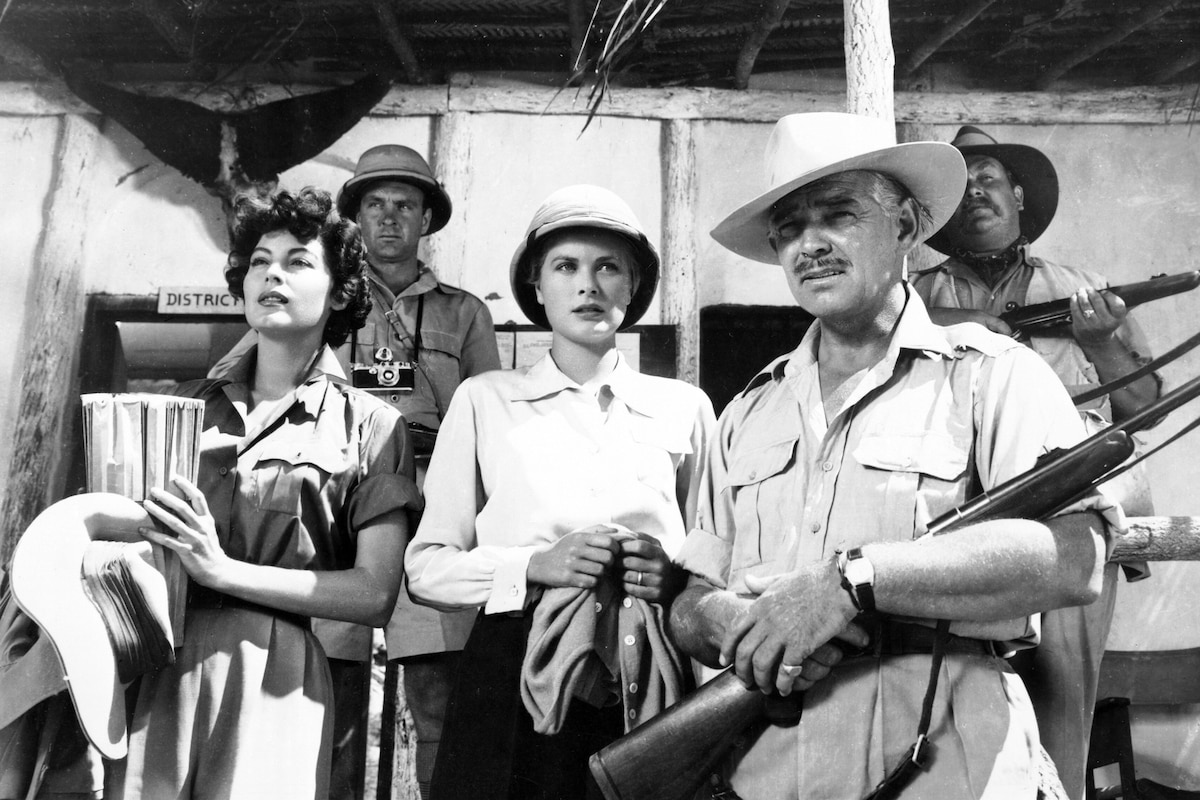
For the location filming, MGM assembled one of the largest safaris in modern times. There was a staff of over 500, including eight "white hunters." The shoot required 13 dining tents, a traveling movie theater, an entertainment tent with pool tables, a hospital with its own X-ray machine, luxurious private tents for the stars and even a jail. The crew created an 1800-yard airstrip in the jungle so they could fly in mail, food and medical supplies from Nairobi and fly out each day's rushes. The camp was first set up in Tanganyika, then reassembled in Uganda.
The safari left Nairobi on November 1, 1952, traveling 1,000 miles over the next eight days to get to a location along the Kagera River in Tanganyika. Other scenes were shot in Kenya, Uganda and French Equatorial Africa.
Ava Gardner arrived in Africa for location shooting with current husband Frank Sinatra in tow. Their marriage was on the rocks at the time following a huge bust-up during a house party at which Lana Turner was a guest. Some reports claim Sinatra found the two women in bed together. More likely, he caught them giggling over the sexual prowess of musician Artie Shaw, to whom both women had been married (Sinatra was jealous of all of his wife's previous romances). At first he canceled his plans to accompany her to Africa. When Gardner changed her phone number, he proposed a reconciliation in Earl Wilson's gossip column. They spent most of their time on location fighting and making up, both at top volume.
Gardner had barely met Ford before filming started. On location, she was upset that he didn't treat her as a star and wasn't giving her much direction. Finally, she turned away from him in anger while shooting a scene. He pulled her aside and told her "You're damned good. Just take it easy." (Quoted in Charles Higham, Ava). From then on, they got along fine.
During the filming, Sinatra had caught word of Columbia Pictures' plans to film From Here to Eternity (1953) and launched a campaign to win the plum supporting role of Maggio. He got Gardner to call studio head Harry Cohn, a friend of hers, and intercede for him. He was in Africa when Cohn demanded a screen test. Gable loaned him the money to return to the states. Sinatra won the role -- which would win him an Oscar® and trigger one of the biggest comebacks in film history -- and returned to the location for a much happier visit with his wife.
Gardner was pregnant at the start of filming, and as her pregnancy progressed she began to suffer greatly from the heat. Finally, she took a break in England, where she wound up in the hospital. Publicity flacks, who had not released news of her pregnancy, said she was suffering from anemia. A few years later she would say that she had suffered a miscarriage, but in private she told the wife of cinematographer Robert Surtees that she had had an abortion. At that point in her relationship with Sinatra, she hated him so much she did not want to bear his child.
Gable got sick on the Mogambo location. A gum infection forced him to return to Los Angeles, mainly because he insisted on seeing his own dentist.
When he returned to the set, Sinatra brought with him spaghetti, tomato sauce and other Italian foods. He and Gardner prepared a massive feast for the entire company. Years later, Ford would say the dinner was the condition he set for allowing Sinatra to come along on the shoot.
During much of the Kenya shoot, Ford and the stars stayed in hotels in Nairobi and flew to and from the location.
Always an avid sportsman, Gable spent breaks in filming hunting in the wild. He was delighted to learn that co-star Grace Kelly enjoyed hunting, too. As they went off together, the two developed a romance. Kelly started calling him "ba," the Swahili word for "father," which was close to "Pa," Lombard's nickname for him. Kelly would later admit to going skinny-dipping with him. Donald Sinden, who played Kelly's husband in the movie, later told interviewers he had caught Gable and Kelly in bed together.
Hundreds of native tribesmen were flown in to appear in the film, including some from tribes that were traditional enemies. The entourage included 68 members of the Wagenia tribe, hired to film a boat trip through the rapids. When they decided their gods were not present on the river, producer Sam Zimbalist flew in three chiefs from Leopoldville to bless the sequence.
During filming in Kenya, MGM hired armed guards to protect the cast and crew in the event of an attack by Mau Mau terrorists. It was rumored that the studio made a secret payment of $50,000 to Mau Mau leader Jomo Kenyatta to protect the cast and crew. Nonetheless, all involved in the filming were issued weapons with which to protect themselves.
While Gardner was shooting a scene with a baby elephant, the creature pushed her into a mud pool. She screamed for help, but Ford motioned the crew to keep quiet and keep on filming. The scene proved to be one of the funniest in the movie.
To shoot the rhinoceros attack on Gable and Gardner's car, hunter Frank "Bunny" Allen drove the camera car so he could keep an eye on the animal. When two other rhinos appeared from the bush and charged the camera car, Allen and cinematographer Robert Surtees were sent flying 100 feet -- in the jeep. Allen finally had to kill two of the animals.
Animals weren't the greatest danger on the set, however. That honor belonged to the various vehicles required for filming in the rough terrain. Assistant director John Hancock was killed when his jeep crashed.
Some episodes in the film were based on events that happened during the shoot. Just as in the movie, a leopard actually wandered into Gardner's tent one night. She also took a stab at cooking for the entire crew, just as her character does on screen.
Years of heavy drinking had left Gable with a case of the shakes. Ford, who suffered from the same problem, was sympathetic and tried to shoot around Gable's bouts of palsy. When the schedule got tight, however, he refused to re-take a scene between Gable and Gardner. This led to a rift between the two. Though they were able to finish filming without any more problems, Gable would never work with the director again.
Christmas fell during the shooting schedule. At the company's celebration, Sinatra and the natives sang Christmas songs, and Ford read "'Twas the Night Before Christmas." Among Sinatra's presents to Gardner was a shower unit he set up with one of the production's carpenters.
After they finished location shooting in Africa on January 28, 1954, the cast and crew took a brief vacation, then assembled in England to shoot the film's interiors.
With the company moved to London, Freddie Young took over as cinematographer. He would later win Oscars® for such David Lean films as Lawrence of Arabia (1962) and Doctor Zhivago (1965).
During the London shoot, Gable took a room in an out-of-the-way hotel so he and Kelly could continue their relationship discreetly. Unfortunately, this was also when the affair ended. Kelly's mother came to stay with her in London, and her apparent approval of the relationship and hopes that the two would marry scared Gable off. He stopped returning Kelly's phone calls and avoided her on the set. When the distraught actress went to Gardner for advice, her co-star counseled "He likes to conquer, and when he's done, he's through with them, and he leaves them" (quoted in Warren G. Harris, Clark Gable).
Taglines used to sell the film include "Flaming love found in the savage heart of the jungle!" and "The battle of the sexes! The battle of the gorillas!"
by Frank Miller
Behind the Camera (9/3) - MOGAMBO
by Frank Miller | February 23, 2005
SIGN UP FOR OUR NEWSLETTERS

CONNECT WITH TCM