Pop Culture 101 - FORT APACHE
John Ford explored similar themes of leadership, heroism, and a doomed battle against superior hostile forces in his earlier World War II action drama, They Were Expendable (1945), which also starred John Wayne as a second-in-command (to Robert Montgomery's leader).
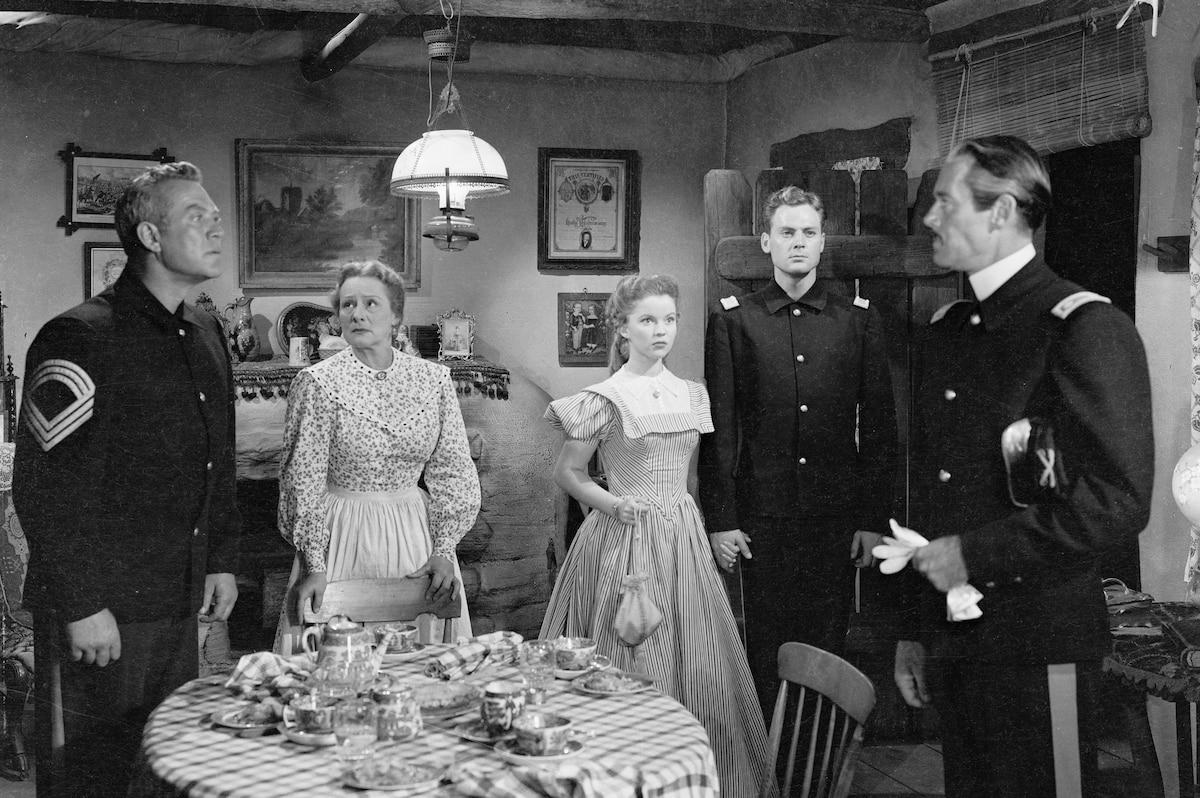
Fort Apache (1948) was the first of a trilogy of pictures John Ford made about the U.S. Cavalry in the Old West. It was followed by She Wore a Yellow Ribbon (1949) and Rio Grande (1950).
John Agar, who plays 2nd Lt. O'Rourke in this picture, also appears in Ford's follow-up, She Wore a Yellow Ribbon, playing Lt. Flint Cohill. In James Warner Bellah's story "Massacre," on which Fort Apache is based, that was the original name of the character played in this film by John Wayne and here called Capt. Kirby York. And in this picture, Dick Foran plays the small part of Sgt. Quincannon. That's the name of the character in both She Wore a Yellow Ribbon and Rio Grande played by Victor McLaglen (he plays Sgt. Mulcahy in Fort Apache). There was even a B-movie Western with the title Quincannon, Frontier Scout (1956) starring singer Tony Martin but it had no connection to Fort Apache.
In Rio Grande, Wayne reprises his role as York, promoted to Lt. Colonel, commander of Fort Stark.
Capt. York's noble gesture of telling an official lie about Col. Thursday's leadership, for the sake of honor and the good of the community, is similar to the outcome of Ford's The Man Who Shot Liberty Valance (1962). In that film, a character (also played by Wayne) allows the town to believe James Stewart's character was the one who rid them of the villain Valance, when in fact it was Wayne himself who shot him. A famous line from the later picture may serve not only as a summary of the ending of Fort Apache but also as a thematic statement relevant to almost all of Ford's movies eulogizing the Old West: "When the legend becomes fact, print the legend."
Ford's beloved Monument Valley was a prominent location in many of his films, including Stagecoach (1939), My Darling Clementine (1946), Cheyenne Autumn (1964), and the entire Cavalry Trilogy. The iconographic Utah location has been used in dozens of films, not only traditional Westerns but also the musical The Harvey Girls (1946), the counter-culture classic Easy Rider (1969), and the drama Forrest Gump (1994).
The idea of a beleaguered outpost in hostile territory with a seasoned pro and a tough commander was updated to a police action drama in urban New York in Fort Apache the Bronx (1981).
The fort built for Fort Apache stood for years and was used in dozens of other productions. It was located at the Corriganville Movie Ranch in Simi Valley, California, a location that has been home to more than 200 film and TV productions. The site is now a city park.
The story is loosely based on the historical details of General George Armstrong Custer's defeat by the Sioux at Little Big Horn. The cover-up by the survivors and the military of Thursday's blunder mirrors the cover up of Custer's errors and his disobedience of orders that led to the famous massacre. Custer's Last Stand has formed the basis for many movies, among them They Died with Their Boots On (1941) with Errol Flynn, Little Big Man (1970) with Richard Mulligan, and Touche pas a la femme blanche (1974), an absurdist black comedy by Marco Ferreri with Marcello Mastroianni as Custer. The historical figure was also depicted on screen as a young officer (played by Ronald Reagan) in Santa Fe Trail (1940).
The Apache leader in Fort Apache is Cochise, a real-life warrior chief who opposed white intrusion into his people's territory in the Southwest for 10 years, until his surrender in 1871. He died on a reservation in 1974. He has been played by a number of actors in other films, including Jeff Chandler in Broken Arrow (1950), The Battle at Apache Pass (1952), and Taza, Son of Cochise (1954).
Pop Culture: Fort Apche (1948)
by Rob Nixon | February 23, 2005
SIGN UP FOR OUR NEWSLETTERS

CONNECT WITH TCM