Behind the Camera on FORT APACHE
Shooting began in Monument Valley late in July 1947. Ford had an almost spiritual attachment to the place and was largely responsible for making it the definitive location for Western films. Besides, Ford would never consider shooting one of these films on a backlot. "I think you can say that the real star of my Westerns has always been the land," he said later.
Battle sequences were shot on the Arizona side of Monument Valley since insurance rates for stunt performers were lower there than on the Utah side.
Ford used Navajo to play the Apache, regarding them as "natural-born actors" and very dependable. He respected these people and they enjoyed working for him. They loved it when a movie was being shot anywhere nearby because it meant work. They would travel by wagon many miles for a job and knew they could count on a big lunch on a Ford set. The movie required 200 Navajo as Apache warriors and another 100 Navajo women and children. It also required 100 non-Indian extras as cavalry troops.
Conditions were difficult, with temperatures sometimes rising to 115 in the day and cooling only to 90 degrees at night. Shooting was delayed several times by high winds and desert storms.
Although Ford would not allow wives and girlfriends onto his locations, John Wayne was allowed to bring his son Michael with him to Monument Valley. He later described the rugged conditions and the long, six-days-per-week working hours. "The only thing people could do in Monument Valley was work; there was no other diversion," Michael Wayne said. "But the rougher it was, the more Ford seemed to like it."
Ford also seemed to enjoy creating difficulties among cast and crew, starting fights and behaving abusively, all of it designed to make everyone fearful of him and obedient. Although Henry Fonda would work with Ford nine times over the course of their careers, the actor found the director's unwillingness to rehearse emotional scenes frustrating. He noted how if he wanted to discuss a scene, Ford would just change the subject or tell him to shut up. And Fonda never became comfortable with Ford's foul language and bullying ways. "I literally saw tears coming out of Henry Fonda's eyes on Fort Apache," Michael Wayne recalled. "He just turned and walked away."
Fonda had his own personal problems at this time: lack of rewarding roles; the difficulties of shooting his last movie with Ford, The Fugitive (1947), and its complete failure at the box office; failed marriages; alienation from his children and some of his friends over the years. His biographer Peter Collier asserts that "the ramrod cavalry martinet he played in John Ford's Fort Apache was perhaps closest to his off-screen personality at this time."
Although he had problems with Ford, Fonda also admitted the director was responsible for some of his best work. Film critics have often agreed, noting that before working with Ford, Fonda was a star but after, we was an actor.
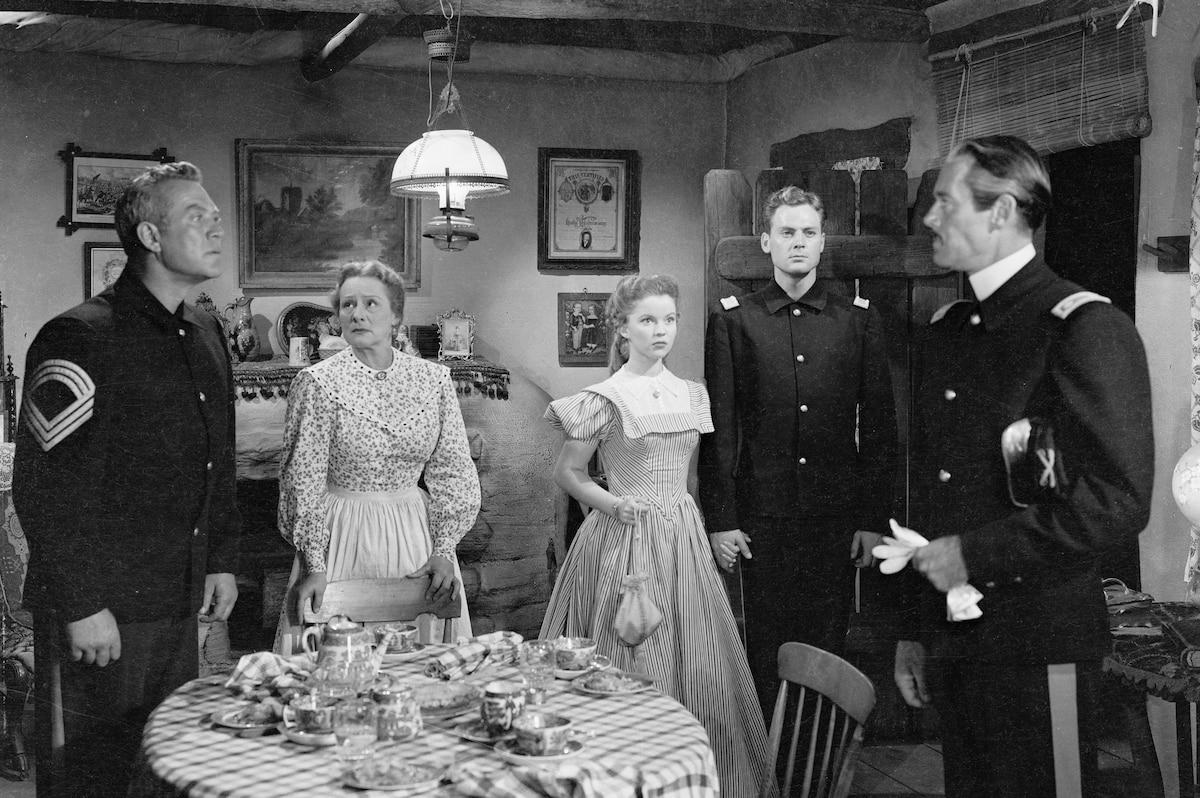
The cast member who had the hardest time with Ford, however, was John Agar, making his film debut. Whether it was because Agar was newly married to Ford's beloved Shirley Temple or because he wanted to test him, the director rode him mercilessly, calling him "Mr. Temple" in front of everyone, criticizing the way he delivered lines, chastising him for his lack of expert horsemanship. One day, Agar stormed off, vowing to quit the picture, but John Wayne took him aside and helped him with some of the more difficult aspects of his job.
Frequent Ford player Ward Bond (they made 26 pictures together) got his share of abuse and ribbing, not only from Ford but Wayne, too. The two used to tease him mercilessly about what they said was the enormous size of his rear end. The burly, rough-edged Bond harbored ambitions of becoming a romantic lead, much to everyone's amusement, and kept complaining throughout the picture that he should have been playing Wayne's role. Ford simply dismissed him with the nickname "Big and Double Ugly."
When working with Ford, John Wayne gave himself over completely to the director's intentions and orders and had great respect for Ford's talent. "When he pointed the camera, he was painting with it," Wayne said. "He didn't believe in keeping the camera in motion; he moved his people toward the camera and away from it."
Another mainstay on the set was Danny Borzage, brother of director Frank Borzage, who Ford would hire as a bit player so Danny could be around to play the director's favorite songs on the accordion between takes to keep the mood lively. Michael Wayne also recalled that sometimes the sound of Borzage's accordion, or someone singing without accompaniment, would be all that pierced the silence at night, while heat lightning flashed in the distance.
Shirley Temple, in one of her first adult roles, was pregnant during shooting and worried that riding horses or wearing her corset too tight would induce miscarriage.
It wasn't just cast members who had a hard time with Ford. Cinematographer Archie Stout quarreled with him frequently and even refused to shoot certain scenes the way Ford wanted them.
Although accidents on Ford's sets were seldom occurrences, there were some close calls in the stunt work on this movie. One stunt performer broke his back during shooting. And in a shot of a speeding munitions wagon going around a sharp bend, the vehicle turned over, dragging the four people on board right toward a rock wall. Luckily stuntman and occasional actor Ben Johnson galloped in and prevented a potentially deadly accident. He was rewarded with a seven-year contract with Argosy and substantial roles in the years to come.
During shooting of one scene, it began to rain, but Ford kept right on filming. Fonda later noted that although you didn't see the rain on screen, the light moisture on the leather of the saddle and harness added an unusual quality. "That was Pappy taking advantage of whatever presented itself," Fonda said.
Location filming wrapped on August 11 and work resumed two days later back in California. A fort was built and all interiors were done there. Filming was completed by October.
Realizing the director needed expert, fast-paced editing to make his pictures work, producer Cooper managed to get Ford to turn over control of this and other films once principal photography was over.
Behind the Camera: Fort Apche (1948)
by Rob Nixon | February 23, 2005
SIGN UP FOR OUR NEWSLETTERS

CONNECT WITH TCM