The Big Idea Behind FORT APACHE
After World War II, more and more filmmakers began forming their own production companies independent of the big studios. Director John Ford and producer Merian C. Cooper had already discussed such a venture before the war, and once Ford returned from the Navy, they jumped on that independent bandwagon. In April 1946, shortly before Ford left for Monument Valley to begin shooting My Darling Clementine (1946), they formed Argosy Pictures with Cooper as president and Ford as chairman of the board.
Ford didn't care much for producers and claimed he had no idea what they did, but he respected Cooper, who gave him total artistic control while Cooper handled all the financial demands. Their first picture was The Fugitive (1947), a strange and haunting story about a priest (played by Henry Fonda) in Mexico living under an anti-clerical regime. It received mostly glowing reviews but the movie was a commercial failure, prompting Argosy to look for projects that would be solid box office successes.
Ford decided to produce a Western since it was more likely to reach the largest audience at that time when the genre was extremely popular. So he turned to a series of stories written by James Warner Bellah for the Saturday Evening Post. Fort Apache (1948) was based on the story "Massacre."
Bellah was not a natural fit for Ford. The right-wing writer (described by his own son as "a fascist, a racist, and a world-class bigot") had great contempt for Ford, who he considered a tyrant (which wasn't entirely off base) and referred to as a Shanty Irishman. But although he disliked Hollywood (because it was "full of Jews and crass commoners," according to his son), he loved money and knew there was plenty to be made in motion pictures. So he managed to swallow his "ideals" to collect his checks.
One aspect of Bellah did make him an ideal source: he wrote exciting action stories with strong, concise dialogue that adapted well to the screen. Ford read Bellah's "Massacre" on board a ship for Hawaii and instructed Cooper to buy the movie rights. He decided to use it to tell his version of the legend of George Armstrong Custer, a real-life Cavalry officer who ignored the best wisdom of his advisers, scouts and superiors and led his troops to their death in the famously disastrous Battle of Little Big Horn.
To adapt the story, Ford hired Frank Nugent, a former New York Times critic who had been brought to Hollywood in 1941 by Darryl Zanuck to be a script doctor. This was Nugent's first screenplay, and he was determined to avoid Bellah's harsh view of the Indians as rapists, thieves, and murderers and portray them with the sympathy he felt they deserved.
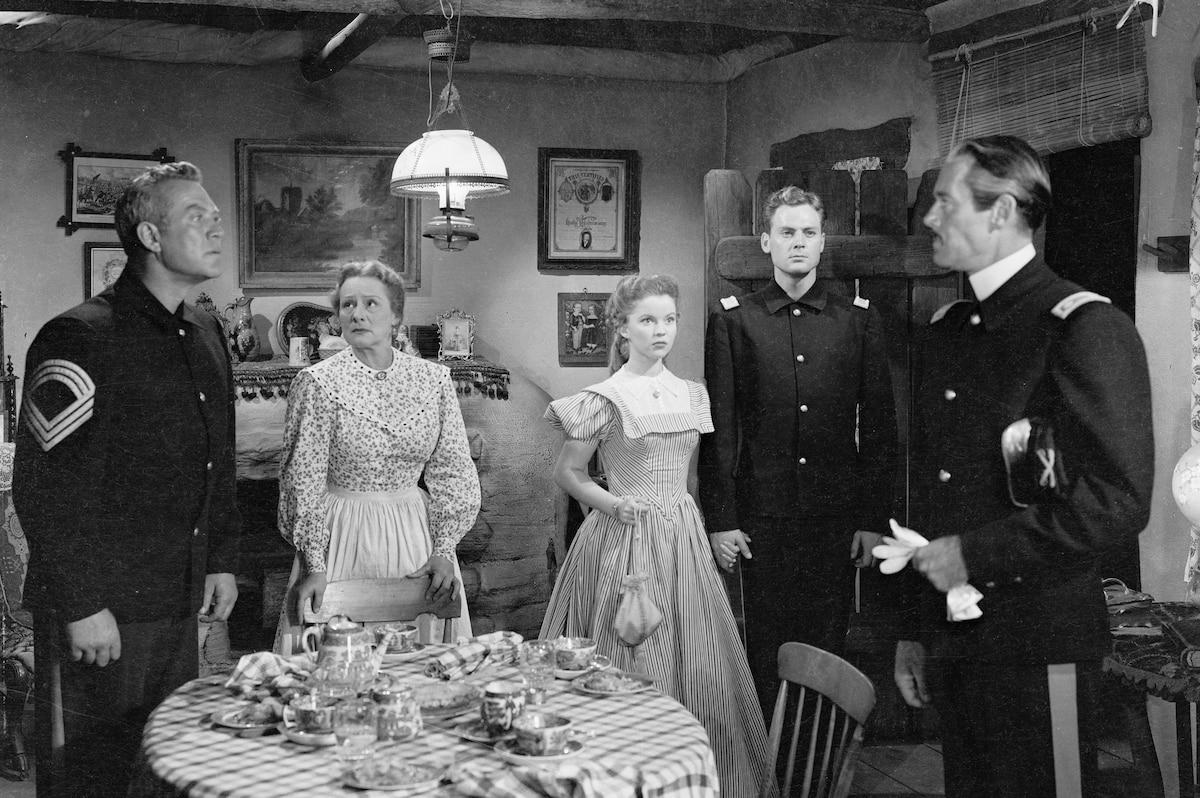
As they outlined the script, Ford told Nugent that in all the Westerns he had seen, the cavalry only functions to ride into the story, save the main characters, and ride off again. "I've been thinking about it - what it was like at a cavalry post, remote, people with their own personal problems, and over everything the threat of Indians, of death," he said. So the two set out to create not just a rousing action entertainment but a human story of the lives of military men in the old West and their families.
Ford handed Nugent a list of 50 books to read covering all aspects of the setting and period. He also sent Nugent to Apache country to get a sense of the land; the writer hired a University of Arizona anthropology student as his guide. After he returned, Ford asked him if he thought he had gathered enough information. When Nugent answered yes, Ford told him, "Good. Now forget everything you've read and we'll start writing a movie."
Nugent sensed that Ford had vague story ideas in mind but didn't know how to develop them, so his working method became a simple routine: write a rough scene, then send it to Ford for comments. He focused mainly on character development, aware that Ford hated exposition and would supply much of his own dialogue.
Ford had Nugent do something on this project that the writer continued throughout his career - write out complete biographies for every character: birth details, education, politics, drinking habits, quirks, etc.
Although they would work together on 11 pictures, writer and director did not establish the same close relationship Ford had with Dudley Nichols, nor did Ford have the same level of respect for Nugent, even though Nugent married Ford's daughter. "Once the script is finished, the writer had better keep out of his way," Nugent said. "The finished picture is always Ford's, never the writers." Nevertheless, Ford was lucky to receive both Nugent's and Cooper's contributions to the project. According to screenwriter Philip Dunne, who worked with Ford on How Green Was My Valley (1941), "Ford doesn't really understand scripts. He has no story sense. He has a great sense of scenes. But Ford should never be the producer of his pictures."
Ford made certain that the story included several Irish characters; he wanted to include "a bit of Americana" by depicting the type of Irish-American who headed west after the Civil War.
Movie censor Joseph Breen had some problems with the script. He was concerned about a scene of the men working at a manure pile as possibly offensive and insisted that a shot of two dead troopers be handled discreetly without any overt gruesomeness. He also gave orders that no toilet should be shown on screen and that drinking scenes be kept to a minimum. Breen also instructed Ford to keep constant contact with Mel Morse, regional director of the American Humane Society, regarding any scenes involving horses or other animals.
While Nugent completed the script, Ford went scouting locations in Monument Valley. Fully aware that he needed a moneymaker to keep Argosy solvent, Ford spent six months carefully planning a shooting script and pre-production set-ups so that he was able to cut his budget from $2.8 million to $2.1 million and shorten the planned shooting schedule from 77 days to 44.
The Big Idea: Fort Apche (1948)
by Rob Nixon | February 23, 2005
SIGN UP FOR OUR NEWSLETTERS

CONNECT WITH TCM