SYNOPSIS
The rigid and arrogant Col. Owen Thursday, the new commander of Fort Apache, ignores the advice of Capt. York, his seasoned second in command, and ends up alienating his troops with his harsh treatment. Thursday is determined to boost his military honor and reputation by engaging and defeating the Apache warrior Cochise. At the same time, Thursday interferes in the relationship between his daughter and a young lieutenant he considers unworthy of his daughter. Refusing to accept criticism or acknowledge any mistakes in his command, Thursday eventually puts his regiment in great danger culminating in a near-disaster for the troops.
Director: John Ford
Producers: Merian C. Cooper, John Ford
Screenplay: Frank S. Nugent, based on the story "Massacre" by James Warner Bellah
Cinematography: Archie Stout
Editing: Jack Murray
Art Direction: James Basevi
Original Music: Richard Hageman
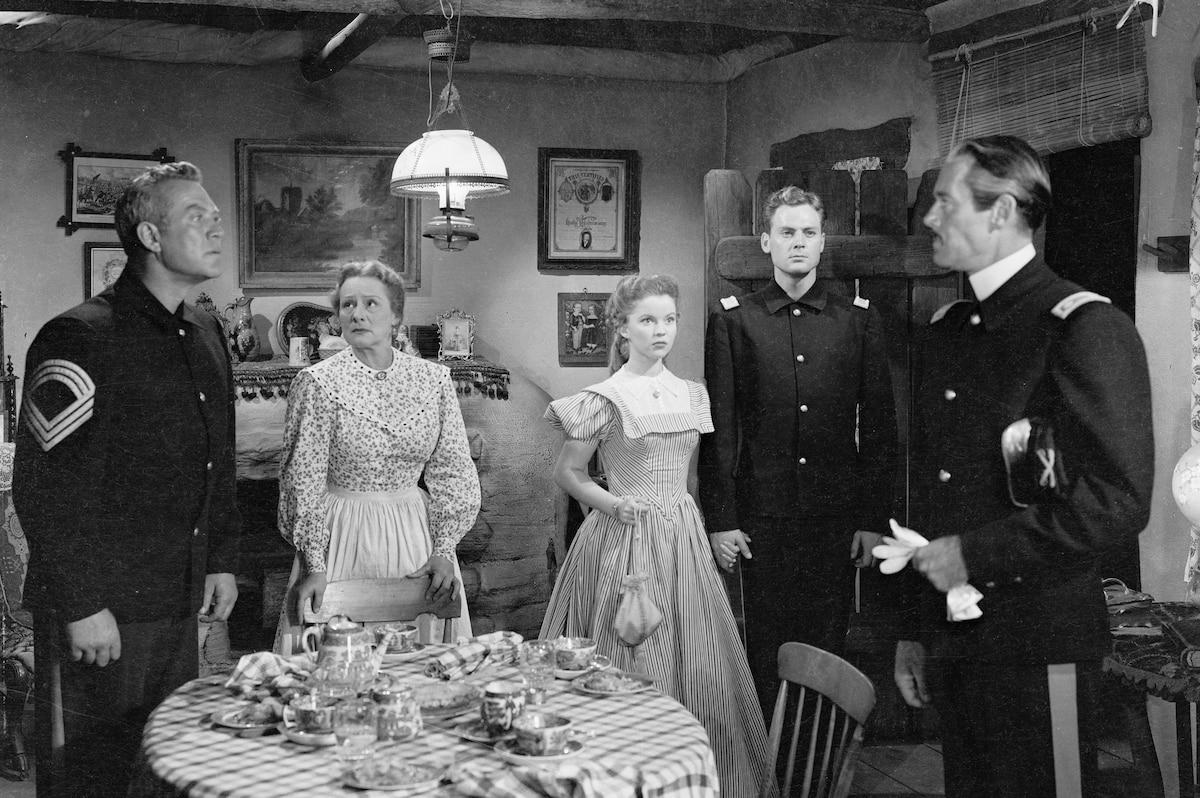
Cast: John Wayne (York), Henry Fonda (Thursday), Shirley Temple (Philadelphia), Victor McLaglen (Mulcahy), John Agar (Lt. O'Rourke), Ward Bond (Sgt. O'Rourke).
BW-128m. Closed captioning.
Why FORT APACHE is Essential
The great film director John Ford needed a hit after the end of World War II. His first effort after the war, The Fugitive (1947), starring Henry Fonda, was met with critical derision and audience indifference. In fact, Ford's production company, Argosy Pictures, had a devil of a time finding a new project that financiers would back and also attract audiences. Ford and Argosy could not afford another noble failure like The Fugitive, a film that even Ford acknowledged at the time was a risky venture.
Ford had met the writer James Warner Bellah in India during the war. The two became acquainted, and Ford took notice of Bellah's series of cavalry stories that were being printed in The Saturday Evening Post. Argosy bought from Bellah a number of his stories, for prices that usually ran around $4,500 apiece. One of these stories, "Massacre," served as the basis for Fort Apache (1948), the film that marked Ford's return to critical and commercial success. Despite a dispute over the depiction of the Indians, Ford and Bellah agreed on one thing: the valor and pride of the military. To capture this long-gone military tradition of the U.S. Cavalry, Argosy hired a researcher named Katherine Spaatz and sent her to Arizona to interview an old cavalry sergeant's widow. Spaatz also talked to her own grandmother, who began her marriage to a soldier in the famed Seventh Cavalry in Arizona during the 1880s.
As the script was nearing completion, Ford, together with producer and Argosy co-founder Merian C. Cooper, realized they lacked a title for the film that would become the first of an informal trilogy of cavalry pictures, the others being She Wore A Yellow Ribbon (1949) and Rio Grande (1950). So the duo held a contest amongst the Argosy employees with a promised prize of $100 going to anyone who came up with a winning title. The story's original title, "Massacre," was considered too graphic. Ironically, it was John Ford himself who suggested Fort Apache. There is no record whether or not he claimed the $100 for himself.
Fort Apache was not John Ford's first Western. He had been working in the genre since the silent era. It was not even his first great Western; that distinction usually goes to Stagecoach (1939). But Fort Apache is the picture that arguably established the John Ford and the Ford film that we think of today: the mythologizing of the Old West, the popular action entertainment lifted to epic heights and presented in a stunning visual style reflecting the director's early training as a painter, the use of Monument Valley as the iconic landscape of the American westward expansion, the blending of his brand of humor and whimsical Irish sentiment into an otherwise dark story of tragic defeat. Although Ford had already incorporated some of these elements into the beautiful and elegiac My Darling Clementine (1946), in Fort Apache and the two other films that make up what is known as the Cavalry Trilogy - She Wore a Yellow Ribbon and Rio Grande - Ford went deeper into his personal vision of American history, one that projected a sense of melancholy for lost innocence and a vanished way of life, plus an insistence on "printing the legend" instead of the harsher and more complicated facts.
If Fort Apache defined for us the John Ford we think of now, it also greatly expanded the screen image of John Wayne, or as film historian David Thomson has noted, "radically enlarged his image," along with his other great film the same year, Howard Hawks' Red River (1948). Although not always recognized by audiences and reviewers at the time, we can look back at Fort Apache and subsequent films and see what a deceptively fine actor Wayne was, and chart the progression of his screen persona from basic action roles to performances of greater warmth, humanity, and complexity.
Fort Apache is not just a showcase for Wayne, however. Henry Fonda turns in one of his best performances in an atypical and unsympathetic role. It also features most of the director's famous stock company, and former child star Shirley Temple, who was gamely attempting to move into adult roles (she retired from the screen a year later after a handful of other films). But mostly, this is Ford's picture, as ultimately they all were, with dynamic action scenes and an intimate depiction of lives and relationships under unusual and stressful conditions, set against a mythic landscape captured with stunning beauty.
The Essentials: Fort Apche (1948)
by Rob Nixon & Scott McGee | February 23, 2005
SIGN UP FOR OUR NEWSLETTERS

CONNECT WITH TCM