Behind the Camera on THE MAGNIFICENT AMBERSONS
In a departure from standard
Hollywood practice, director Orson
Welles rehearsed his actors for five
weeks before he started
filming.
Production started October 28, 1941.
When RKO studio chief George Schaefer
saw some of the earlier scenes a
month later, he was delighted and
made sure Welles knew it. Editor
Robert Wise reports that all involved
thought the film was going to be a
masterpiece.
Welles instructed cinematographer
Stanley Cortez to use the kind of
low-key lighting found in antique
photographs.
The sleigh-riding scene was shot
inside a Los Angeles ice factory. It
took 12 days to perfect the snow
effects and get the actors' breath to
appear just right for the camera.
Then filming took longer than
expected because the cold kept
causing equipment problems.
Everybody except Welles contracted
head colds from working on the
sequence. Ray Collins, who played
Uncle Jack, lost several days when he
came down with pneumonia.
Welles had problems with
cinematographer Stanley Cortez from
the beginning of the picture. Unlike
Gregg Toland, the cinematic innovator
who had shot Citizen Kane,
Cortez had great difficulty meeting
Welles's image of the film. One
sequence Welles wanted, a long point
of view shot as George walks through
the now empty mansion, took him four
days to set up. Welles was so
unhappy that he ended up scrapping
the shot. Toward the end of
production, he demoted Cortez to
shooting second-unit work and had his
assistant, Harry Wild, take
over.
For the kitchen scene in which George
and Uncle Jack tease Fanny about her
infatuation with Eugene Morgan,
Welles rehearsed the actors for five
days. He did not write a word of the
scene. Instead, he discussed each
character's background with the
actors and then asked them to
improvise it as the camera rolled.
The four minute plus scene plays out
in a single take.
There are two versions of how Welles
shot Agnes Moorehead's breakdown
scene in the abandoned mansion. In
one, he did numerous takes of the
intricate dolly shot until the
actress almost had a breakdown during
the take he printed. According to
Moorehead, he spent the day
suggesting different ways for her to
play it, then had her put it all
together so he could get the scene in
one take. When people asked if she
was exhausted, she protested that she
found the work exhilarating, later
stating that she couldn't sleep for a
week afterwards.
In the fall of 1941, the State
Department approached Welles about
making a film to promote good will
between the U.S. and South America.
The idea he came up with was It's
All True, a documentary about
life in South America. RKO agreed,
partly because of the need for films
to appeal to the Latin American
market, which had replaced the
European market during World War II,
and partly because the U.S. State
Department would contribute to the
film's budget. But to film a segment
set at Mardi Gras, Welles would need
to be in Brazil in February 1942,
when he was scheduled to do
postproduction work on The
Magnificent Ambersons and start
work on Journey Into Fear. To
accommodate the schedule change,
Welles handed direction of Journey
Into Fear to Norman Foster. The
film's production was moved up to
start in January, so he shot his
supporting role at night while
finishing direction of The
Magnificent Ambersons during the
day. Since Schaefer wanted to
release Ambersons for Easter,
Welles left Mercury Theatre business
manager Jack Moss in charge of
postproduction. He also arranged to
send editing instructions via
telegram to Wise, who would then fly
to Brazil to screen footage for him
and discuss further changes.
Throughout filming there had been
sound problems because of the
extensive use of moving camera and
crane shots. Rather than delay
shooting further, Welles ignored
suggestions that the problems be
worked out. As a result, the cast
had to re-dub almost all of the
film's dialogue, at a cost of
$25,000. That was three times what
had been budgeted for
re-dubbing.
Another factor driving up the film's
cost was art direction. Where Perry
Ferguson on Citizen Kane had
created impressive sets with a
minimum of expense, largely through
suggesting more on screen than was
actually built, Mark-Lee Kirk built
full sets for everything, even sets
only glimpsed for a few minutes. For
Wilbur Minafer's funeral, he built an
elaborate parlor set filled with
floral displays, even though most of
the room wouldn't even be seen. The
film's final set-construction cost
was $137,265.44, a higher proportion
of set costs to the overall budget
than that of Gone With the
Wind (1939).
The film finished shooting on January
22, 1942, more than $200,000 over
budget and 14 days behind
schedule.
In February 1942, Wise assembled a
three-hour version of the film and
flew with it to Miami, where Welles
screened it and gave cutting notes on
his way to Brazil. That was the last
time Welles got to work on the film.
Because of wartime travel
restrictions, the U.S. government
refused Wise permission to travel to
Brazil for the final editing.
Working from Welles's notes, Wise cut
the film to 132 minutes and sent that
version to Welles in Brazil.
Although most scholars consider that
the definitive version of the film,
Welles requested another 22 minutes
of cuts, most of them depicting
George Minafer's efforts to end his
widowed mother's relationship to
Eugene Morgan. Wise complied and
turned in that 110 minute version of
the film.
The Magnificent Ambersons had
its first preview in Pomona, Calif.,
on March 17, 1942. It was shown to
an audience largely composed of
teenagers who had come to see the
Paramount musical The Fleet's
In (1942). The audience laughed
at dramatic moments, particularly
Agnes Moorehead's big scenes as the
neurotic Fanny Minafer. Most of the
comment cards were overwhelmingly
negative, one counseling that "People
like to laff [sic], not be bored to
death." The positive ones were very
strong, particularly one stating,
"Too bad audience was so
unappreciative." Schaefer called it
the worst preview he'd witnessed in
28 years in the business.
The film's second preview was set in
the more sophisticated town of
Pasadena. Wise had restored Welles's
22 minutes of cuts and made smaller
cuts in other places to make up the
difference. The results were much
more positive, but panic had already
set in at the studio. When Welles
heard of the problems, he begged the
studio to send Wise to Brazil so they
could re-cut the film together, but
that was still impossible. Instead,
RKO created a committee consisting of
Moss, Wise and Joseph Cotten to
shorten the film. Welles sent
lengthy telegrams to the committee
suggesting changes. In the end, RKO
chief George Schaefer turned the
entire editing process over to
Wise.
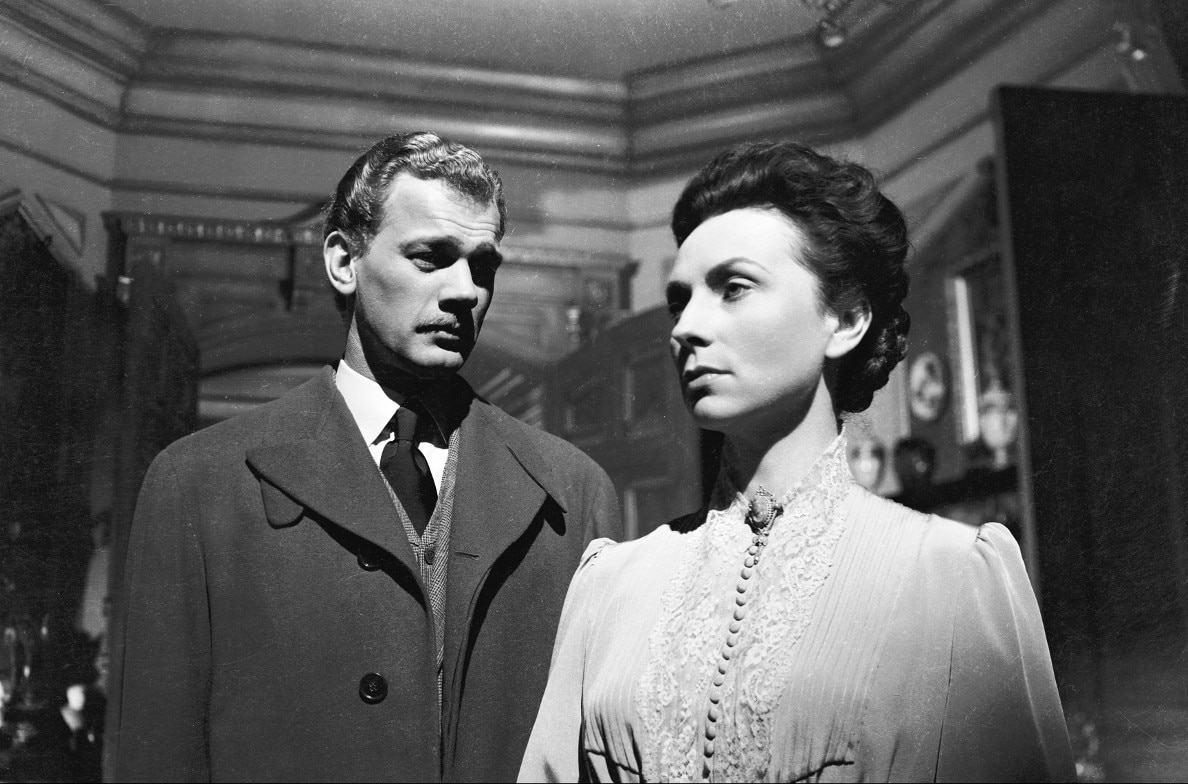
The final scene, showing Joseph
Cotten and Agnes Moorehead in the
hospital, was shot by Welles's
assistant director, Freddie Fleck.
Neither the lighting nor the score
(which Bernard Herrmann did not
compose for the scene) matched
anything else in the film. In the
original ending, which Welles
considered one of the best scenes in
the film, Eugene (Cotten) visits a
now withdrawn Fanny (Moorehead) in
her new home, a boarding house filled
with noisy eccentrics. That provided
an ironic counterpoint to his good
news about George's recovery and his
reconciliation with Eugene's
daughter, an effect heightened when
he leaves the boarding house, and the
camera pulls back to reveal that it
is the converted Amberson
mansion.
In his first directing assignment,
Wise shot a few additional scenes to
patch up the film's continuity.
Post-production head Jack Moss also
filmed some additional footage. Gone
from Welles's original were any hints
of George's Oedipal relationship with
his mother, the scenes depicting the
town's transformation from 19th
century gentility to modern
impersonality, and the family's
attempts to save themselves
financially. The ball sequence,
which Welles had shot in one long
crane shot covering the three floors
of the Amberson mansion, was
re-edited to remove a long chunk of
dialogue, thus destroying the effect
Welles had originally created.
Re-shot scenes included George and
Isabel discussing Eugene's letter and
deciding to go to Europe, George's
keeping Eugene from seeing Isabel on
her deathbed, and the end of Fanny's
breakdown. In the latter, everything
after the long dolly shot was re-done
by Moss to cut down on Fanny's
hysterics as she sits with her back
against the water heater.
There is some debate over how much
Wise and Moss fought to preserve
Welles's vision. Wise has always
said that cutting the film was a
painful process dictated by economic
necessity and changing times (the
nation was going to war, and
audiences would have little time or
patience for the thoughtful, lengthy
film Welles originally made), but
Welles considered him a traitor and
never spoke to him again. Future
director Cy Endfield, who was working
for the Mercury Theatre at the time,
has said that Moss deliberately
ignored Welles's telegrams and phone
calls.
RKO previewed Wise's new version,
running 87 minutes, in Long Beach to
better response than the initial
preview had experienced. Wise then
did some more tinkering, resulting in
the 88-minute version released to
theatres in June and currently
available.
By this time, Schaefer was out as RKO
president, partly because of the
financial losses on Welles's films.
His replacement, Charles Koerner,
fired Welles and the Mercury Theatre,
shut down production on It's All
True and dumped The
Magnificent Ambersons on the
lower half of a double bill with the
B comedy Mexican Spitfire Sees a
Ghost (1942). With a shortage of
storage space on the lot, he ordered
all existing negatives of the film's
original version burned.
The film's tagline was "Real life
screened more daringly than it's ever
been before!"
As late as the '60s, Welles
considered assembling the surviving
cast members (Holt, Baxter, Cotten
and Moorehead were alive at the time)
to film a new final scene. It would
have shown the characters 20 years
later. Unfortunately, he couldn't
get the rights.
Welles could never bring himself to
watch the revised version. In the
early '80s, director Henry Jaglom, a
Welles protege, convinced him to
watch an uninterrupted cablecast of
the film. Welles watched enrapt for
the first hour or so, then clicked
off the film, saying "From here on it
becomes their movie..." (David
Kamp, "Magnificent Obsession,"
Vanity Fair, January
2002).
by Frank Miller
Behind the Camera (7/23) - THE MAGNIFICENT AMBERSONS
by Frank Miller | February 18, 2005
SIGN UP FOR OUR NEWSLETTERS

CONNECT WITH TCM