The Big Idea Behind THE MAGNIFICENT AMBERSONS
Booth Tarkington's novel The Magnificent Ambersons, about a powerful Indianapolis family destroyed by their inability to adapt to changing times, was published in 1918 and won the Pulitzer Prize for Fiction.
The novel first reached film as a 1925 silent feature titled Pampered Youth, with Cullen Landis as George Minafer and Alice Calhoun as his mother.
After Citizen Kane's (1941) phenomenal critical reception, director Orson Welles wanted to follow it with an adaptation of Arthur Calder-Marshall's 1940 espionage novel The Way to Santiago, about a fascist organization in Mexico. The project fell through because studio executives feared it would offend the Mexican government. Instead, RKO studio chief George Schaefer suggested he take over an adaptation of Eric Ambler's Journey Into Fear (1943), another spy story that the studio had been developing. Welles didn't think that was important enough for his second film, however.
At the time, Welles was also considering a film version of Charles Dickens's The Pickwick Papers to star W.C. Fields.
He finally settled on a favorite earlier project. Welles had adapted The Magnificent Ambersons to the radio for The Mercury Theatre of the Air in 1939 (that version is available on the film's laser-disc edition). He played George Amberson Minafer, the family's spoiled son, on the broadcast with guest star Walter Huston as Eugene Morgan. Aunt Fanny, the character later played on screen by Agnes Moorehead, was cut from the story for this version. The only actor from the radio version to repeat his role in the film was Ray Collins as Jack Amberson.
To sell RKO on the project, Welles had to sign a new contract for The Magnificent Ambersons and Journey Into Fear, giving them cast and script approval along with the final cut. The original contract under which he had enjoyed unprecedented freedom while making Citizen Kane would have come back into play for any films made after Ambersons and Journey Into Fear - if they were successful.
It took Welles only nine days to finish the screenplay. He then had his assistant, Amalia Kent, put it into screenplay format. Historian Robert L. Carringer, author of The Making of Citizen Kane and The Magnificent Ambersons: A Reconstruction, has suggested that Welles's failure to use an experienced screenwriter contributed to some of the continuity and pace problems during the film's final third. These problems were apparent even before the studio re-cut the film.
Two key members of the Citizen Kane production team, cameraman Gregg Toland and art director Perry Ferguson, were unavailable. The studio assigned Mark-Lee Kirk to design the sets, and Welles picked Stanley Cortez, best known for his work on B movies, to shoot the film. Both would have a tremendous impact on the production's efficiency and cost.
Welles decided he looked too old to play George convincingly on film. Instead he cast Tim Holt, a second generation star of B Westerns. The choice was met with surprise in Hollywood.
To play the family scion, Major Amberson, Welles cast one of his favorite stage stars, Richard Bennett (the father of Joan and Constance). He found him living in obscurity in a boarding house in Catalina. He also convinced one-time silent star Dolores Costello, one of John Barrymore's ex-wives, to come out of retirement to play his daughter, Fanny Amberson
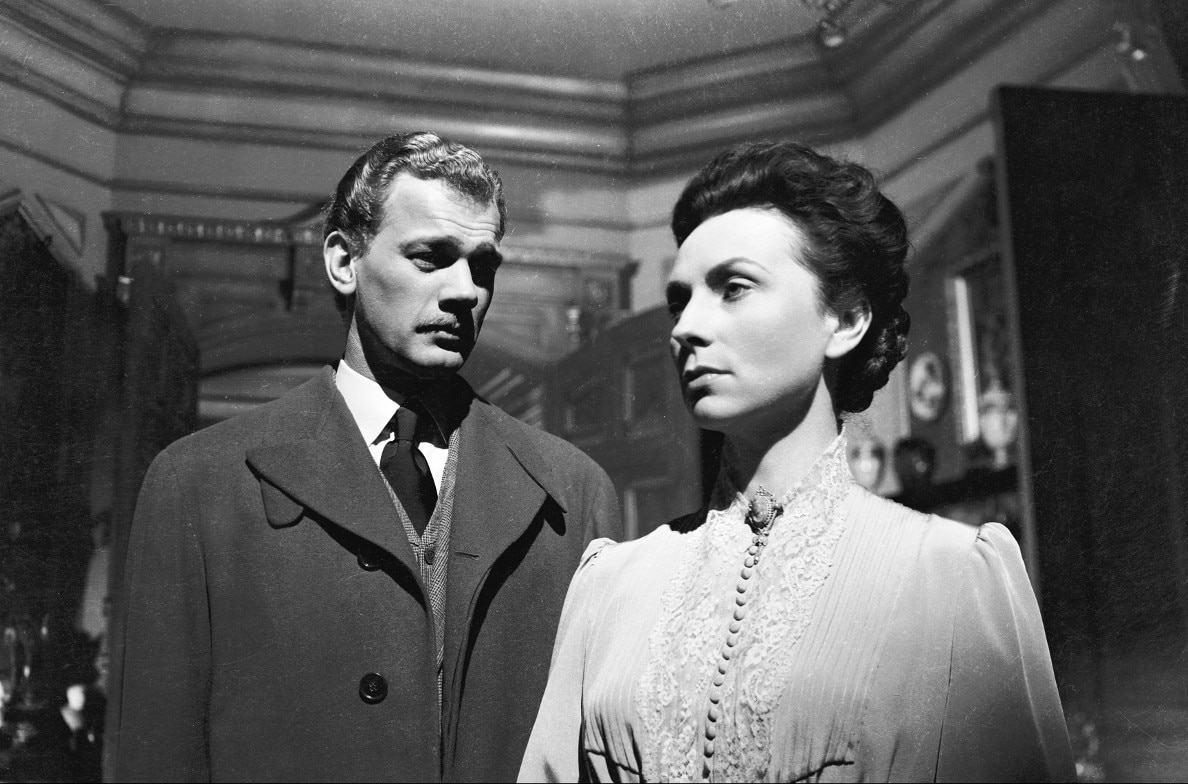
For other key roles, Welles drew on his Mercury Theatre colleagues Joseph Cotten (Eugene Morgan), Ray Collins (Jack Amberson) and Agnes Moorehead (Fanny Minafer).
Anne Baxter had recently signed a contract with 20th Century-Fox when she tested to play Cotten's daughter. In her screen test, she referred to a "little clump of trees over there" and indicated the direction with just her eyes. When Welles showed the test to Cotten and Cortez, all three caught themselves looking in the direction of her gaze. She had convinced them she really had seen something.
Although Welles's contract stipulated that his films cost no more than $800,000, the top budget allowed for any RKO production at the time, he submitted a budget of over $900,000. After much negotiating with Schaefer and the studio's board of directors, this was reduced to $853,950.
by Frank Miller
The Big Idea (7/23) - THE MAGNIFICENT AMBERSONS
by Frank Miller | February 18, 2005
SIGN UP FOR OUR NEWSLETTERS

CONNECT WITH TCM