SYNOPSIS
Changing times forever alter the lives of the Ambersons, a powerful Midwestern family whose belief in their own importance and social ranking blind them to an impending financial loss. Their only heir, George Amberson Minafer, is a spoiled dilettante who pursues his dreams with a recklessness that leave many in their town hoping to see him get his comeuppance. As the family fortunes fade, George fights to keep his widowed mother from marrying her childhood sweetheart, even though his interference costs him the love of the suitor's daughter.
Director: Orson Welles, Freddie Fleck, Robert Wise, Jack Moss
Producer: Orson Welles
Screenplay: Orson Welles
Based on the novel by Booth Tarkington
Cinematography: Stanley Cortez, Russell Metty, Harry J. Wild
Editing: Robert Wise, Jack Moss, Mark Robson
Art Direction: Mark-Lee Kirk
Music: Bernard Herrmann, Roy Webb
Cast: Joseph Cotten (Eugene Morgan), Dolores Costello (Isabel Amberson Minafer), Anne Baxter (Lucy Morgan), Tim Holt (George Amberson Minafer), Agnes Moorehead (Fanny Minafer), Ray Collins (Jack Amberson), Richard Bennett (Maj. Amberson), Erskine Sanford (Benson), Don Dillaway (Wilbur Minafer), Orson Welles (Narrator).
BW-88m.
Why THE MAGNIFICENT AMBERSONS is Essential
The world is littered with damaged artwork, whether it's broken classical sculpture or poorly edited novels. But for film buffs there are two mutilated masterpieces that immediately come to mind: Greed (1925) and The Magnificent Ambersons (1942). The fact that even in their present, truncated form both are powerful, essential works only raises never-ending questions of "What If?"
Director Orson Welles had long been interested in Booth Tarkington's novel The Magnificent Ambersons (which had been filmed as Pampered Youth in 1925). Apart from Welles' fascination with 1890s America he was also drawn to the novel's exploration of social illusions and the changes technology creates as it follows the fortunes of a Midwestern family over two decades. In fact, Welles previously adapted the novel for CBS radio's Campbell Playhouse in October 1939, with guest star Walter Huston. So when he was looking for a follow-up to Citizen Kane (1941), this was one of the things he considered after rejecting a thriller set in Mexico, a film of Cyrano de Bergerac and a story based on wife murderer Landru to star Charlie Chaplin (the latter eventually became Monsieur Verdoux (1947) without Welles' involvement).
Welles started working on the Ambersons screenplay in the summer of 1941, while aboard the yacht of fellow director King Vidor. Welles was also producing a full radio schedule and a live magic show (with Dolores Del Rio as his assistant). Filming on The Magnificent Ambersons started October 28th and ended January 22nd. (Journey Into Fear had started earlier in January and some days Welles would work on Ambersons in the morning and Journey at night.) Welles hired some of his former Mercury Theatre performers like Joseph Cotten and Agnes Moorehead. In fact, Ray Collins was the only actor from the original radio version of Ambersons that was cast in the film. Welles himself had played George on the radio but now brought in B-Western actor Tim Holt. Years later, Welles said Holt was "One of the most interesting actors that's ever been in American movies, and he decided to be just a cowboy actor." Strangely enough, cinematographer Gregg Toland, who was so important to Citizen Kane, was not hired for this movie; in his place was Stanley Cortez, hired just the day before start of filming.
Most of the filming was done on the RKO lot. The Ambersons' house was a specifically constructed set with walls that could move up or out to allow camera passage. Some winter scenes were shot in a L.A. icehouse so the actors' breath would be visible, though the intense cold caused lights to pop and the constant smell of fish annoyed the cast and crew. Shooting was tightly organized and everything seemed to go according to plan.
Though nobody realized it at the time, The Magnificent Ambersons became an ill-fated project when Welles was personally asked by Nelson Rockefeller to make a film in Latin America as part of the wartime Good Neighbor Policy. Naturally Welles agreed not realizing the chain of events that would follow. On February 2nd 1942, he left for Miami where he spent three days with editor (and future director) Robert Wise working on a rough cut of Ambersons. Wise was planning to concentrate on the editing in Brazil while Welles would be filming the carnival for his U.S. government commissioned film. This never happened due to sudden wartime travel restrictions though a copy of the film's rough-cut was sent to Brazil for Welles to work on when he had the time.
Another stroke of bad luck occurred on March 17th at a now infamous preview of the film in Pomona, California. The standard story is that the audience was hostile and disapproving, which sent the studio into a panic over what they considered Welles' excesses. But critic/historian Jonathan Rosenbaum has examined the 125 original comment cards and reports that 53 were positive; in fact, many were overwhelmingly enthusiastic. When you consider that the preview of the lengthy and admittedly somber Ambersons occurred immediately after a showing of the lightweight Dorothy Lamour musical, The Fleet's In, the audience response seems much more favorable than reported. Nevertheless, the studio executives considered the Pomona preview a disaster but their attitudes may have been influenced by the general dislike of Welles in Hollywood, a factor which had resulted in Citizen Kane winning only one Oscar.
Welles sent a 37-page memo listing revisions to Wise, fully expecting to participate in further editing. Instead, at the studio's insistence Wise started not only recutting the film - "hacking" might be a better word - but even shooting new scenes. Also shooting additional footage were second-unit director Freddie Fleck and production manager Jack Moss. This resulted in Welles' elegant tracking shots being reduced to bits and pieces and many of the darker scenes tracing the family's fall were abbreviated or altogether eliminated. Producer David Selznick requested that a copy of Welles' rough-cut be submitted to the Museum of Modern Art but this was considered too expensive and never done. Even worse, the studio eventually pulled the plug on the Latin American film, claiming to be alarmed at Welles' prolific spending, an unfounded charge.
After two more previews were held, The Magnificent Ambersons was eventually released on July 10, 1942 with a running time of 88 minutes. This was about 30 to 40 minutes shorter than the first preview (unfortunately, there's no accurate account of that running time) but probably even more footage from Welles' original cut was deleted. The excised footage was destroyed by the studio so that no reconstruction could be made - the same thing that happened to Greed (and later to The Red Badge of Courage 1951, among others). The final version ofThe Magnificent Ambersons did indeed lose money for the studio but then so had Citizen Kane so it's hard to imagine that all the reworking actually improved the box office returns. Still, The Magnificent Ambersons is now recognized as a classic and some film scholars consider it even better than Citizen Kane. Recently, Welles' original shooting script was used by director Alfonso Arau for a remake - which apparently runs even longer than Welles' original - and premiered at the Munich Film Festival in July 2001. It recently aired on the A & E Network to mixed reviews.
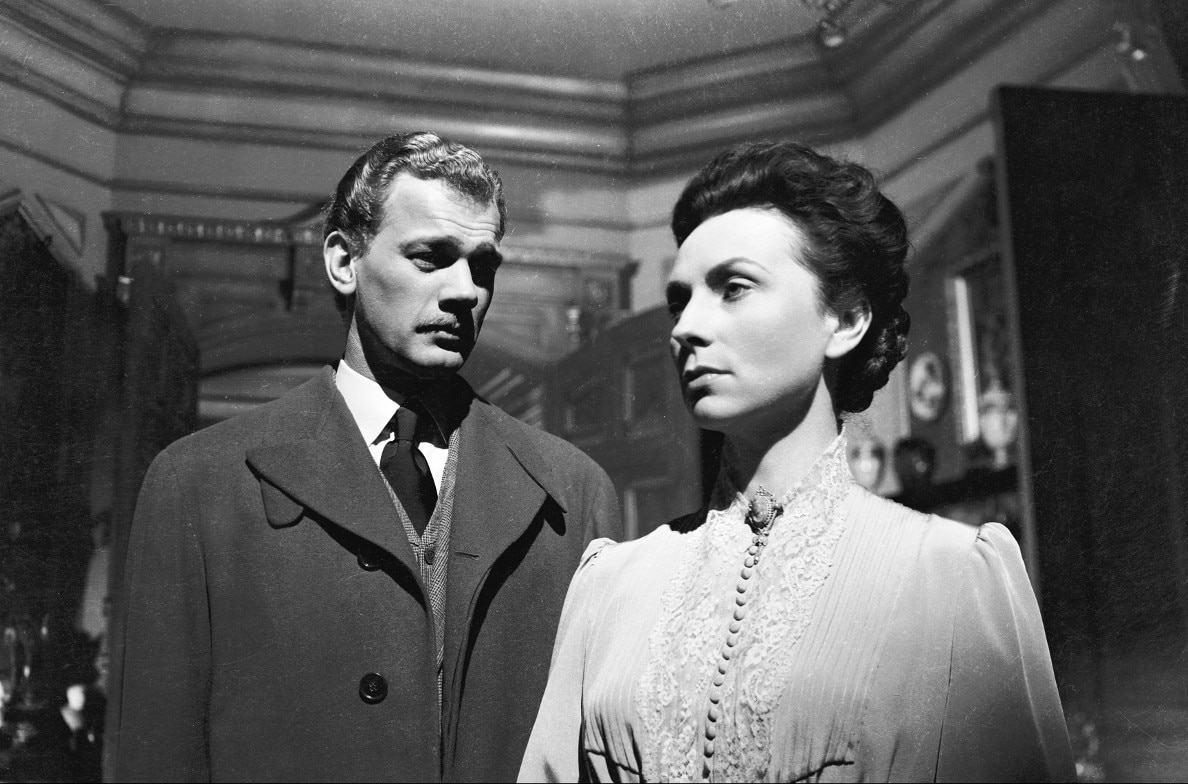
With Citizen Kane, The Magnificent Ambersons introduced new approaches to narrative filmmaking via visuals and sound. Through his cinematographer, Welles used deep focus and visible ceilings to capture the worlds in which his characters moved as rarely before on screen. Aurally, he used radio tricks -- overlapping dialogue, volume levels related to the speaker's proximity to the camera, timbre affected by the size and physical makeup of the scene's setting -- to create some of the most innovative sound recording in film history. Many historians have referred to these effects as "Welles sound," though they certainly can be found, at least individually, in the work of other directors.
by Frank Miller & Lang Thompson
The Essentials (7/23) - THE MAGNIFICENT AMBERSONS
by Frank Miller & Lang Thompson | February 18, 2005
SIGN UP FOR OUR NEWSLETTERS

CONNECT WITH TCM