Behind the Camera on INVASION OF THE BODY SNATCHERS
The film was shot in dozens of locations in and around Los Angeles and the town of Sierra Madre, which largely stood in for the fictional Santa Mira.
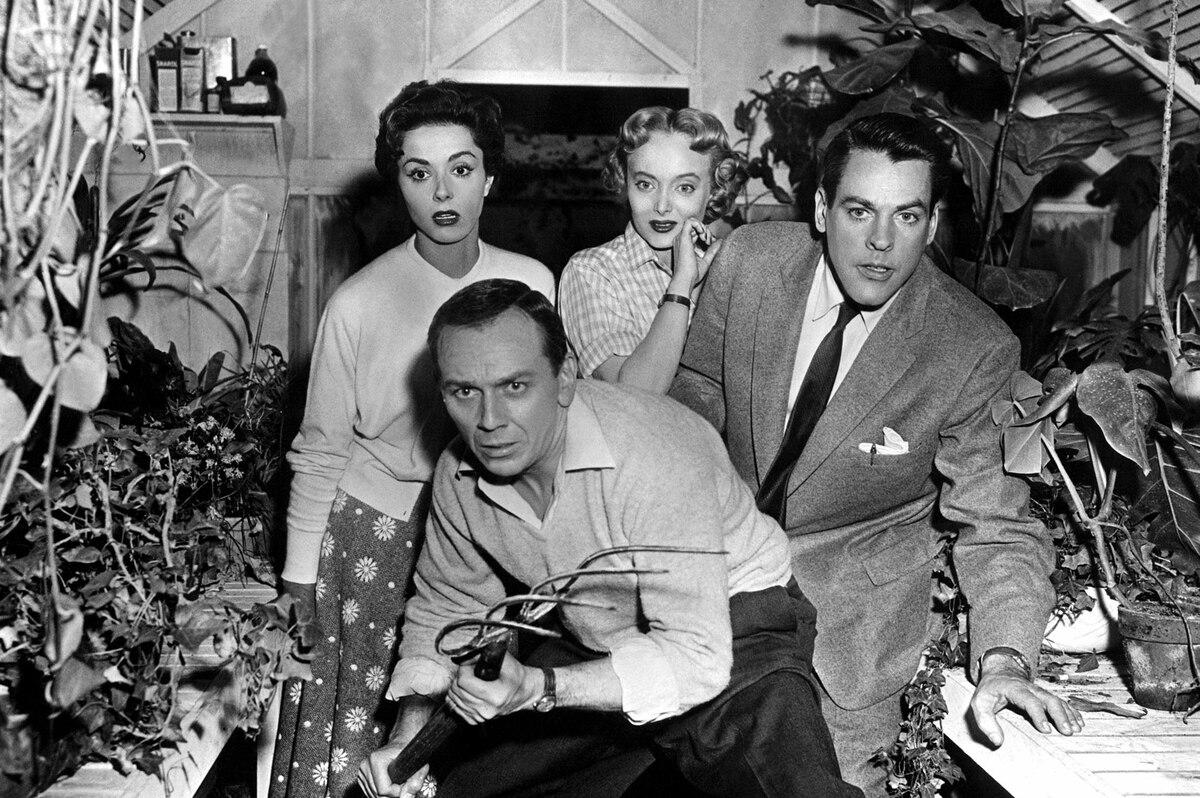
A few scenes, such as the interior of Miles Bennell's office, were done at Sunset Studios. It was Production Designer Ted Haworth's challenge to match the look to the low-key location scenes they filmed. The greenhouse scene was also done in the studio because there were so many technical elements to be controlled when the pods burst open and bubbled, revealing the replicas of the characters.
The scene in which Miles and Becky are pursued up a long, steep outdoor staircase was shot in Bronson Canyon in the Hollywood Hills. The head grip came up with the idea to build a small dolly with wheels that rode the top of the staircase's iron rails ahead of the actors.
Bronson Canyon was also the location for the tunnel where Miles and Becky hide. A trench was dug for them to lie in with planks placed over them for the scene in which the pod people run through the tunnel looking for them.
The last sequence was shot, not on the actual Hollywood Freeway, but on a little used cross-bridge. The cars were driven by stunt drivers. Don Siegel said later that Kevin McCarthy was in real danger of getting hit, because the sequence was shot at dawn and he was near complete exhaustion.
Ted Haworth came up with a fairly simple and inexpensive (about $30,000 total) idea for creating the pods. The most difficult part was when the pods burst open, revealing the likenesses of the actors. The actors had to have naked impressions of themselves made out of thin, skin-tight latex. Making the casts, which involved being submerged in the very hot casting material with only a straw in their mouths to breathe through, was grueling for the actors, especially Carolyn Jones, who was claustrophobic. Dana Wynter, in an interview with Tom Weaver, recalled "I was in this thing while it hardened, and of course it got rather warm! I was breathing through straws or something quite bizarre, and the rest of me was encased, it was like a sarcophagus. The guys who were making it tapped on the back of the thing and said, 'Dana, listen, we won't be long, we're just off for lunch [laughs]!' In the end, we had to be covered except for just the nostrils and I think a little aperture for the mouth."
Haworth was worried that studio executives would object to the "nudity" of the pod likenesses. Siegel reminded him that Hollywood executives were all pods and, as such, had no real feeling about anything, including nudity. One executive, however, voiced strong objections and ordered Siegel to eliminate any nudity from the picture. Siegel returned to Haworth and told him to continue as planned. "I was sure that before the impressions were made, this executive would have become a pod, too," he said in his autobiography. At any rate, the issue was fairly moot; the pod replicas are revealed under foaming soap bubbles that manage to keep any overt nudity concealed.
Wynter genuinely enjoyed the shoot and noted that everyone in the cast and crew was extremely nice to her as a newcomer - except Carolyn Jones. She said the more experienced Jones was "strangely unfriendly and unhelpful," yet she still managed to hone her style by observing her.
The pace of the shooting meant there was little time for the actors to rest between takes of the exhausting chase sequences. And there was no time to discuss scenes. Wynter said the actors were always responsible for mentally rehearsing their characters and actions before jumping in front of the cameras.
The biggest problem Siegel and company had with the studio was over the use of humor. Siegel, Mainwaring and Wanger had scripted scenes with humor in them, and McCarthy said the actors improvised some during shooting. When the film was still in the work print stage, Siegel and Wanger decided to try it out in front of a preview audience behind the studio's back. Much of the humor was still in the film at that point, and the audience response went from shrieks to screams to laughter and back again. Siegel had sneaked a tape recorder into the theater so they could prove to the studio just how great the reception was to their rough cut. But studio head Steve Broidy hit the roof when he found out and wanted to know why the audience was laughing in places. He ordered any trace of humor removed.
Invasion of the Body Snatchers was originally to have ended on a close-up of McCarthy screaming into the camera (and to the audience), "You're next!" But the studio thought that was too downbeat an ending and ordered a new one shot. In their version, Miles is picked up by the authorities who finally believe him when they receive news that a truck full of mysterious pods has been reported. The studio also insisted on an opening prologue in which Miles begins to tell the story in flashback, thereby destroying any suspense about whether or not he survives. The additional scenes were shot in a public television station in Los Angeles.
Lead actor Kevin McCarthy didn't particularly like the script because he felt that, in streamlining the novel for the screen, depth of character was lost. McCarthy thought it was a mistake that these fairly sophisticated, educated characters had such bland dialogue and manner of relating to one another, "lacking the curves and nuances that you often hear in the conversation of ordinary, mature men and women."
Siegel later claimed that during filming he crept into Wynter's house and slipped a pod under her bed, causing her to become hysterical when she found it. "That is a bit far-out," Wynter replied when she heard Siegel's account. "Actually, he left it on my doorstep. He had a girlfriend who lived next door to me...and he would pass my cottage all the time. And one night he just left it on the doorstep!"
Ted Haworth was probably the most livid about the studio's tampering. He wrote a letter to Steve Broidy telling him Allied Artists was destroying the picture. Haworth had been Alfred Hitchcock's art director on Strangers on a Train (1951) and I Confess (1953), and he told Broidy that Hitchcock would have given his eyeteeth to have made a picture that frightening.
The urbane, genial Wanger was liked and respected by everyone involved. But Kevin McCarthy later said he had the impression during production that Siegel, despite the glowing words he had for his producer in later years, thought Wanger was more diplomatic than effective in his dealings with the front office on such issues as the humor, the title, and the additional scenes. "I think he might have called Wanger a pod, if the two of them hadn't been partners," McCarthy said.
The picture took only 19 days to make, according to Siegel (other reports say as much as 24 days, with about 4 days of studio production). There was no second-unit work and no process shots.
by Rob Nixon
Behind the Camera (7/16 & 12/31) - INVASION OF THE BODY SNATCHERS (1956)
by Rob Nixon | February 18, 2005
SIGN UP FOR OUR NEWSLETTERS

CONNECT WITH TCM