SYNOPSIS
Dr. Miles Bennell returns to his hometown, Santa Mira,
California, to find that many of his patients are
suffering from a mysterious but similar malady. They are
coming to him insisting that family members and loved ones
are impersonators, devoid of emotion, and not the people
they used to know. Miles at first tends to believe a
fellow psychiatrist's diagnosis that it's all a case of
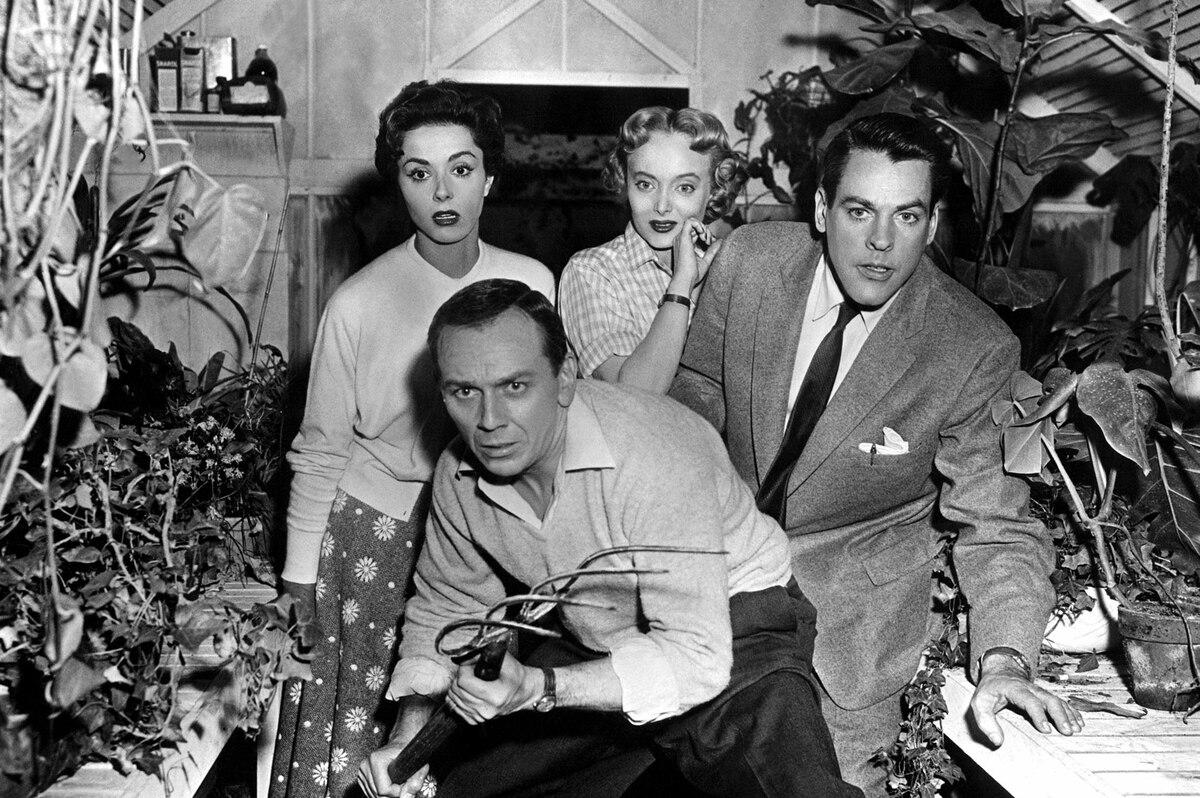
mass hysteria. But after discovering a half-formed replica
of his friend Jack, and later giant seed pods in his
greenhouse, Miles and his girlfriend Becky confront their
worst fears - that these mysterious pods are in fact
replacing the humans of the town when they sleep. In the
midst of the invasion, Miles and Becky try to escape and
warn the authorities.
Director: Don Siegel
Producer: Walter Wanger
Writer: Daniel Mainwaring, from the novel "The Body
Snatchers" by Jack Finney
Cinematography: Ellsworth Fredericks
Editing: Robert S. Eisen
Production Design: Ted Haworth
Original Music: Carmen Dragon
Cast: Kevin McCarthy (Miles Bennell), Dana Wynter (Becky
Driscoll), King Donovan (Jack Belicec), Carolyn Jones
(Teddy Belicec), Larry Gates (Dr. Dan Kauffman).
BW-80m.
Why INVASION OF THE BODY SNATCHERS is Essential
A debate has raged for years over the meaning and subtext
of Invasion of the Body Snatchers (1956). Very much
a product of its era, the Cold-War 1950s, analysts have
seen in it a metaphor for the creeping threat of
Communism, portrayed at this point in U.S. history as
soulless, without feeling or sense of beauty - an attempt
to make all its citizens lockstep into a sameness of
purpose and behavior. Certainly that notion was reinforced
by reports around this time of the Ôbrainwashing' of
captured American troops by the Chinese Communists during
the Korean War. Still others have seen the movie as a
depiction of the era's conformity and the dangerous path
of McCarthyism, forcing everyone to think and believe the
same and leaving no room for eccentricity or individual
expression. And the strong-arm attempts to silence dissent
in this period, as well as the incarceration and
blacklisting of talented film artists on the pretext of
"dangerous" political beliefs, lent extra weight to that
notion. As for the director, Don Siegel, he was mostly
evasive on this question, while conceding one couldn't
help but read those messages into the picture. For him,
however, "pod people" were everywhere, especially in the
film industry which was teeming with individuals with
their eye on the lowest common denominator; producers
simply to make a quick buck to the detriment of a
filmmaker's creativity. And for producer Walter Wanger,
the appeal of Jack Finney's story may have been in its
echoes of the regimented prison life Wanger had only
recently experienced (he had served time for shooting and
wounding the agent (Jennings Lang) of his wife, actress
Joan Bennett).
Whatever subtext - if any - may have been intended, it's
clear the appeal of Invasion of the Body Snatchers
goes beyond Cold War politics into an anxiety more deeply
rooted in human consciousness - the fear of loss of
identity, dehumanization, and of not knowing who can be
trusted in an increasingly complex world. Possession of
ordinary people by alien entities, whether gods or demons,
figures in the oldest myths. When the homogenization and
mechanization of the modern world is added to that, the
fear is compounded. A lot of movies have been made on this
theme in dozens of variations. What makes Invasion of
the Body Snatchers so memorable is that, even in its
own low-budget, B-picture context, it taps into a
believable paranoia.
Siegel grounds the picture by shooting on location in
familiar surroundings, then infuses them with a
relentlessly building sense of unease. There are very few
special effects. Other than brief glimpses of the pods and
a couple of violent outbreaks, nothing is much stranger
than we would encounter on any day except that the
everyday has been transformed into something threatening.
Siegel keeps the film moving and tension building through
a number of devices he perfected in the tightly structured
action films by which he made his mark as a director:
characters constantly in motion, scenes played out in
claustrophobic tight quarters or in near darkness, the
point of view staying tightly focused on the main
protagonist (Miles), cutting between chilling close-ups
and mysterious long shots.
The movie was not released the way the director intended;
all of the humor had been cut out by the studio, and a
tacked-on beginning and ending with narration was forced
on Siegel to keep the story from being so bleak and
hopeless. But even that interference can't dull the
essential power and appeal. Siegel's "little picture" has
outlasted some of the bigger ones of its time, thanks to
the combination of a director working at top form and a
story that plays on our deepest human fears.
Invasion of the Body Snatchers was shot on location
in the small town of Sierra Madre, California and in and
around Bronson Canyon in the Hollywood Hills. It took
nineteen days to shoot at a cost of approximately
$300,000. For the casting, Vera Miles was considered for
the role of Becky Driscoll, Miles' girlfriend, but
producer Walter Wanger decided he wanted to use Dana
Wynter, a young actress who was under contract to Fox.
Kevin McCarthy had already worked with Siegel on a
previous film, An Annapolis Story (1955), so they
had a good working rapport; McCarthy even suggested a less
sensational title for the film, "Sleep No More" but the
studio brass rejected it as too high brow. In addition to
Carolyn Jones and King Donovan, the film's second leads,
the rest of the cast was comprised of first rate character
actors such as Whit Bissell, Richard Deacon and, in a bit
part, future director Sam Peckinpah as the meter reader
(he also served as the dialogue director on the film).
Of course, the real stars of Invasion of the Body
Snatchers are the pods. Siegel recalled in his
autobiography, that "My brilliant art director, Ted
Haworth, figured out a way of creating the pods that was
simple and relatively inexpensive (around $30,000). The
most difficult part was when the pods burst open,
revealing exact likenesses of our leading actors.
Naturally, they had to have naked impressions of their
bodies made out of thin, skin-tight latex. Foaming soap
bubbles would gradually disappear, revealing, yet still
concealing, their entire bodies." This process required
body casts of the lead actors.
One aspect of Invasion of the Body Snatchers that
continues to arouse controversy and divide viewers even
today is the fact that the film exists in two different
versions, one with a downbeat ending, the other with a
more hopeful one. Siegel also revealed that he had
originally included several humorous touches in his final
cut which the studio, Allied Artists, later edited out
without his approval. "In their hallowed words, 'horror
films are horror films and there's no room for humor,'
Siegel recalled. I translated it to mean that in their pod
brains there was no room for humor. The studio also
insisted on a prologue and an epilogue. Wanger was very
much against this, as was I. However, he begged me to
shoot it to protect the film, and I reluctantly
consented...Oddly enough, in Europe and in the
'underground' in America, Invasion of the Body
Snatchers was shown with the prologue and epilogue
edited out. Like this, it was known as 'the Siegel
version.'" Most viewers, however, are probably more
familiar with the official Allied Artists cut, which ends
with McCarthy convincing a psychiatrist and hospital
doctor to contact the FBI. In Siegel's more pessimistic
climax, McCarthy spots a truckload of pods on its way to
the next town while passing motorists ignore his frantic
attempts to warn them.
by Rob Nixon & Jeff Stafford
The Essentials (7/16 & 12/31) - INVASION OF THE BODY SNATCHERS (1956)
by Rob Nixon & Jeff Stafford | February 18, 2005
SIGN UP FOR OUR NEWSLETTERS

CONNECT WITH TCM