Although James Cagney found White Heat to be a good
picture on a number of levels, in his 1985 autobiography
Cagney called the film "another cheapjack job" because of
its limited shooting schedule and the studio's decision to
"put everybody in it they could get for six bits." Cagney
was particularly irritated by the fact that he pressed
them to cast his old friend Frank McHugh in the small role
of Tommy in order to bring a touch of humor and lightness
to the otherwise heavy piece. According to the star,
Warners repeatedly agreed to do it, putting Cagney off
until the first day of shooting when he was told McHugh
wasn't available. Cagney found out later McHugh had never
even been asked.
Cagney took credit for having
the idea for the scene in which Cody sits in his mother's
lap. He said he told director Raoul Walsh, "Let's see if
we can get away with this," and Walsh agreed. But in his
1974 autobiography Each Man in His Time (which film
writer Leonard Maltin has called "highly entertaining
fiction with an occasional nod at the truth"), Walsh took
credit for the idea and said the scene worked because
Cagney and Margaret Wycherly made it so
convincing.
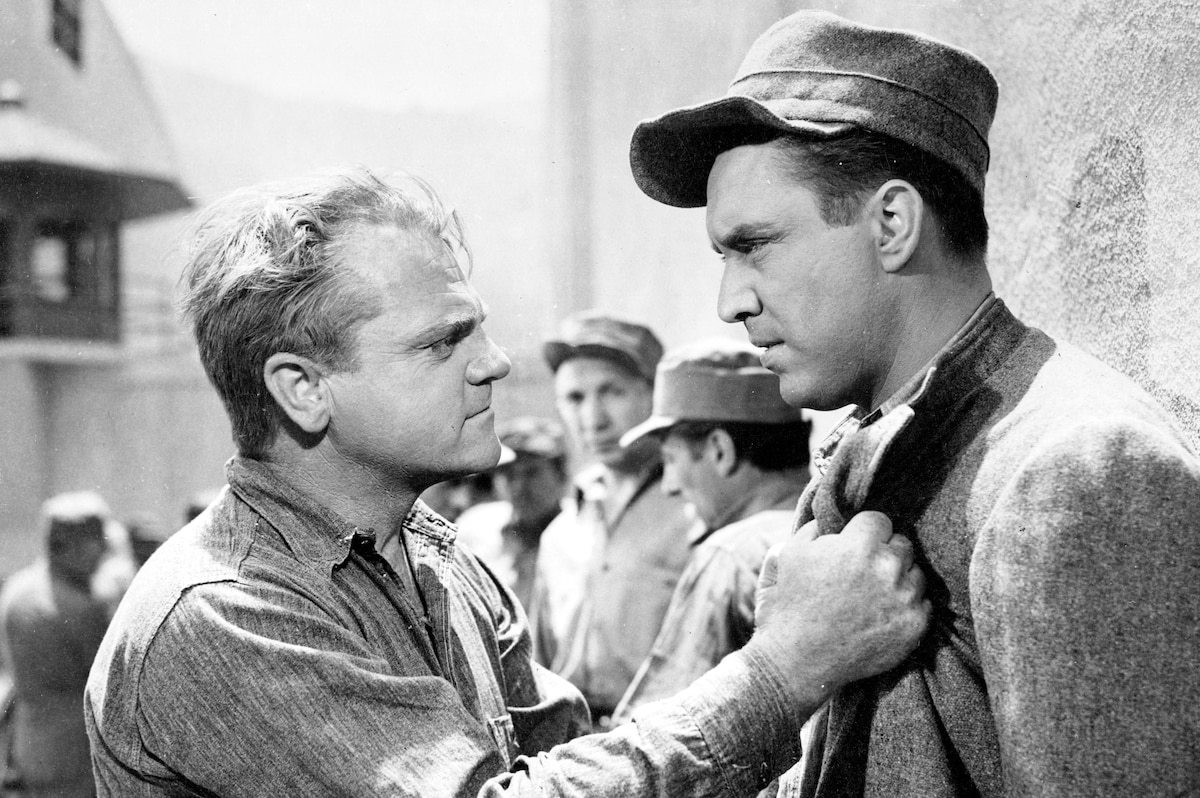
The spectacular ending aside, the
most famous scene in the picture is undoubtedly the one in
which Jarrett gets the news in prison of his mother's
death. The news is passed down from inmate to inmate at
the prison mess hall tables until it finally reaches
Jarrett, who explodes into psychotic grief, staggering
around the room landing punches on everyone who gets in
his way while letting out a kind of strangled, primal cry.
Cagney was once asked by a reporter if he had to "psych"
himself up for the scene. Cagney responded, "You don't
psych yourself up for these things, you do them,"
reiterating his very non-Method philosophy that working on
inward emotional motivation is a waste of time leading to
a performance solely for the actor himself. According to
Cagney, an actor shouldn't psych himself up to be
the character, he should simply understand the character
and play it for the audience. His only preparation for the
scene, he later said, was remembering a visit as a
youngster to see a friend's uncle who was in a psychiatric
hospital. "My God, what an education," he said. "The
shrieks, the screams of those people under restraint. I
remembered those cries, saw that they fitted, and I called
on my memory to do as required."
When Cody gets
the news of his mother's death, Cagney plays his first
reaction merely looking down, building into the emotional
explosion. Years later, he explained to Los Angeles
Times film critic Charles Champlin, "That first agony
is private. If I'd looked up right away and started
bellowing, it would have been stock company,
1912."
Walsh said of his star: "Jimmy, I can
honestly say, was the best actor I ever
directed."
Edmond O'Brien was also rather in awe
of his co-star. In the book Cagney, author Michael
Freedland said O'Brien found out how generous an actor and
gentle a person Cagney could be. In a close-up the two
were playing together, O'Brien felt Cagney standing with
increasing pressure on the top of O'Brien's right foot,
forcing the younger actor to move in that direction.
O'Brien realized if he had not done so, he would have been
out of frame and Cagney would have had the scene to
himself. Freedland also relates how when the cameras were
rolling, Cagney would look like "an angry tiger," but as
soon as the director yelled cut, the star would quietly go
up to O'Brien with a poem he had written and ask him in a
whisper, "Would you mind telling me what you think of
this?" When it came time to return to work, Cagney would
plead, "Please, don't tell anyone about it."
Location work was done in the California towns of Van Nuys
and Chatsworth (in a railroad tunnel). The explosive
finale was shot in Torrance, Calif.
By Rob Nixon
Behind the Camera - White Heat
by Rob Nixon | February 02, 2010
SIGN UP FOR OUR NEWSLETTERS

CONNECT WITH TCM