SYNOPSIS
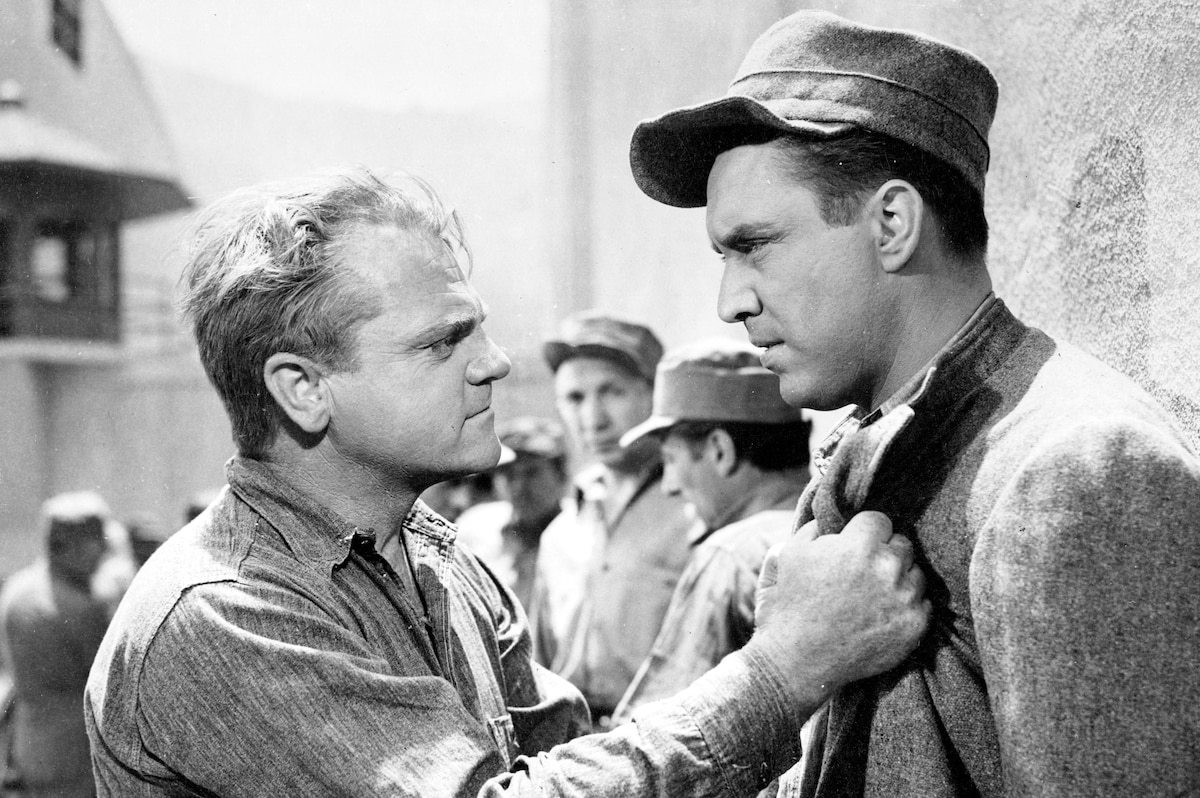
Brutal, psychotic criminal Cody Jarrett trusts no one, least of all his unfaithful wife Verna and overly ambitious right-hand man Ed Sommers; no one, that is, except his equally criminal mother, the only one who can soothe the blinding migraines that plague him. Sent to jail on a charge he fakes to avoid conviction for the more serious crimes of train robbery and murder, Cody takes into his gang smalltime crook Vic Pardo, who is in reality undercover cop Hank Fallon, sent to infiltrate the Jarrett gang. Cody controls his gang from prison via instructions passed to his mother. Later, in the prison mess hall, Cody learns of Ma Jarret's murder. He goes berserk, and it takes several guards to restrain him and drag him screaming from the room. He's put into a straitjacket and placed in the prison clinic, from which he engineers an escape, taking "Pardo" along with him. After a botched payroll-robbery at an oil refinery, Cody learns Pardo is a special agent and tries to kill him.
Director: Raoul Walsh
Producer: Louis F. Edelman
Screenplay: Virginia Kellogg (story), Ivan Goff, Ben Roberts (script)
Cinematographer: Sidney Hickox
Editor: Owen Marks
Art Director: Edward Carrere
Original Music: Max Steiner
Cast: James Cagney (Cody Jarrett), Virginia Mayo (Verna Jarrett), Edmond O'Brien (Vic Pardo/Hank Fallon), Margaret Wycherly (Ma Jarrett), Steve Cochran (Big Ed Somers), John Archer (Philip Evans).
BW-114m. Closed captioning. Descriptive video.
Why WHITE HEAT is Essential
An exciting, dynamic film in its own right, White Heat also stands out as the flaming finale to the era of stark, fast-paced crime films made famous by Warner Brothers and James Cagney (among other stars) from the 1930s on films in which the focus was on the often violent but charismatic gangster rather than the law enforcement officials who hunt him. It was also the apotheosis of Cagney's brilliant career, a kind of summing up of the memorable outlaw characters he had created. His projects that followed in the 1950s were mostly lackluster affairs, and the cocky, pugnacious star audiences had come to love was glimpsed infrequently in such films as Love Me or Leave Me and Mister Roberts (both 1955). His last big film before retirement was the Billy Wilder Cold War comedy One Two Three (1961). He returned to the screen twenty years later as the turn-of-the-century New York police chief in Ragtime and made one more film, the TV drama Terrible Joe Moran (1984) before his death in 1986.
White Heat, then, is a chance to catch Cagney one last time as the no-holds barred gangster he created in such pictures as The Public Enemy (1931) and Angels with Dirty Faces (1938). Here, however, the character has been pushed to the extreme, and the progression to Cody Jarrett can be traced through a trio of gangster films made by director Raoul Walsh, of which this was the last. In The Roaring Twenties (1939), Cagney's criminal is seen in the context of history and society, a man whose ambition and drive is put to service on the wrong side of the law by the circumstances of time and place. In High Sierra (1941), Walsh cast Humphrey Bogart as Roy "Mad Dog" Earle, a troubled man on the run, the gangster as the last individual in an increasingly soulless world. With White Heat the archetype is pushed to the very edge, depicted as a vicious man gripped by insanity. It's fitting that the image Cagney was so identified with should go out with such a bang.
In some ways, White Heat is also a swan song for Warner Brothers, the studio that had become known for quickly produced, gritty action-oriented pictures with a social conscience. By the time this film was released, the Supreme Court had forced the big Hollywood studios to divest themselves of their lucrative theater chains, and the stock company that had made Warners so successful in the 1930s and early '40s had either left the studio or were on their way out. Several stars had already made their last movies under their long-term contracts: Ida Lupino in 1947, Olivia De Havilland in 1946, Ann Sheridan in 1949 and "Little Caesar" Edward G. Robinson in Key Largo (1948). Humphrey Bogart's last Warners picture would be The Enforcer (1951), and Errol Flynn would exit in 1953. Even 'Queen of the Lot' Bette Davis was history, storming out of her contract after the over-the-top melodrama Beyond the Forest (1949), and not to return until Whatever Happened to Baby Jane?(1962).
Cagney had already quit the studio after his Oscar®-winning turn as George M. Cohan in Yankee Doodle Dandy (1942). "Movies should be entertaining, not blood baths," he said in the last days of his Warners contract. "I'm sick of carrying a gun and beating up women." He formed his own production company with his brother William, and for the next five years their pictures were distributed by United Artists. There were, however, only four films in those years, none of them very successful financially. So Cagney returned to Warner Brothers with a degree of autonomy (his production company remained intact) and made the kind of "blood bath" he had turned his back on seven years earlier. "It's what people want me to do," he grumbled. "Someday, though, I'd like to make just one picture kids could go see."
For all his grumbling, though, White Heat remains one of the crowning achievements of Cagney's career. It's hard to imagine another actor of the time convincingly pulling off this all-stops-out portrayal of Cody Jarrett. And this is no mere farewell or throwback to another era. It has the volatile dynamism of the best gangster flicks of the '30s and '40s, but it mixes in important tendencies taking shape in post-war cinema. The train robbery heralds the attention to the logistical details of a crime that would play such a vital element in films like John Huston's The Asphalt Jungle (1950) and Stanley Kubrick's The Killing (1956). It displays elements of the documentary style made popular by Naked City (1948) and similar movies. And it shares something of the film noir style in its often shadowy cinematography and focus on its lead character's twisted psychology.
By Rob Nixon
The Essentials - White Heat
by Rob Nixon | February 02, 2010
SIGN UP FOR OUR NEWSLETTERS

CONNECT WITH TCM