Trivia and Other Fun Stuff on STEAMBOAT BILL, JR.
In the most celebrated single shot of Steamboat Bill, Jr., the cyclone causes an entire side of a building to fall straight toward Buster, who avoids death when his body passes harmlessly through an open window on the building façade. Stories of the filming of this gag are apparently NOT apocryphal - clearly the structure was weighted and solid, and obviously it misses hitting Keaton by inches. The gag was worked out mathematically and no doubt attempted many times with inanimate stand-ins. Nevertheless, many crew members left the premises rather than nervously watch the filming of the shot with Keaton.
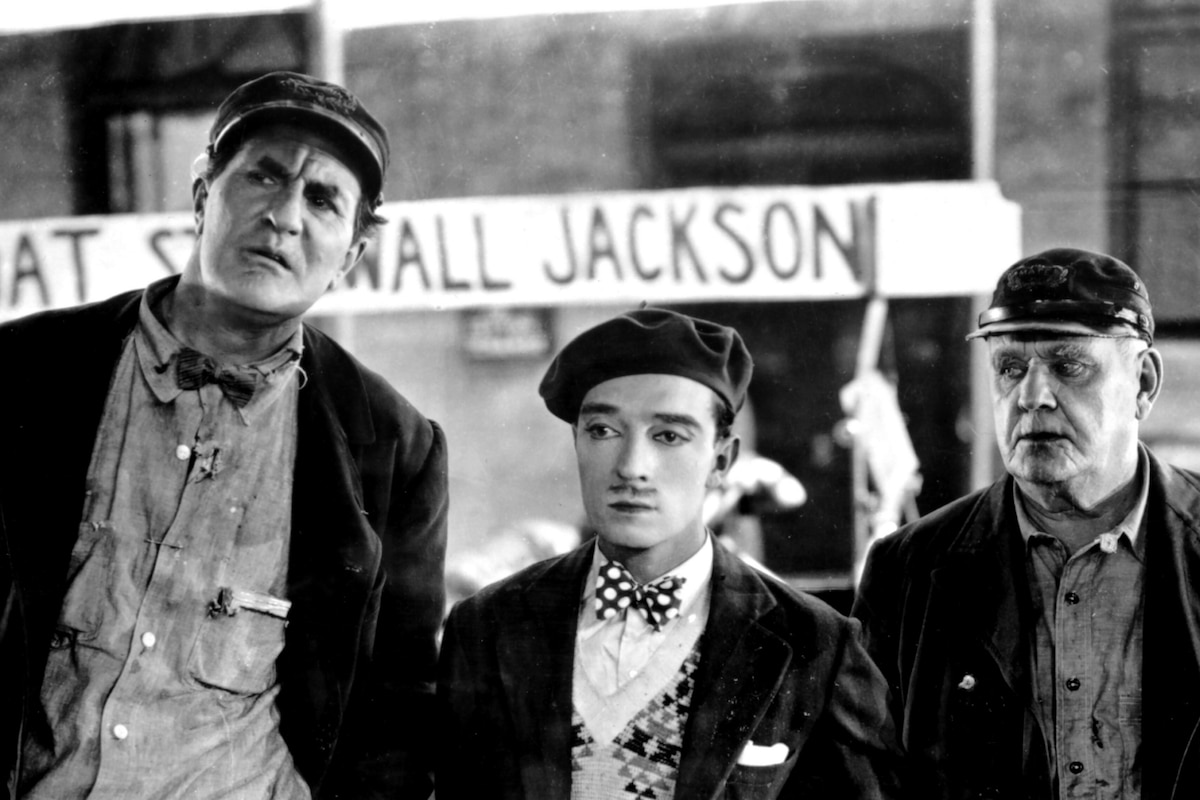
Another justly famous scene in the film occurs when Willie is hauled by his father into a clothing store to replace the foppish apparel that Willie shows up wearing. Of particular offense is the natty but completely inappropriate beret on Willie's head. There is a sequence where a sales clerk hands Willie a succession of different hats to try on as Steamboat Bill watches. For the majority of the scene, Keaton frames the shot as if the camera were a mirror; that is, Buster is looking straight into the camera. Bill is to his side, and the sales clerk is off screen handing the hats into the frame. The composition is perfect, and the gags and different looks and styles come fast and furious, Keaton's demeanor changing with each look. In a wonderful self-reflexive moment, Keaton slips on his trademark porkpie hat, has a shocked look on his face, then quickly snaps it off his head before anyone can see it on him.
The lead actress of Steamboat Bill, Jr., Marion Byron, was only sixteen years old at the time of filming and could not swim. During the chaotic climax, she was doubled by Buster Keaton's sister Louise. Louise Keaton had some vaudeville experience and later went on to act in some of Buster's short subjects made in the mid-1930s for Educational Pictures.
The scenes at the River Junction train station were filmed in the little town of Freeport, California. The rest of the movie was shot almost entirely at what is now Broderick, just across the Sacramento River from downtown Sacramento.
The credited director of Steamboat Bill, Jr. (actually co-director with Keaton) was Charles F. Reisner. Reisner had gotten his start as a writer and comedian for Keystone, Vitagraph and elsewhere. Prior to working with Keaton, Reisner had worked on several films with the cinema's other great silent comic, Charles Chaplin. Reisner was billed as Associate Director on Chaplin's A Dog's Life (1918), The Kid (1921), and The Pilgrim (1923). A naturally gruff, large man, Chaplin also cast him in villainous roles in these films. Reisner also worked as associate director on Chaplin's 1925 masterpiece, The Gold Rush. He was under contract to Warner Bros. in 1927, so he was loaned out by that studio to work on Steamboat Bill, Jr.
During the dreamlike "vaudeville stage" portion of the cyclone sequence, Buster has a particularly odd run-in with a ventriloquist's dummy. Reacting to the winds, the dummy lurches in a life-like manner, startling Buster. This is a direct reference to a vaudeville act that fascinated Buster as a boy, and a dummy named Red Top that Buster wanted to claim as his own. As Keaton's third wife Eleanor relates in her book Buster Remembered, "the ventriloquist, named Trovollo, who owned Red Top discovered Buster's plan to abduct his dummy after an evening show and sneaked back into the theater just before Buster arrived. As Buster reached for Red Top in the dark empty theater, Trovollo, hiding behind Red Top, brought the dummy to life. Red Top shot up and yelled 'Don't touch me, boy, or I'll tell your old man!' Scared out of his wits, Buster ran out of the theater as fast as he could."
By John M. Miller
Trivia (6/25) - STEAMBOAT BILL, JR.
by John M. Miller | February 17, 2005
SIGN UP FOR OUR NEWSLETTERS

CONNECT WITH TCM