The Critics' Corner on STEAMBOAT BILL, JR.
Critical reaction to Steamboat Bill, Jr. upon its release in 1928 was decidedly mixed. Variety gave the film a glowing review, saying, "it's a pip of a comedy," and "one of [Keaton¿s] best." They take special note of what has become the film's single most famous shot: "The old vaudeville stunt of a falling set with the victim emerging unharmed because it held a center door fancy which framed his body, is twisted into a corking screen gag through the added thrill of apparently seeing a whole side of a house fall, and Keaton remain standing upright, oblivious of danger because an open window fell around him." The reviewer also makes note of the apparent high budget of the picture, saying it "¿looks like a heavy production outlay and warrants it, for the effects obtained are thrilling. The windstorm is a gem and the river stuff interesting and colorful."
Conversely, Mordaunt Hall in The New York Times calls Steamboat Bill, Jr. a "gloomy comedy" and a "sorry affair." He says, "the producer appears to rely chiefly on water and smashing scenery to create fun. It seems longer than it really is, and the end strikes one as being brought about through sheer fatigue."
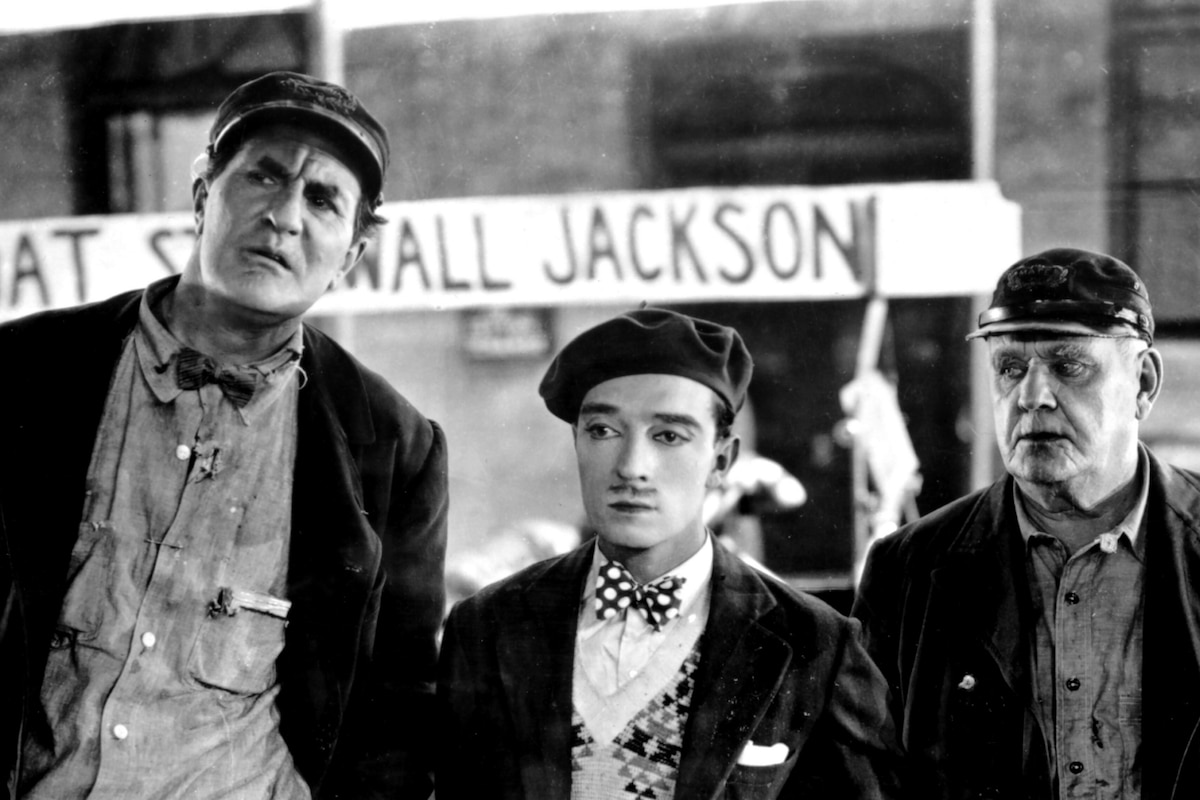
"I enjoy Keaton's pictures thoroughly, and while his latest production [Steamboat Bill, Jr.] does include such old favorites as a tornado which blows houses and trees on the frozen head of our hero and a wide-eyed heroine who peers into the camera with the angelic expression of a child anticipating a great big stocking full of goodies from Santa Claus, it has several bits of pantomime between Ernest Torrence and Buster Keaton which are sheer amusement. You may be bored at the long intervals during which the blank-faced hero slides across the Mississippi delta on one ear, but just wait for the scene in the haberdashery where Torrence, as the hard-boiled old river pilot, buys his collegiate son a hat. That scene alone is worth the price of admission." - Pare Lorenz, Judge, June 2, 1928.
"One of the least known of the Buster Keaton features, yet it possibly ranks right at the top. It is certainly the most bizarrely Freudian of his adventures, dealing with a tiny son's attempt to prove himself to his huge, burly, rejecting father...The film features a memorable comic cyclone, and a peerless (and much imitated) sequence in which Keaton tries on hats and changes personality with each, becoming a series of movie stars of the period." - Pauline Kael, 5001 Nights at the Movies.
"This is one of the best Keatons, almost as good as The General...All the forces of nature attack Keaton, who makes no attempt to control them and doesn't even seem to resent them, but uses them instead to perform a kind of free ballet." - Georges Sadoul, Dictionary of Films.
"Hilarious, of course, with both delicately observed jokes and energetically athletic stuntwork coursing through the movie. But what really delights is the detailed depiction of small town life, plus Keaton's comic awareness of his own persona..." - Geoff Andrew, TimeOut Film Guide.
"Rather flat comedy redeemed by a magnificent cyclone climax." - Halliwell's Film & Video Guide.
Compiled by John Miller & Jeff Stafford
The Critics Corner (6/25) - STEAMBOAT BILL, JR.
by John Miller & Jeff Stafford | February 17, 2005
SIGN UP FOR OUR NEWSLETTERS

CONNECT WITH TCM