The Big Idea Behind STEAMBOAT BILL, JR.
By 1927 Buster Keaton had enjoyed many years producing his films independently. The head of Buster Keaton Productions since its beginning was Joseph M. Schenck, who was a manager and father figure to Buster as well as a financier. Buster was free to create at a pace he preferred, using any collaborators of his choosing. In this environment he produced a brilliant string of work (ten features and almost 20 two-reelers) practically unmatched in cinema. By the mid-1920s, Schenck was becoming heavily involved in the management of United Artists. He became president of UA in 1926 and naturally moved the distribution of Buster's features to the beleaguered company. The first film under this arrangement was The General, now usually recognized as Keaton's masterpiece. In 1927, however, it was seen as an over-budget box-office failure. The first indications of impending challenges to Keaton's independence occurred during preparations for his next feature, College (1927). From the outset, it was designed to be quicker, smaller and cheaper - therefore more profitable. For the first time, Keaton was assigned a director (though he basically directed the film himself), and more alarmingly, a "production supervisor" - someone to watch over shooting and report any financial overages. Keaton was particularly offended when this person, Harry Brand, was given his own credit during the opening titles of College.
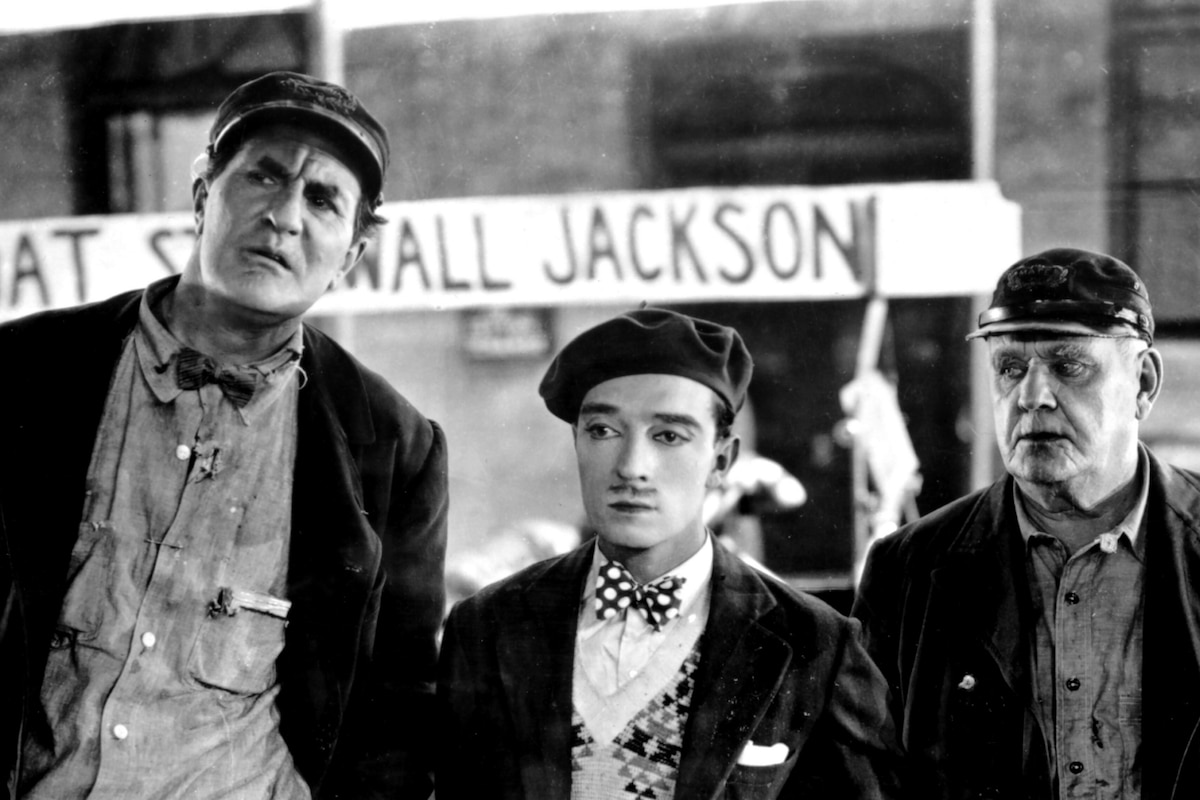
Brand was back in the supervisor position for Steamboat Bill, Jr. (1928). Keaton was also again assigned a director, although this time it was someone he liked and respected. Chuck Reisner was one of Keaton's friends from the old vaudeville days (he referred to his friend as "little Buster"). Reisner had graduated from performing onstage to being a writer, actor and director in films, most notably as an associate director for Charles Chaplin. It was Reisner's idea for Buster to play the son of a steamboat pilot, a notion that to Buster would've seemed full of possibilities. Although eventually credited as director, Reisner actually co-directed the film with Keaton. The production was also assigned a scenarist, Carl Harbaugh, but Keaton was later to say that he did virtually nothing, and that Keaton and his circle of gagmen devised the film's plot and gags in the usual manner.
Steamboat Bill, Jr. was tightly budgeted at $200,000, or less than half of the cost of The General. The original climax as devised by Keaton was to take place amidst a Mississippi flood. Unfortunately, there were actual floods on the Mississippi River in 1927 which caused great loss of life and property, and Brand convinced Schenck that it would be perceived as bad taste to proceed with a comedic flood. A cyclone provided a satisfactory substitute, but an expensive one: the final budget for the film would exceed $400,000.
by John Miller
The Big Idea (6/25) - STEAMBOAT BILL, JR.
by John Miller | February 17, 2005
SIGN UP FOR OUR NEWSLETTERS

CONNECT WITH TCM