SYNOPSIS
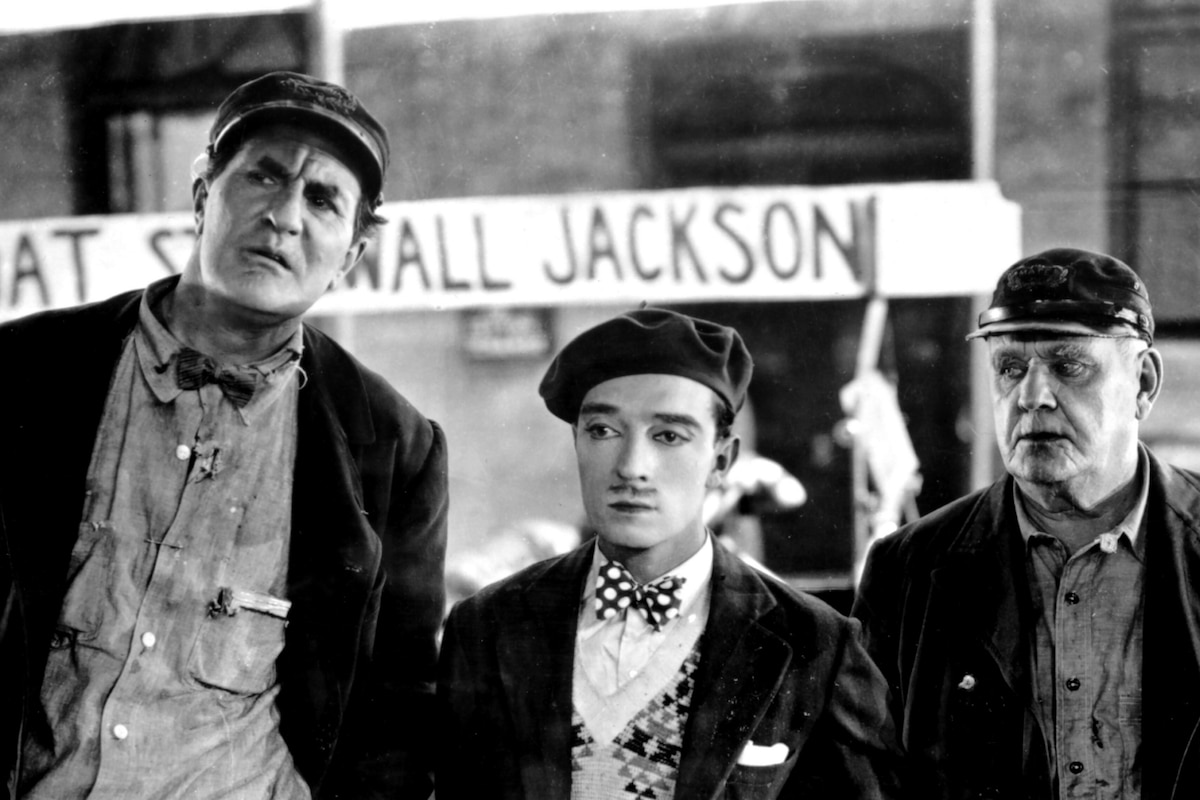
Steamboat Bill Canfield is a gruff, burly Mississippi riverboat pilot. Presenting quite a contrast, his son William Canfield, Jr. has lived with his mother since he was a toddler and has just graduated from an elite college back East. Arriving by train wearing a polka-dot tie, beret, and pencil-thin moustache, Willie (Buster Keaton) is immediately hauled away for a Mississippi makeover. Bill Sr. (Ernest Torrence) and his equally huge first mate (Tom Lewis) are being challenged in the steamboat business by the local magnate, J. J. King (Tom McGuire). As it happens, King's own daughter Kitty (Marion Byron) is also visiting from school, and is acquainted with Willie. She and Willie make several attempts to meet each other over the objections of their fathers. Willie, meanwhile, proves to be less than proficient in learning the ropes of piloting a steamboat. King has the power to have Bill's boat condemned, so Bill physically confronts King and is promptly thrown in jail. Willie now sees that he must try and spring his father from jail, save his steamboat from the junk heap, and reunite with Kitty. Amidst all this, there is a mighty storm brewing.
Director: Charles Reisner
Executive Producer: Joseph M. Schenck
Story: Carl Harbaugh
Cinematography: Bert Haines, Dev Jennings
Editing: Sherman Kell
Production Supervisor: Harry Brand
Assistant Director: Sandy Roth
Technical Director: Fred Gabourie
Cast: Buster Keaton (William "Willie" Canfield, Jr.), Ernest Torrence (William Canfield, Sr.), Marion Byron (Kitty King), Tom McGuire (John James King), Tom Lewis (Tom Carter), Joe Keaton (Barber)
B&W-71m.
Why STEAMBOAT BILL, JR. is Essential
Buster Keaton was one of the most important figures in all of early cinema, and Steamboat Bill, Jr. (1928) was his last independent silent feature and one of his funniest films. Though he does not take co-scripting or co-directing credit, Steamboat Bill, Jr. is one of his most personal and autobiographical movies. It is characteristic of Keaton's other great silent features The General (1927) and Our Hospitality (1923) in that it is rich in period detail and energized by some of Keaton's most inventive gags, including the most elaborate climax he devised for any of his films.
The idea came to him from his friend Chuck Reisner, the eventual credited director. Keaton must have taken greatly to it, since it would afford him another chance to recreate in great detail a time and place which teems with comic possibilities. He also layers into the proceedings bits and details of an autobiographical nature. Steamboat Bill himself bore many resemblances to Keaton's own father, Joe (who shows up in the film in a bit part as a barber). For the finale, Keaton staged many gags in an old theater, drawing on his vaudeville days for inspiration. Finally, the sight of Buster being whisked through the air by the cyclone must have been a sly wink in itself: Buster's father often related a tall tale involving baby Buster being carried off by a tornado while still in diapers and being safely deposited on a street blocks away.
Steamboat Bill, Jr. works as a virtual tour of Keaton themes and motifs. The basic story is one he had fashioned before - that of an ineffective boob who rises to the occasion when faced with seemingly insurmountable obstacles. The quintessential Keaton hero eventually proves his worth by saving the game or the girl or the day. He had proven himself athletically in his previous film, College (1927), had overcome forces of nature in Our Hospitality and Seven Chances (1925) and had ultimately proven the mastery of his surroundings in any number of films.
In Steamboat Bill, Jr., Keaton especially emphasizes the contrasts of his hero, which serve to not only heighten the comic possibilities, but also to lend the film a wonderful symmetry. Willie's first day consists of foppishness, failed romance, bumbling abilities, and general feebleness, and is contrasted the next day by his courage, derring-do, mastery of his abilities, and success in love. Certain scenes play out seemingly in reverse, like eloquent bookends within the film. Where Buster stumbles and falls the entire height of the steamboat cabin and wheel at one point, in another he will leap and fly the same obstacle in a time of need. A scene where he fumbles with the controls in the pilot's cabin and causes a wreck is later mirrored with a scene in which he not only masters the complex gears - he improvises his own remote controls!
The film also highlights Keaton's mastery of composition. He favored the long shot for clarity, to firmly set the elements of the scene in the viewer's mind. Typically, such elements were the little guy (Keaton) set against the larger forces of machine (steamboat, locomotive, hot air balloon, etc.) or nature (cyclone, raging river, rock slide, etc.) in a realistic and defined setting. Keaton economically establishes the workings of the besetting forces, then places himself and the camera for maximum impact. It is by conscious design, not accident, that images from Keaton's films are so iconic. Keaton is always a figure in motion and he is best enjoyed that way, yet his compositions are so pleasing that stills and frame blow-ups from his movies also have power and resonance. Steamboat Bill, Jr. contains some of his most memorable imagery, from a lone figure leaning into an overpowering wind, to massive structures that have fallen or splintered and missed our hero, to simple images of a son trying to emulate his father's stance and attitude. Such images are startling and delightful, and Steamboat Bill, Jr. is full of them.
Made for producer Joseph M. Schenck, Steamboat Bill, Jr. brought to a close one of the most fruitful collaborations in the annals of silent comedy. Keaton gave up his independence to make films for Metro Goldwyn Mayer, Hollywood's most prestigious studio, but his brand of spontaneously innovative slapstick did not translate to the regimented structure of the studio system. He made one more great film, The Cameraman (1928), but many consider the films that followed the beginning of a decline in Keaton's innovative comedy output. The coming of sound also had a negative impact on Keaton's career; his talent for stunts and visual gags was no longer valued by an industry infatuated with the new sound pictures and Keaton increasingly turned to alcohol for solace, creating further problems for himself.
by John Miller & Felicia Feaster
The Essentials (6/25) - STEAMBOAT BILL, JR.
by John Miller & Felicia Feaster | February 17, 2005
SIGN UP FOR OUR NEWSLETTERS

CONNECT WITH TCM