Pop Culture 101 - VERTIGO
Although the reincarnation theme in Vertigo (1958) turns out to
be a red herring, it was a hot topic at the time of the film's
production. In 1956, a bestseller called The Search for Bridey
Murphy was published, detailing the true-life "recollections" of a
woman under hypnosis of her previous life as a nineteenth-century
Irish woman. The success of the book prompted a rash of imitations,
as well as movies (I've Lived Before (1956), The Bride and
the Beast, 1958) and TV shows rushing to capitalize on the
then-current interest in reincarnation.
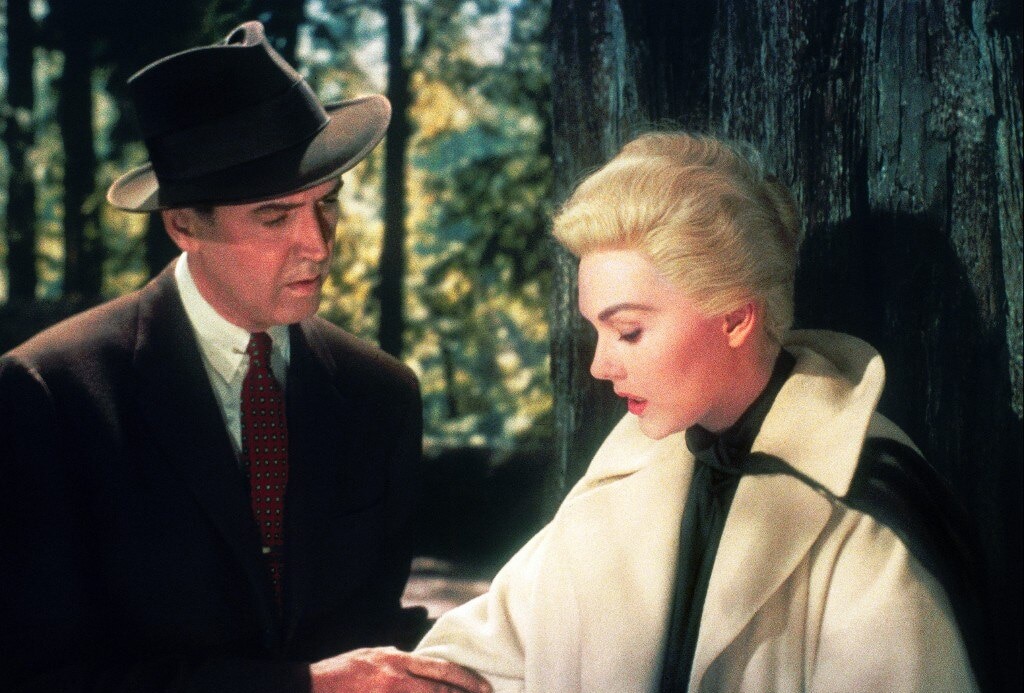
Before Vertigo was even released, James Stewart and Kim Novak
were teamed again for the film Bell Book and Candle (1958) for
Columbia Pictures. The pairing was not an accident - it was part of
the loan-out agreement which brought Novak from Columbia to shoot
Vertigo. Bell Book and Candle was a
comedy-fantasy-romance co-starring Jack Lemmon and Ernie
Kovacs.
A theme song entitled "Vertigo" was written by Jay Livingston and Ray
Evans, and was recorded by Billy Eckstine. Evans and Livingston had
written the song "Whatever Will Be, Will Be (Que Sera Sera)" for
Hitchcock's 1956 picture The Man Who Knew Too Much. It had
been a huge hit for Doris Day and also won an Oscar® for best
original song. Unfortunately for Eckstine and the songwriters, the
song "Vertigo" was never heard by moviegoers; Hitchcock felt it was
inappropriate for the film and omitted it.
In Vertigo, when Madeleine appears to die in a fall, Hitchcock
is simply playing with audience expectations by killing off their
leading lady halfway through the film. He will play upon these same
expectations in a much more dramatic fashion during the beginning of
Psycho (1960), when the Janet Leigh character Marion Crane
meets up with Anthony Perkins' Norman Bates.
Brian De Palma has made a career out of borrowing Hitchcock themes,
visuals and motifs for his films. (Some consider his work during his
early years to be less an homage and more like blatant thievery). In
the 1976 film Obsession, De Palma and his co-screenwriter Paul
Schrader present their take on Vertigo. In it, Cliff Robertson
plays a real estate developer who fixates on a woman (Genevieve
Bujold) who reminds him of his murdered wife. The setting is New
Orleans rather than San Francisco, but to compose the music score, De
Palma enlisted none other than Bernard Herrmann.
Hitchcock was never hesitant to try new camera techniques to heighten
the psychological effects he was striving for in his films. In
Vertigo, he needed to convey Scottie's fear of heights and his
disorientation. It was 2nd unit cameraman Irmin Roberts who created
the in-camera special effect that has since become known as a
"contra-zoom shot", a "trombone shot" or, most popularly, the "vertigo
shot." It is created when using a zoom lens to adjust the field of
view while the camera is physically moving toward or away from a
subject in the frame. This causes a distortion of the perspective -
the background of a scene appears to change size while the main
subject remains the same. Since this optical effect has no
correlation to normal human perception, the result is mentally
disorienting.
After Vertigo, the most notable use of the "contra-zoom shot"
effect was in Spielberg's Jaws (1975), as Roy Scheider reacts
to a shark attack. Increased use of the effect in films like
Scorsese's Goodfellas (1990) and many lesser films in the 90s
have tended to render the "Vertigo shot" a cliché. The original
"Vertigo shot" was also parodied during a second season episode of the
animated TV series The Simpsons, "Principal Charming",
broadcast in 1991. Who knew Springfield Elementary had a bell
tower?
The source novel for Vertigo, D'Entre les Morts, was
filmed again in Canada in 1995 as La Presence des ombres.
Directed by Marc F. Voizard, the film featured a French-Canadian
cast.
by John M. Miller
Pop Culture (6/18 & 12/3) - VERTIGO
by John M. Miller | February 17, 2005
SIGN UP FOR OUR NEWSLETTERS

CONNECT WITH TCM