Behind the Camera on VERTIGO
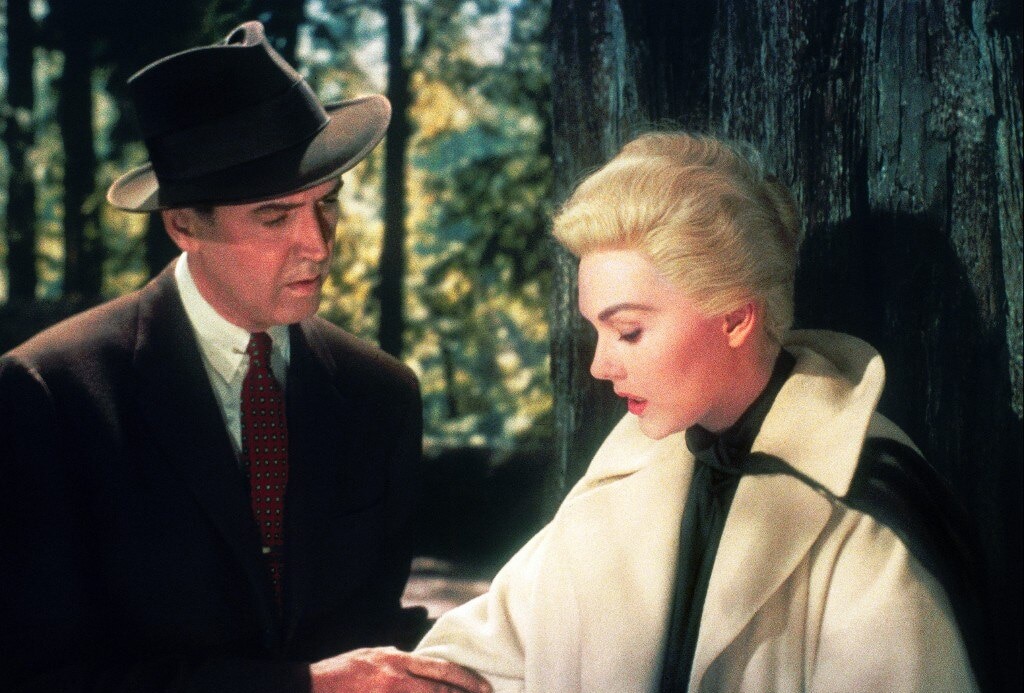
While James Stewart had been an early and solid choice for the male lead in Vertigo (1958), (it helped that he and Alfred Hitchcock had the same agent, Lew Wasserman), the casting of the female lead went through a major change. Hitchcock had been grooming the actress Vera Miles for stardom for several years. She had appeared on his television series and in the unglamorous role of Henry Fonda's wife in The Wrong Man in 1956. Vertigo was to have followed it as Miles' star-making vehicle, but there were many production delays caused by script development and by Hitchcock's hospital visits. During this same time, Miles became pregnant and had to drop out. Some have also suggested that Hitchcock was disappointed in her work for The Wrong Man while other reports suggest that Miles was simply unwilling to become the director's new blonde creation.
Harry Cohen, head of Columbia Pictures, had been grooming Kim Novak for stardom. She was proving her box-office worth, and was a natural to step into the role when Vera Miles was unable to do Vertigo. In fact, she did not even screen test for it. She felt the part immediately, saying later, "when I read the lines, 'I want you to love me for me' I just identified with it so much...it was what I felt when I came to Hollywood as a young girl. You know, they want to make you over completely."
Novak already had a reputation for being difficult, so perhaps it was not a surprise when she refused to show up for work on the Vertigo set in August, 1957. She was striking for more money from her home studio Columbia, who was paying her $1,250 a week even though they were receiving $250,000 for her loan-out for Vertigo and one more picture. The ploy worked and Novak got a raise.
Background plates and second unit work had been done in San Francisco much earlier in the year during the production delays. Shooting with the main cast began on September 13th. Famous sites in the city were beautifully captured on film: Mission Dolores, Lombard Street, Fort Point near the Golden Gate Bridge, the Empire Hotel on Sutter, The Palace of the Legion of Honor - all of which are popular stops on any self-guided "Vertigo tour" of the city today. As with most Hitchcock movies, the filming went relatively smoothly. The director avoided surprises, preferring to have every detail planned out in advance. Extensive storyboarding of most sequences assured that his trusted production staff would know what was expected of them.
After additional location shoots at the Big Basin Redwoods State Park and the Spanish mission San Juan Bautista, the cast and crew settled in at Paramount Studios soundstages for two months of filming. In the studio, Hitchcock was in his element and could exert absolute control though he had his share of creative challenges. One very striking sequence is the kissing scene that occurs when Scottie has finally made Judy over as Madeleine. As the couple kiss, the background slowly swirls, and we lose equilibrium as we see Judy's apartment become the livery stables of San Juan Bautista, setting for an earlier emotional scene between Scottie and Madeleine. The shot was achieved with rear projection of the background plates; the camera tracking slowly back, then forward; and with Stewart and Novak revolving on a circular platform. These simultaneous movements were very difficult to coordinate, and to pull off without the actors getting dizzy - in one take Stewart fell and was slightly injured. Principal photography was completed three days after this shot, just before Christmas, 1957.
The postproduction period in early 1958 was consumed with retakes, editing, and the creation of special effects shots involving models and matte paintings, particularly of the all-important bell tower.
For Vertigo, Bernard Herrmann wrote a brilliantly evocative and emotional score - one of the greatest scores for any motion picture. Ironically, though, he was not able to conduct it himself. A musician's strike halted recording in the U.S. so an overseas recording was necessary. The London Symphony began to record in March, 1958 with Muir Mathieson conducting. Halfway through the recording, the British musicians also went on strike, forcing completion of the score in Vienna. Vertigo premiered in San Francisco on May 9th, 1958.
by John M. Miller
Behind the Camera (6/18 & 12/3) - VERTIGO
by John M. Miller | February 17, 2005
SIGN UP FOR OUR NEWSLETTERS

CONNECT WITH TCM