SYNOPSIS
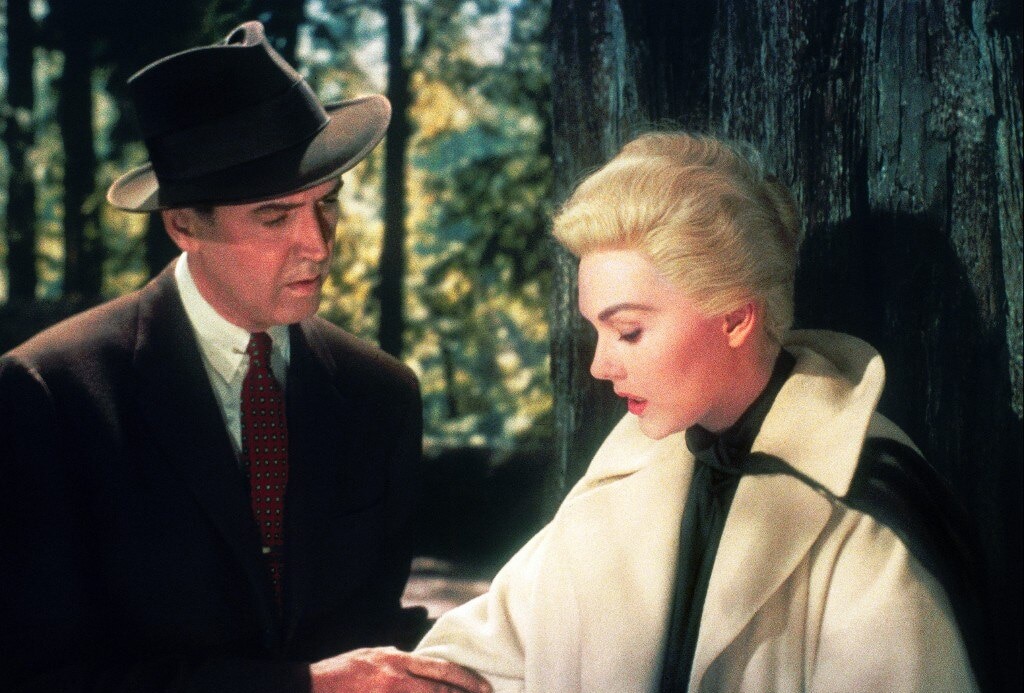
A San Francisco police detective, John "Scottie" Ferguson, leaves the force after seeing a fellow policeman fall to his death during a rooftop chase. Ferguson suffers from vertigo, an extreme anxiety associated with heights. He confides in his ex-fiancee Midge, and is hired for a detective job by Gavin Elster, a former schoolmate. Elster wants Scottie to follow his wife Madeleine, who he fears is suicidal. As Scottie tails Madeleine, and saves her from a suicide attempt in the bay, he falls in love with her. But Scottie is unable to stop her next attempt as she climbs the bell tower of an old Spanish mission and jumps off the top. Devastated, Scottie withdraws from life temporarily but is jolted back to reality by his encounter with Judy, a shopgirl who bears an uncanny resemblance to the dead Madeleine. In his relentless pursuit of her, his fascination turns to obsession.
Producer/Director: Alfred Hitchcock
Associate Producer: Herbert Coleman
Screenplay: Samuel Taylor, Alec Coppel
Based on the novel D'Entre les Morts by Pierre Boileau and Thomas Narcejac
Cinematography: Robert Burks
Editor: George Tomasini
Music: Bernard Herrmann
Costumes: Edith Head
Special Effects: Farciot Edouart, John P. Fulton, W. Wallace Kelley
Sound: Harold Lewis, Winston Leverett
Title Design: Saul Bass
Dream Sequence Design: John Ferren
Cast: James Stewart (John "Scottie" Ferguson), Kim Novak (Madeleine Elster/ Judy Barton), Barbara Bel Geddes (Midge Wood), Tom Helmore (Gavin Elster), Ellen Corby (Hotel manageress), Henry Jones (Coroner), Raymond Bailey (Doctor), Konstantin Shayne (Pop Leibel), Lee Patrick (Madeleine look-alike), Margaret Brayton (Ransohoff salesperson), Joanne Genthon (Dream Carlotta), Sara Taft (Nun).
C-127m. Letterboxed. Closed captioning.
Why VERTIGO is Essential
When it first appeared in May of 1958, Vertigo was considered a disappointment by most critics and moviegoers who thought the movie was too slow. Even Hitchcock's peers in the film industry were dismissive of Vertigo, granting it only two Oscar® nominations (for Best Art Direction-Set Decoration & Best Sound) and no wins. Hitchcock himself measured his own films' worth by the attention they garnered, so he could only move on to the next project and hope for better results. In what was proven to be a gradual but complete turnaround, Vertigo is now the most studied and discussed film of Alfred Hitchcock's career - it has been seen and enjoyed on the big screen by new generations in two major reissues, and has been voted the 2nd greatest film ever made (after Citizen Kane, 1941) in the most recent Sight and Sound survey of international film critics.
Hitchcock took a French novel, D'Entre les Morts (From Among the Dead), and first changed the setting from Paris to San Francisco, a perverse choice that placed a character with an intense fear of heights in the most vertical city in the United States. He then infused the story of an obsessive personality with obsessions of his own. For followers of the Auteur Theory, there is no greater attraction than the allure of such a personal document - Hitchcock had made a career of remaking blondes into his own vision of the perfect woman, so here is a film that is a meditation on that very subject!
For the cast, Hitchcock wanted James Stewart as the detective from the beginning of the project. Vertigo would be the fourth Stewart film directed by Hitchcock; it would also be the last. Hitchcock would later complain that Stewart, at 49, may have been too old for the role but most critics would rank it as possibly Stewart's finest performance. Kim Novak, as the object of the detective's obsession, was a late addition. Vera Miles, later to play Janet Leigh's sister in Psycho (1960), was to have played the role but bowed out after she became pregnant. Novak, however, surprised everyone with her performance in a difficult dual role, projecting mystery, fear and a touching vulnerability.
Certainly Vertigo works simultaneously on multiple levels. While audiences in 1958 were more concerned with the murder mystery aspects of the plot, it was the least interesting aspect for the director. Hitchcock films often feature what he called the "MacGuffin" - the plot device that sets the narrative in motion and motivates the characters (uranium samples, government papers, etc.) but is irrelevant to the audience. Some modern critics have said that the MacGuffin in Vertigo is the plot itself. Scottie Ferguson's obsession is Hitchcock's interest, so two-thirds of the way through the movie the twist ending is revealed. Hitchcock later explained to director Francois Truffaut that the change was made to highlight suspense over surprise. What will the detective do when he finally discovers the truth we already know?
The revelation by Judy that she is Madeleine has been criticized by some as being a premature revelation - it is twenty minutes before Scottie realizes the same. While they see this as a flaw in the picture's structure, others see it as a brilliant ploy by Hitchcock to shift audience sympathies and identification from Scottie to Judy; to de-emphasize the "whodunit" nature of the story and push forward the much more complex and challenging set of themes and concerns; and to implicate the viewer as a voyeur, a common occurrence in any Hitchcock film.
Just as Hitchcock's standing reached its peak in the early 1970's, Vertigo was pulled from release. The combination of the reputation of this now highly regarded film and a lack of access whipped up enthusiasm among movie lovers for the masterpiece they were denied. This could have led to a major letdown when Vertigo was finally re-released in 1984 but, for once, expectations of greatness were confirmed on the screen. In 1996 the film was extensively restored, given a new Dolby Surround soundtrack, and re-released to even greater acclaim.
by John M. Miller & Brian Cady
The Essentials (6/18 & 12/3) - VERTIGO
by John M. Miller & Brian Cady | February 17, 2005
SIGN UP FOR OUR NEWSLETTERS

CONNECT WITH TCM